Get the best advanced engineering courses on Abaqus
ABAQUS FEA Training (Free cantilever beam tutorial)
Abaqus for beginners (Mechanical Engineering)-Free Version
Python scripting in ABAQUS-(FREE Version)
UMAT Subroutine (VUMAT Subroutine) in ABAQUS-Free Version- UMAT Abaqus example
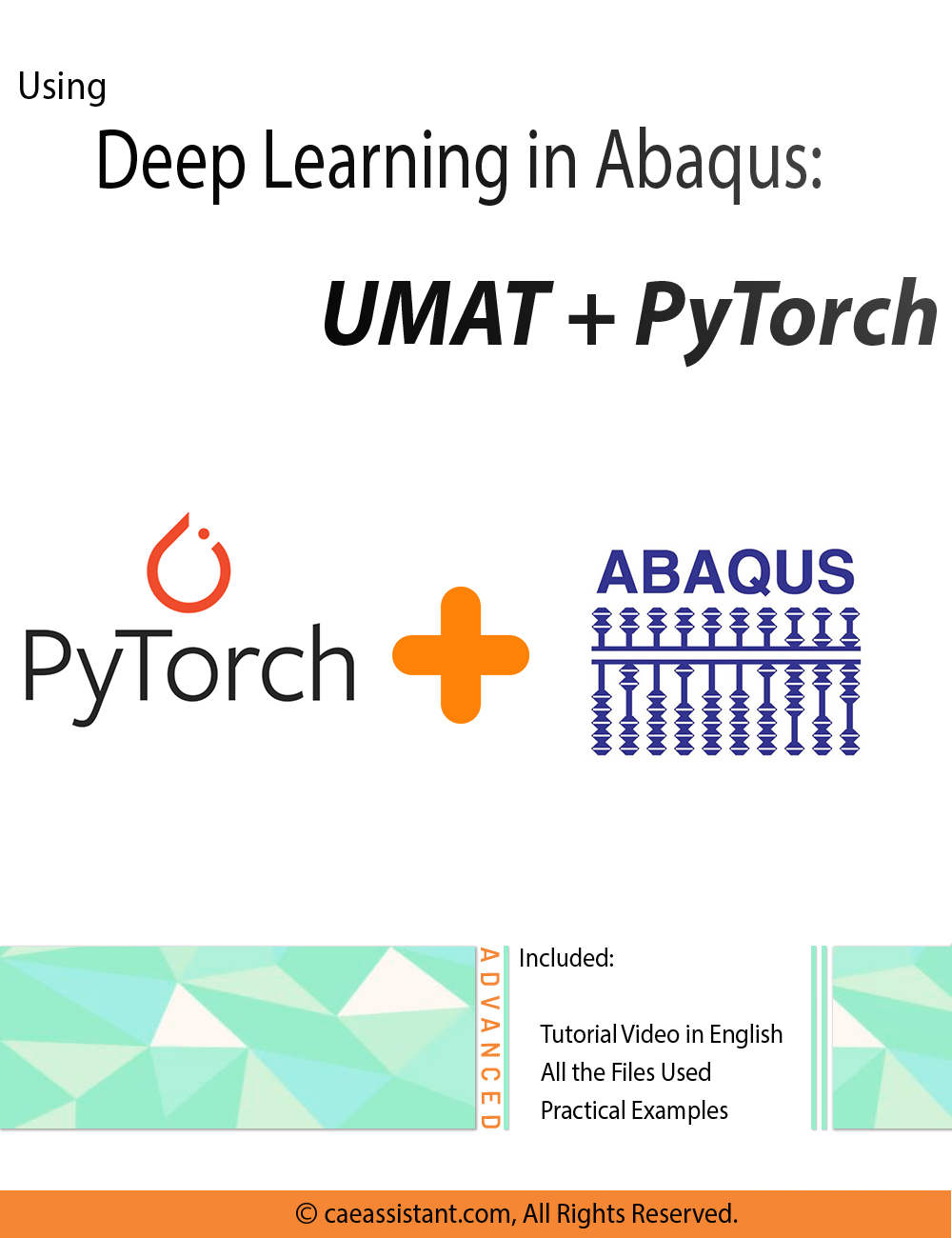
"UMAT Subroutine (VUMAT Subroutine) introduction" is used when the material model is not available in ABAQUS software. If you follow this tutorial package, including standard and explicit solver, you will have the ability to write, debug and verify your subroutine based on customized material to use this in complex structures. These lectures are the introduction to writing advanced UMAT and VUMAT subroutines in hyperelastic Martials, Composites, and Metal, and so on. Watch Demo
"Advanced UMAT Subroutine (VUMAT Subroutine)" training package helps Abaqus users to prepare complex UMAT and VUMAT subroutines. This training package is suitable for those who are familiar with subroutine or want to learn UMAT/VUMAT subroutine Professionally. Equations for computational plasticity based on kinematic stiffness are also discussed. In addition, metal damage has been implemented based on Johnson Cook's model. Watch DemoAdvanced Finite Element Analysis of Off-Axis Tunnel Cracking Laminates
An Efficient Stiffness Degradation Composites Model with Arbitrary Cracks | An Abaqus Simulation
FREE ABAQUS TUTORIAL PDF
Golden Package
Composite simulation for experts-Part-1
ABAQUS course for beginners | FEM simulation tutorial
Bio-Mechanical Abaqus simulation Full package
This video tutorial package offers a comprehensive guide to biomechanical simulations using Abaqus, covering a range of applications from dental to orthopedic and cardiovascular analyses. The workshops delve into finite element method (FEM) simulations, exploring static loading on human teeth, crack growth in bones under bending, bone drilling, and the behavior of titanium foam implants. Each tutorial emphasizes the importance of precise modeling and meshing techniques, utilizing dynamic explicit procedures, Johnson-Cook material models, and various contact and boundary conditions to simulate realistic biomechanical behaviors. Additionally, the package includes fluid-structure interaction (FSI) simulations for blood flow within coronary vessels, addressing both Newtonian and non-Newtonian models, and demonstrates the integration of computational fluid dynamics (CFD) with structural analysis for enhanced accuracy. The lessons complement the workshops by introducing fundamental FEM concepts, solver selection, explicit analysis considerations, and damage modeling, ensuring users gain a solid understanding of both theoretical and practical aspects of biomechanical simulations in Abaqus.
We also offer a similar budget-friendly package that includes all the workshops from this package. However, since it does not include the lessons, it is available at a lower price. You can purchase it on our website at a more competitive rate than similar platforms.Python Scripting in Abaqus Full Tutorial
Abaqus Soil Modeling Full Tutorial
ABAQUS course for beginners | FEM simulation tutorial
Curing process simulation in Abaqus
Composite Fatigue Simulation with UMAT Subroutine in ABAQUS (unidirectional)
💿Abaqus for Beginners (Abaqus for Civil Engineering)
Golden Package
Latest Blogs
Our Vendors
Our Consultants
Here in CAE assistant, Our team of experts works on advanced engineering courses for example Abaqus course, focusing mostly on solid mechanics engineering. We provide simulation tutorials for, “shape-memory alloys”, “3D printing manufacturing process” & other topics. We aim to produce contents that cover advanced levels of each topic rather than focusing on general and elementary courses that can be easily found on the internet & YouTube. Packages also include sample codes to apply advanced theories in the analysis software.
The finite element method (FEM) approach can be used to solve problems in a variety of engineering and mathematical physics fields, such as structural analysis, heat transfer, fluid flow, mass transport, and electromagnetic potential. It is quite impossible to find analytical mathematical solutions to model the behavior of physical systems with complex geometries, loadings, and material properties and these differential equations typically cannot be solved because of the complex circumstances of the problem. FEM is a comprehensive tool to solve many problems and boost innovations in engineering. The main advanced engineering course that we currently cover is FEM in various software like Abaqus, Comsol and Ansys.
What is Abaqus CAE?
Abaqus CAE is used for pre-processing (modeling and analysis of mechanical parts and assemblies) as well as viewing the results of finite element analysis. The automobile, aerospace, and industrial products industries use Abaqus because of the software’s extensive material modeling capabilities and adaptability (for example, users can design their own material models so that novel materials could likewise be simulated in Abaqus), the product is popular among non-academic and research institutes in engineering as well. Abaqus CAE is the perfect software for production-level simulations when various fields need to be coupled, because it offers a good selection of multi-physics features, including coupled acoustic-structural, piezoelectric, and structural-pore capabilities.
You can find the best training courses for ABAQUS software on CAEassistant.com; as well as courses from the primary and step-by-step training of each Abaqus module to the implementation of the most complex theories in this software fore example Abaqus fracture.
What is our innovation in CAEassistant.com?
The CAE assistant community is rapidly increasing its coding speed by using basic codes of the main and essential theories of solid mechanics and their video tutorials, leading to accelerated industrial and scientific development.
Want to join us?
Are you a solid mechanics expert? Do you have the ability to provide advanced engineering courses, especially Abaqus training courses?
We can help you publish your scientific research so that researchers and innovators can benefit from the methods and results. You can create a video course as an educational package with us on the CEAassistant.com website. Join us and share your knowledge with the world.
CAE assistant aims to provide advanced engineering courses, focusing on specific topics rather than general and elementary topics, which is why our services stand unique in the industry, differing our products from websites such as Udemy and Coursera.
Whether you’re a seasoned Abaqus user or just starting out, our comprehensive blog articles and informative posts are packed with valuable insights and practical tips to elevate your Abaqus simulation skills. Delve into our wealth of knowledge and discover how to optimize your Abaqus workflow, enhance your computational efficiency, and gain deeper understanding of complex engineering scenarios. Whether you’re looking for tips on pre-processing, contact modeling, dynamic analysis, or post-processing techniques, our blog is your one-stop resource for mastering Abaqus simulation and achieving superior results.
Explore our comprehensive Abaqus tutorial page, featuring free PDF guides and detailed videos for all skill levels. Discover both free and premium packages, along with essential information to master Abaqus efficiently. Start your journey with our Abaqus tutorial now!
Discover everything you need to know about the Abaqus Student Edition in our detailed blog post. From download instructions and installation steps to understanding its limitations and new features, our comprehensive guide ensures a smooth start with Abaqus for students.
Explore the transformative role of AI in mechanical engineering with our comprehensive article. From understanding AI fundamentals to its applications in CAD, CFD, and FEA, and emerging technologies like digital twins and quantum computing, we cover it all. Equip yourself with the knowledge to harness AI for innovative solutions and future advancements in the field.
Explore advanced composite damage and fatigue analysis techniques with our insightful articles. Learn about unidirectional composite materials damage, their damage mechanisms, and failure criteria, as well as how to simulate these damages in Abaqus. Dive into the fatigue analysis of composite fatigue analysis, understanding fatigue damage, behavior, and simulation using the UMAT subroutine. Enhance your knowledge and simulation accuracy with these comprehensive guides.
Speaking of damage and damage in composites, the Hashin Failure Criteria is a crucial tool in evaluating the structural integrity of composite materials, allowing engineers to predict different failure modes such as fiber breakage and matrix cracking.
Learn more the complexities of composite material failure with our deep dive into the Tsai Hill failure criterion. This essential tool empowers engineers to predict the onset of failure in composite structures, ensuring safety and reliability in critical applications.
Learn about the composite curing process. This blog post will explain how composite materials are cured to achieve their desired properties. We will discuss different curing methods and the importance of optimizing the curing cycle. Additionally, we will explore how simulation tools like Abaqus can be used to predict and improve the curing process.
Abaqus Element deletion is a powerful technique for simulating material failure by removing elements from a model when they meet specific damage criteria. This method enhances the accuracy of simulations involving fracture, impact, or fatigue, making it essential for engineers aiming to realistically model material degradation and failure.
Fatigue analysis is essential for understanding how materials respond to repeated or cyclic loading, as even stresses below their breaking point can lead to crack formation and eventual failure. This type of analysis helps engineers predict when a component might fail, taking into account the stages of fatigue crack growth and factors like loading conditions and material properties.
Discover how XFEM Abaqus simplifies crack and fracture simulations! Our latest blog covers key concepts like enrichment functions and cohesive crack modeling, plus step-by-step guides for 2D and 3D simulations. Solve complex engineering challenges with precision.
Discover how DLOAD and VDLOAD subroutines in Abaqus let you define complex, custom loads for precise simulations. From wind pressures to wave loads, our guide covers it all!
Discover the power of Additive manufacturing simulation—essential for tackling challenges like warping, optimizing designs, and achieving precision in 3D printing. Our blog covers key parameters and highlights three top software tools to help you master simulation and improve your prints.
Looking to improve the efficiency of your designs? Our article on structural optimization in Abaqus dives into the essentials of topology and shape optimization techniques.
Ready to take your metal 3D printing simulations to the next level? Our article covers the Inherent Strain Method in Abaqus, showing you how to effectively simulate residual stresses and distortions in additive manufacturing.
Looking to customize your heat fluxes and thermal distributions in Abaqus? Our guide on the DFLUX and VDFLUX subroutines walks you through the process of applying custom thermal loads to your simulations.
Want to finally understand shear force and how it affects structural elements? This blog breaks it all down in a simple way, with clear explanations about bending moment and their diagrams as well.
Struggling to understand moment of inertia and moment of area? This simple, beginner-friendly guide breaks down everything you need to know — with clear examples and visuals. Whether you’re a student or a working engineer, this is the only blog you need to finally get these essential concepts.
If you’re looking to understand how structures vibrate and how to prevent resonance issues, our latest blog post on modal analysis in Abaqus is a must-read. It breaks down the essentials of modal analysis in a clear and approachable way, helping you grasp how to identify natural frequencies and mode shapes.
Discover the ins and outs of the stress strain curve in our beginner’s guide from CAE Assistant! This friendly breakdown explains how materials behave under load—covering elastic, plastic, and failure stages—with clear visuals and simple examples. It’s a great resource if you’re diving into material science, mechanical design, or just want to strengthen your engineering toolkit.
Want to take your Abaqus simulations to the next level? Check out this step‑by‑step guide on using the UEXTERNALDB subroutine to seamlessly connect your model with external data files or databases. With clear explanations, handy tips, and real code examples, it’s perfect for engineers looking to automate workflows and boost simulation power.
Want better soil behavior in your Abaqus simulations? Our CAE Assistant article breaks down core Abaqus soil models and practical setup tricks for reliable, real-world results. Friendly, clear, and packed with expert insights, it’s the perfect resource to bolster your geotechnical toolbox.
Curious how pressing or deforming a material can generate electricity? Our CAE Assistant article on piezoelectric effect simulation demystifies the science and shows you exactly how to model it in Abaqus. With simple explanations, step-by-step workflows, and real case studies, it’s the smart resource you need to bring energy-harvesting and sensor simulations to life.
Curious about how structures stand strong? Our latest blog on truss analysis breaks down the basics in a simple, easy-to-follow way. Whether you’re a student or an engineer, you’ll get practical insights and tips on simulating trusses effectively.
Struggling with complex simulations involving large deformations or fluid-structure interactions? Our blog on Coupled Eulerian Lagrangian in Abaqus explains this powerful method in simple terms—perfect for engineers and students aiming to boost their simulation skills.
Discover how structural optimization can transform your designs! This beginner-friendly guide breaks down the essentials—from defining load conditions and material limits to using advanced software tools—to help you achieve the strongest, most efficient structure possible.
Explore how laser assisted machining (LAM) can help you tackle tough materials more efficiently! This clear, step-by-step guide shows how to set up machining and heating models in Abaqus, configure boundary conditions, and use subroutines like DFLUX and VDFLUX to simulate the moving laser heat source.
Discover how to analyze glass fracture and post‑fracture behavior using Abaqus! This practical tutorial breaks down key concepts—like brittle failure patterns, post‑fracture stiffness, vibration response, thermal influence, and residual strength—making it easy for engineers and simulation enthusiasts to understand and apply.
Curious how to represent concentrated mass in Abaqus simulations? This quick, clear blog shows you how to add mass‑point elements, assign point mass, and interpret the results—perfect for boosting modal or dynamic analysis accuracy.
Discover the essentials of impact dynamics in our latest CAE Assistant tutorial: learn how engineers use Abaqus explicit-dynamics simulations to model both low‑velocity tests—like drop or composite panel impacts—and high‑velocity collisions, such as bullet penetration or fluid-structure coupling.
Want to get a solid grasp on material behavior in FEA? Our CAE Assistant blog post on isotropic vs anisotropic materials (published July 19, 2025) explains why isotropic materials—like many steels, glasses, and plastics—behave the same in all directions, and how that simplifies simulations.
Want to learn how materials slowly deform under long‑term loads? This CAE Assistant article dives into the fundamentals of creep behavior and shows you how to set up ABAQUS creep models to simulate it accurately.
Wondering how to simulate bolted joints with precision? This CAE Assistant article explains bolt load connection modeling in Abaqus, walking you through everything from preload to tightening and how it affects stress distribution.
Curious how FDM‑style 3D printing influences your part’s performance? This CAE Assistant post breaks down how to simulate Fused Deposition Modeling (FDM) using Abaqus and the AM Modeler plug‑in. You’ll learn how to model heat transfer during extrusion, progressive layer deposition, and the resulting stresses—perfect for engineers and designers who want to predict residual stress, warping, and material behavior before printing.
Discover how Functionally Graded Materials (FGMs) can revolutionize engineering design! This article introduces FGMs—materials that smoothly blend properties across their structure—and walks you through their benefits in applications from aerospace to biomedical.
Discover how stent simulation with Abaqus lets engineers test and perfect cardiovascular stent designs long before physical prototypes are made. This insightful post walks you through why finite element analysis is a game-changer for evaluating strength, flexibility, and durability in realistic conditions—plus it includes step-by-step video workshops, all backed by CAE Assistant’s supportive learning approach.
Curious how dynamic water movements inside tanks can be accurately predicted? Our latest feature explores a real-world sloshing simulation of a ground-supported cylindrical tank using Abaqus—perfect for understanding earthquake-induced liquid behavior in concrete storage systems.
Discover how Physics Informed Neural Networks (PINNs) bridge the gap between deep learning and the laws of physics, delivering smarter, more reliable models with fewer data. This article offers a clear and engaging look at why PINNs are becoming(being) a go-to tool for engineers and scientists—perfect for anyone curious about cutting-edge AI made practical.
Curious about how to model hyperelastic material in Abaqus? Our article breaks down the essentials in a clear and practical way, so you can easily understand the behavior of rubbers, foams, and other nonlinear materials. It’s a must-read if you want to boost your FEM skills and get reliable results in your projects.
Curious about how Abaqus handles materials that slowly change shape under stress? In this guide, we dive into viscoplasticity—where plasticity meets viscosity—and show how Abaqus uses tools like creep, rate-dependent plasticity, and the Perzyna model to capture these effects. A practical read for anyone working with advanced simulations and eager to get more accurate, reliable results.
Discover how digital twin technology is transforming engineering and simulation. This powerful approach lets you create virtual replicas of real-world systems to test, optimize, and innovate faster. If you’re ready to take your designs to the next level, this article is the perfect starting point.
Discover how Abaqus connector elements simplify modelling of joints, hinges, springs, and other mechanical connections without complex contact interfaces. This article breaks down what connector elements are, when to use them, how to set them up correctly, and gives practical tips to avoid common modeling mistakes—all in a clear, friendly way. Ideal if you want to improve simulation efficiency without sacrificing accuracy.
Whenever materials expand or contract with temperature, thermal stress comes into play. In our latest blog, we show how thermal stress analysis works and why Abaqus is a powerful tool to handle even the toughest thermal–mechanical problems. Dive in to see how smarter analysis leads to safer designs.
From everyday appliances to aerospace engines, heat transfer plays a role everywhere. In our latest post, we explain heat transfer analysis step by step and highlight how engineers use Abaqus to model and predict thermal performance. Check it out and see how better analysis means smarter design.
Dive into the world of steel structure analysis with our blog, where we break down the importance of analyzing steel beams and joints, understanding structural models, and designing efficient steel structures. Learn the best techniques, compare Abaqus FEM with traditional methods, and explore practical tips for mastering structural steel design.
| ✅ Subscribed students | +80,000 |
| ✅ Upcoming courses | +300 |
| ✅ Tutorial hours | +300 |
| ✅ Tutorial packages | +100 |