
In the world of engineering, accurately predicting how materials will behave under stress is essential. One key concept in this domain is the Von Mises stress, a valuable tool used to forecast when a material might start to yield or fail under various loading conditions. This type of stress analysis is particularly significant when working with ductile materials, which need to withstand complex stress states without undergoing permanent deformation.
The Von Mises stress helps engineers simplify the complex stress states that occur in materials. It combines the effects of different stress components into a single value, making it easier to compare against a material’s yield strength. By using this criterion, engineers can better understand how and when a material might reach its breaking point, ensuring that designs are both safe and effective.
In this blog, we will explain Von Mises stress, a scalar value used to predict when materials yield under complex loading. We also compare this criterion with others like Tresca and Rankine, noting its accuracy for ductile materials. Moreover, we discuss principal stresses and strains, their calculation, and visualization using Mohr’s Circle. Finally, we highlight the role of Von Mises stress in finite element analysis (FEA) with Abaqus, crucial for ensuring structural safety and reliability.
.
 Listen to our podcast on Von Mises Stress and get practical, real-world insights on:
.
inp File” img_size=”45×45″ woodmart_css_id=”68739937248c5″ info_box_inline=”no” wd_hide_on_desktop=”no” wd_hide_on_tablet_landscape=”no” wd_hide_on_tablet=”no” wd_hide_on_mobile=”no” responsive_spacing=”eyJwYXJhbV90eXBlIjoid29vZG1hcnRfcmVzcG9uc2l2ZV9zcGFjaW5nIiwic2VsZWN0b3JfaWQiOiI2ODczOTkzNzI0OGM1Iiwic2hvcnRjb2RlIjoid29vZG1hcnRfaW5mb19ib3giLCJkYXRhIjp7InRhYmxldCI6e30sIm1vYmlsZSI6e319fQ==” wd_z_index=”no”][/woodmart_info_box]
Tutorial Video” img_size=”45×45″ woodmart_css_id=”6873995e9fed2″ info_box_inline=”no” wd_hide_on_desktop=”no” wd_hide_on_tablet_landscape=”no” wd_hide_on_tablet=”no” wd_hide_on_mobile=”no” responsive_spacing=”eyJwYXJhbV90eXBlIjoid29vZG1hcnRfcmVzcG9uc2l2ZV9zcGFjaW5nIiwic2VsZWN0b3JfaWQiOiI2ODczOTk1ZTlmZWQyIiwic2hvcnRjb2RlIjoid29vZG1hcnRfaW5mb19ib3giLCJkYXRhIjp7InRhYmxldCI6e30sIm1vYmlsZSI6e319fQ==” wd_z_index=”no”][/woodmart_info_box]
1. What is Von Mises stress?
Von Mises stress, also known as the equivalent stress, is a scalar stress value derived from the stress state at a point and is used in engineering to predict the yielding of materials under any loading condition.
The Von Mises stress ( ) is calculated from the principal stresses (
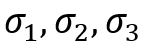 ) using the following formula:
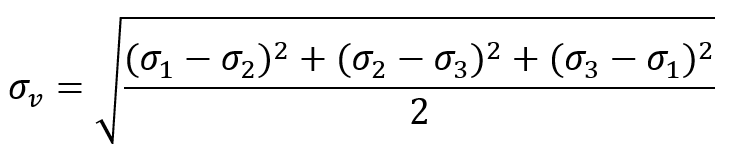
Alternatively, in terms of the stress components in the x, y, and z directions (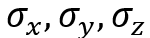 ) and the shear stresses (
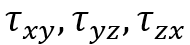 ), the Von Mises stress is given by:

For a 2D stress state, it simplifies to:

Example: Consider a point in a material subjected to the following stress state:
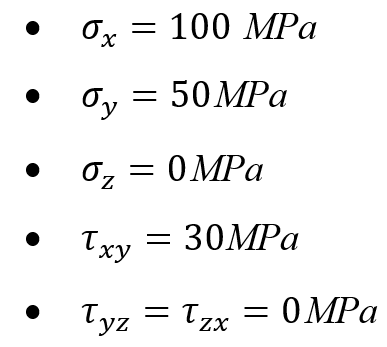
Using the formula:

|
Explore our comprehensive Abaqus tutorial page, featuring free PDF guides and detailed videos for all skill levels. Discover both free and premium packages, along with essential information to master Abaqus efficiently. Start your journey with our Abaqus tutorial now! |
 |
In this Abaqus training package for beginners, which is designed for FEM Simulation students in mechanical engineering, various examples in the most widely used fields are presented:
|
2. What is Von Mises criterion?
The Von Mises criterion, also known as the Von Mises yield criterion or the maximum distortion energy criterion, is a formula used to predict the yielding of ductile materials under complex loading conditions. Although the von Mises stress is a scalar value, the von Mises criterion uses this stress to determine the failure of a material. It states that yielding begins when the second deviatoric stress invariant reaches a critical value, which corresponds to the yield stress of the material in uniaxial tension. It is particularly useful in the fields of material science and mechanical engineering.
2.1. Formula
The Von Mises criterion is expressed mathematically as:
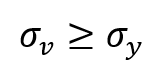
Where  is the yield strength of the material.
Example: consider a point in a material subjected to the following stress state and the yield stress is 250 MPa:
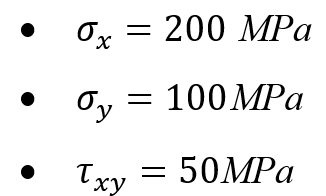
Using the formula:

Since 223.6 MPa < 250 MPa, the material will not yield under these conditions.
2.2. Graphical presentation
The Von Mises yield criterion can be represented in the principal stress space (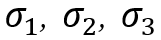 ) as an ellipse or ellipsoid. In the 2D principal stress plane
 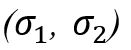 , it appears as an ellipse. This plot shows the combination of principal stresses that will cause yielding according to the Von Mises criterion if the von Mises stress exceeds its limits.
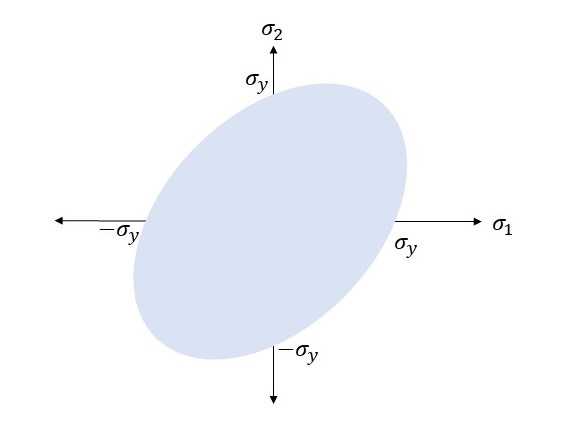
Figure 1: 2D Von Mises graphical presentation
2.3. Other Failure Criteria
- Tresca Criterion: The Tresca yield criterion (maximum shear stress criterion) is another commonly used criterion for ductile materials. It states that yielding occurs when the maximum shear stress reaches the shear yield stress of the material. The Tresca criterion is more conservative than the Von Mises criterion, predicting yielding at lower stress levels. Von Mises theory can more accurately predict failure. This can mean optimal use of materials
- Rankine criterion: This criterion, also known as the maximum normal stress criterion, is often used for brittle materials and considers both normal stresses. The maximum stress criterion states that failure occurs at a point in brittle material when a principal stress reaches either the uniaxial tensile or compressive strength. It is more suitable for materials like concrete and soils.
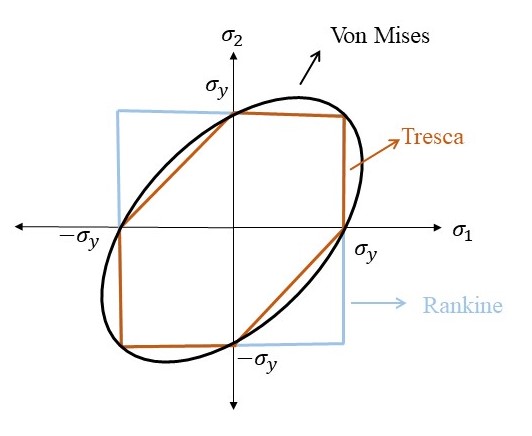
Figure 2: Von Mises, Tresca, and Rankine graphical presentation
2.4. Why should we use the Von Mises criterion?
Predicting Yielding: Von Mises stress is particularly useful for predicting the onset of yielding in ductile materials under complex loading conditions. It combines the effects of all three principal stresses into a single equivalent stress value that can be compared directly to the material’s yield strength.
Material Safety: By using Von Mises stress, engineers can ensure the safety and reliability of structures and mechanical components. This stress criterion helps in designing components that can withstand operational loads without undergoing permanent deformation.
Simplicity and Accuracy: The Von Mises criterion simplifies the assessment of complex stress states and provides accurate predictions of yielding for ductile materials. It is widely accepted and used in engineering design and analysis.
Design Standards: Many engineering design standards use the Von Mises stress criterion for evaluating material failure. It provides a common basis for comparing the performance and safety of different materials and designs.
inp File” img_size=”45×45″ woodmart_css_id=”68739937248c5″ info_box_inline=”no” wd_hide_on_desktop=”no” wd_hide_on_tablet_landscape=”no” wd_hide_on_tablet=”no” wd_hide_on_mobile=”no” responsive_spacing=”eyJwYXJhbV90eXBlIjoid29vZG1hcnRfcmVzcG9uc2l2ZV9zcGFjaW5nIiwic2VsZWN0b3JfaWQiOiI2ODczOTkzNzI0OGM1Iiwic2hvcnRjb2RlIjoid29vZG1hcnRfaW5mb19ib3giLCJkYXRhIjp7InRhYmxldCI6e30sIm1vYmlsZSI6e319fQ==” wd_z_index=”no”][/woodmart_info_box]
Tutorial Video” img_size=”45×45″ woodmart_css_id=”6873995e9fed2″ info_box_inline=”no” wd_hide_on_desktop=”no” wd_hide_on_tablet_landscape=”no” wd_hide_on_tablet=”no” wd_hide_on_mobile=”no” responsive_spacing=”eyJwYXJhbV90eXBlIjoid29vZG1hcnRfcmVzcG9uc2l2ZV9zcGFjaW5nIiwic2VsZWN0b3JfaWQiOiI2ODczOTk1ZTlmZWQyIiwic2hvcnRjb2RlIjoid29vZG1hcnRfaW5mb19ib3giLCJkYXRhIjp7InRhYmxldCI6e30sIm1vYmlsZSI6e319fQ==” wd_z_index=”no”][/woodmart_info_box]
3. What are principal stresses and strains?
Principal Stresses: Principal stresses are the normal stresses that occur at particular orientations where the shear stress is zero. These stresses are the eigenvalues of the stress tensor and represent the maximum and minimum normal stresses that a material element experiences. They are crucial for understanding the state of stress at a point in a material.
Principal Strains: Principal strains are the normal strains that occur in the directions of the principal stresses. Similar to principal stresses, these strains represent the maximum and minimum normal strains that a material element experiences. They are the eigenvalues of the strain tensor.
Principal angle: This is the orientation angle at which the principal stresses or strains occur in a material. In other words, it’s the angle between the original coordinate system (usually aligned with the material’s axes) and the axes along which the principal stresses or strains are aligned. At this angle, the shear stress is zero, and the normal stresses reach their maximum or minimum values, known as the principal stresses.
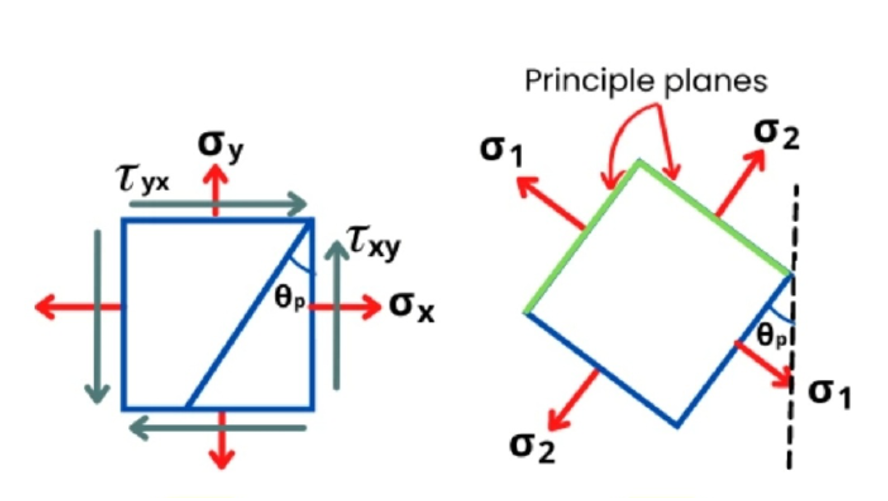
Figure 3: Elements of material under subjected stress and principal stresses
3.1. Maximum and Minimum principal stresses
To find the principal stresses, we need to solve the characteristic equation derived from the stress tensor. The principal stresses  and
and  which are respectively the maximum and minimum principal stresses are given by:
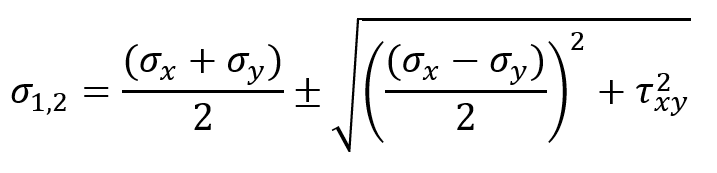
Example: consider a 2D stress state with the following components:
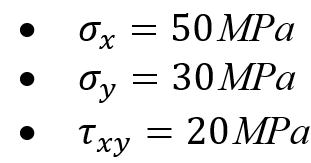
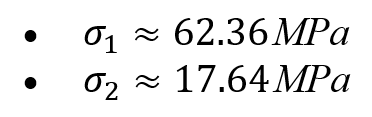
The principal stresses and are given by:

So, the principal stresses are:
3.2. Principal Strains
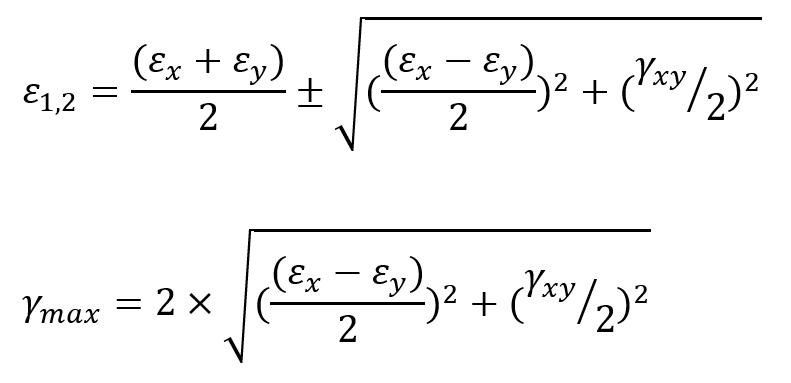
To find the principal strains, we solve a similar characteristic equation derived from the strain tensor. For 2D, the principal strains can be found similarly to principal stresses:
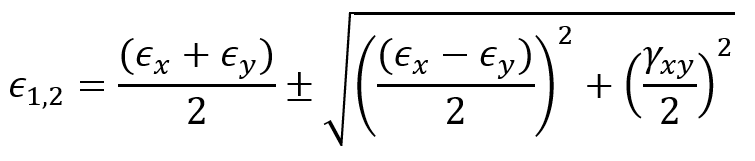
Example: consider a 2D strain state with the following components:
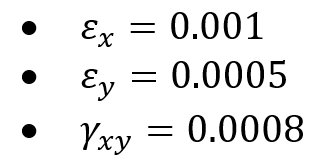
The principal strains  and
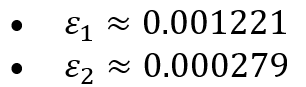
and  are given by:

So, the principal strains are:
4. Mohr’s Circle
Mohr’s Circle is a graphical representation of the state of stress at a point in a material. It provides a visual method to determine principal stresses, principal strains, and maximum shear stresses. The circle is constructed using the normal and shear stress components on different planes, allowing us to visualize how these stresses transform as the orientation of the plane changes.
4.1. How to draw Mohr’s Circle
Constructing Mohr’s Circle is a fundamental skill that allows you to move from a messy stress state to a clear visual representation. By following these precise steps, you can graphically solve for principal stresses and maximum shear without relying solely on transformation equations.
- Plot the Points
- Determine the Center and Radius
- Draw the Circle
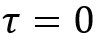
- Find Principal Stresses:
- The principal stresses
 and
and  are found at the points where the circle intersects the horizontal axis (
 ).
). - (major principal stress) is at the rightmost intersection.
-
 (minor principal stress) is at the leftmost intersection.
  is at the highest point of the circle.
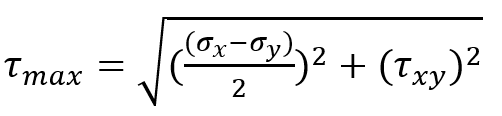
- Also, Maximum shear stress is calculated by:
 .
.
- The principal stresses
 ).
). is at the highest point of the circle.
 .
.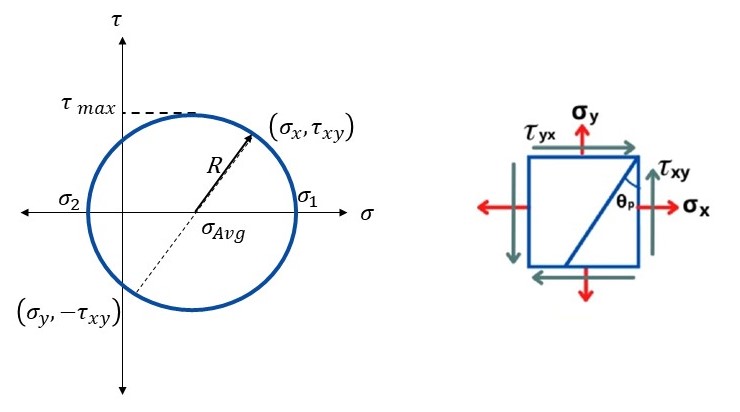
Figure 4: Drawing Mohr’s Circle
We have a full tutorial of mohr circle and all things about it in our blog: The Ultimate Guide to Mohr’s Circle and Stress Transformation
4.2. Principal Strains using Mohr’s Circle for Strain
Mohr’s Circle can also be used to determine principal strains in a similar manner. The procedure involves plotting the normal strains 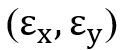 and shear strain
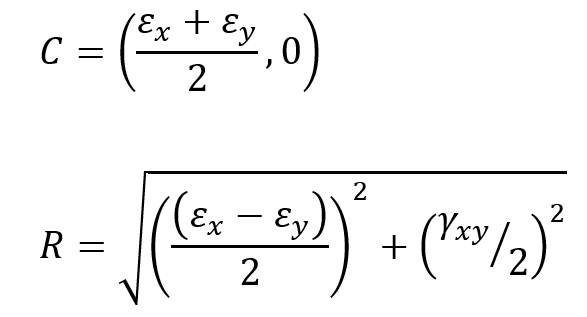
  to construct the circle and find the principal strains at the intersection points with the horizontal axis. The relations for calculating the parameters of the Mohr’s Circle strain are as follows:
4.3. Benefits of Using Mohr’s Circle
- Visualization: Provides a clear graphical representation of stress transformation.
- Simplicity: Simplifies the complex calculations involved in stress analysis.
- Comprehensiveness: Simultaneously shows principal stresses, maximum shear stresses, and their orientations.
- Insight: Helps in understanding the relation between normal and shear stresses and strains.
5. Von Mises stress in Abaqus
Von Mises stress is particularly useful in situations involving ductile materials (such as metals) under complex loading conditions. In the context of finite element analysis (FEA) using Abaqus, Von Mises stress plays a crucial role in evaluating the material’s response to loading. It is used to predict yielding if the material has reached its yield point under the given load conditions. Also, it is used to identify regions in a model where the stress exceeds the material’s yield strength, indicating potential failure.
5.1. Critical Comparison: Von Mises Stress vs. Principal Stresses
- Von Mises Stress: Provides a scalar value representing the equivalent stress state that can be compared directly with the yield strength of the material. It is especially critical for predicting yielding in ductile materials.
In the third lesson of Abaqus for beginners package, there is a simple example of a beam that would help you to simulate concentrated load on it and do a stress analysis to obtain the Von Mises stress one the beam.
- Principal Stresses: Represent the maximum and minimum normal stresses at a point. While they provide valuable information about the stress state, they are not as directly correlated with yielding in ductile materials as Von Mises stress.
According to Figure 2, which illustrates the more precise and conservative behavior of the von Mises criterion compared to the maximum normal stress criterion, in numerous engineering applications, Von Mises stress is considered more critical for assessing yielding, especially in ductile materials. However, principal stresses are also important for understanding the stress state and identifying potential failure modes like cracking in brittle materials.
For example: consider a cylindrical pressure vessel subjected to internal pressure. Using Abaqus, you can perform a finite element analysis to evaluate the stress distribution.
After running a static analysis to compute the stress distribution in the vessel and plotting the Von Mises stress distribution, we can identify regions where the Von Mises stress exceeds the yield strength of the material. So, if:
- The maximum Von Mises stress in the vessel is below the material’s yield strength, the design is considered safe.
- The Von Mises stress exceeds the yield strength, it indicates potential yielding, and the design may need to be modified to reduce stress concentrations.
5.2 Modern Perspectives and Limitations of von Mises Stress in Advanced Analyses
Although von Mises stress remains one of the most widely used indicators in solid mechanics, recent research emphasizes that it should be interpreted with greater care and context than in traditional textbook applications. Fundamentally, the von Mises criterion was developed as a yield criterion for isotropic, ductile metals under proportional loading. Modern engineering applications, however, increasingly operate outside these ideal assumptions.
One important update concerns the limitations of von Mises stress for non-ductile and advanced materials. For brittle materials, composites, anisotropic metals, and many additively manufactured parts, von Mises stress does not reliably correlate with failure initiation. Recent studies highlight that relying solely on von Mises stress in such cases may obscure critical damage mechanisms, particularly those driven by normal stress components or microstructural effects.
Another active area of discussion is the role of von Mises stress under non-proportional and multiaxial loading. Since the von Mises criterion is path-independent, it does not capture load-history effects that are crucial in cyclic loading and multiaxial fatigue. As a result, contemporary analyses often combine von Mises stress with additional measures such as critical plane concepts or energy-based criteria to improve physical relevance.
In nonlinear finite element simulations, especially those involving plasticity, researchers increasingly stress the distinction between von Mises stress and actual failure indicators. While von Mises stress is effective for identifying the onset of yielding, quantities such as equivalent plastic strain, stress triaxiality, and damage variables are more appropriate for assessing failure progression and fracture.
Finally, modern design practice is shifting from reporting a single maximum von Mises value toward analyzing the spatial distribution (field) of von Mises stress. This field-based interpretation helps identify stress gradients, load transfer paths, and mesh-sensitive regions—an approach particularly important in topology optimization, additive manufacturing, and multiscale modeling.
Together, these developments do not diminish the importance of von Mises stress; rather, they reposition it as one component within a broader, more physically informed analysis framework.
inp File” img_size=”45×45″ woodmart_css_id=”68739937248c5″ info_box_inline=”no” wd_hide_on_desktop=”no” wd_hide_on_tablet_landscape=”no” wd_hide_on_tablet=”no” wd_hide_on_mobile=”no” responsive_spacing=”eyJwYXJhbV90eXBlIjoid29vZG1hcnRfcmVzcG9uc2l2ZV9zcGFjaW5nIiwic2VsZWN0b3JfaWQiOiI2ODczOTkzNzI0OGM1Iiwic2hvcnRjb2RlIjoid29vZG1hcnRfaW5mb19ib3giLCJkYXRhIjp7InRhYmxldCI6e30sIm1vYmlsZSI6e319fQ==” wd_z_index=”no”][/woodmart_info_box]
Tutorial Video” img_size=”45×45″ woodmart_css_id=”6873995e9fed2″ info_box_inline=”no” wd_hide_on_desktop=”no” wd_hide_on_tablet_landscape=”no” wd_hide_on_tablet=”no” wd_hide_on_mobile=”no” responsive_spacing=”eyJwYXJhbV90eXBlIjoid29vZG1hcnRfcmVzcG9uc2l2ZV9zcGFjaW5nIiwic2VsZWN0b3JfaWQiOiI2ODczOTk1ZTlmZWQyIiwic2hvcnRjb2RlIjoid29vZG1hcnRfaW5mb19ib3giLCJkYXRhIjp7InRhYmxldCI6e30sIm1vYmlsZSI6e319fQ==” wd_z_index=”no”][/woodmart_info_box]
6. Conclusion
This article focused on Von Mises stress, a crucial concept in engineering used to predict material yielding under complex loading conditions. Understanding Von Mises stress is essential for designing safe and effective structures, especially when working with ductile materials.
The importance of this topic lies in its application within finite element analysis (FEA) using tools like Abaqus, where Von Mises stress is employed to assess whether a material will withstand operational loads. The article covered several key areas: the definition and calculation of Von Mises stress, its role in predicting yielding through the Von Mises criterion, and how it compares to other failure criteria like the Tresca and Rankine criteria. Additionally, it discussed the importance of principal stresses and Mohr’s Circle in stress analysis, providing insight into the stress state at a point in a material.
In conclusion, we learned that Von Mises stress is an important tool in engineering that helps predict material failure, ensuring the safety and reliability of designs. Understanding its calculation, application, and comparison to other criteria allows engineers to make informed decisions in the design process.
| Theory/Criterion Name | Material Suitability | Failure Definition | Key Physical Assumption | Mathematical Formulation | Relationship to Hydrostatic Stress | Conservatism Level (Inferred) |
|---|---|---|---|---|---|---|
| Maximum Shear Stress Theory (Tresca Criterion) | Ductile (metals) | Yielding (onset of plastic deformation) | Yielding is caused by maximum shear stress reaching a critical value. |  | Independent | High (More conservative than von Mises as its yield surface is entirely inside it) |
| Maximum Distortion Energy Theory (von Mises Criterion) | Ductile (isotropic metals) | Yielding (onset of plastic deformation) | Yielding occurs when the distortion energy (deviatoric stress) reaches a critical value. |  | Independent | Moderate (Agrees best with experimental data for ductile materials) |
| Maximum Principal Stress Theory (Rankine Theory) | Brittle (e.g., cast iron) | Fracture (reaching ultimate strength) or yielding | Failure occurs when the maximum or minimum principal stress reaches the material's strength limit. |  | Sensitive (Incorrectly predicts failure due to hydrostatic stress in ductile materials) | Low (Unsafe for ductile materials as it ignores shear effects) |
| Coulomb-Mohr Theory | Brittle | Fracture | Failure depends on the difference between tensile and compressive ultimate strengths. | Sensitive | Moderate (Less accurate in some quadrants compared to Modified Mohr) | |
| Modified Mohr Theory | Brittle | Fracture | A variation of Coulomb-Mohr adjusted to better fit experimental fracture data. | Sensitive | Moderate to High (Preferred for general brittle failure prediction) |






 English
  Korean
  Chinese