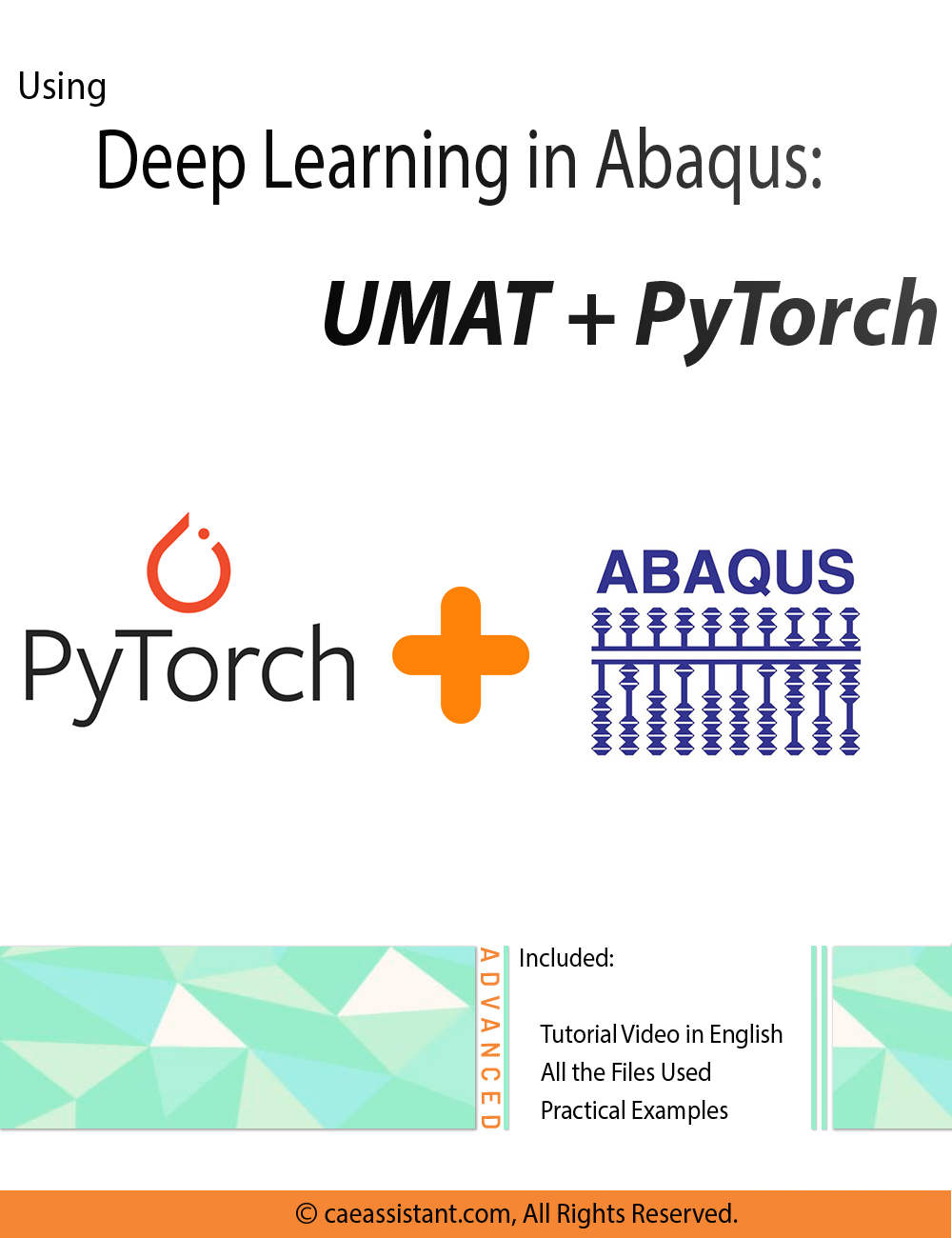
Using Deep Learning in Abaqus: UMAT + PyTorch

What You'll Learn

Buy Together & Save

This Course Includes

Course Content

Using Deep Learning in Abaqus: UMAT + PyTorch

Product Informations

[woodmart_info_box image=”47504″ style=”bg-hover” rounding_size=”” alignment=”center” title_size=”small” title_font_weight=”200″ css_animation=”none” woodmart_css_id=”69ef1f1c0179b” svg_animation=”no” info_box_inline=”no” responsive_spacing=”eyJwYXJhbV90eXBlIjoid29vZG1hcnRfcmVzcG9uc2l2ZV9zcGFjaW5nIiwic2VsZWN0b3JfaWQiOiI2OWVmMWYxYzAxNzliIiwic2hvcnRjb2RlIjoid29vZG1hcnRfaW5mb19ib3giLCJkYXRhIjp7InRhYmxldCI6e30sIm1vYmlsZSI6e319fQ==” wd_z_index=”no” wd_hide_on_desktop=”no” wd_hide_on_tablet=”no” wd_hide_on_mobile=”no” link=”url:https%3A%2F%2Fcaeassistant.com%2Fproduct%2Fusing-deep-learning-in-abaqus-umat-pytorch%2F” bg_hover_color_gradient=”rgb(60, 27, 59)-0/rgb(90, 55, 105)-33/rgb(46, 76, 130)-66/rgb(29, 28, 44)-100/|linear-gradient(left , rgb(60, 27, 59) , rgb(90, 55, 105) 33% , rgb(46, 76, 130) 66% , rgb(29, 28, 44) 100%)|linear|left” subtitle=”Using Deep Learning in Abaqus:
UMAT + PyTorch” img_size=”medium”][/woodmart_info_box]
[woodmart_title align=”left” size=”medium” font_weight=”200″ title_decoration_style=”bordered” woodmart_css_id=”67f4e446dacb9″ title=”What included in this package?” title_font_size=”eyJwYXJhbV90eXBlIjoid29vZG1hcnRfcmVzcG9uc2l2ZV9zaXplIiwiY3NzX2FyZ3MiOnsiZm9udC1zaXplIjpbIiAud29vZG1hcnQtdGl0bGUtY29udGFpbmVyIl19LCJzZWxlY3Rvcl9pZCI6IjY3ZjRlNDQ2ZGFjYjkiLCJkYXRhIjp7ImRlc2t0b3AiOiIyNnB4IiwidGFibGV0IjoiMzJweCIsIm1vYmlsZSI6IjI2cHgifX0=” responsive_spacing=”eyJwYXJhbV90eXBlIjoid29vZG1hcnRfcmVzcG9uc2l2ZV9zcGFjaW5nIiwic2VsZWN0b3JfaWQiOiI2N2Y0ZTQ0NmRhY2I5Iiwic2hvcnRjb2RlIjoid29vZG1hcnRfdGl0bGUiLCJkYXRhIjp7InRhYmxldCI6e30sIm1vYmlsZSI6e319fQ==” css=”.vc_custom_1744102513831{margin-bottom: 35px !important;}” wd_hide_on_desktop=”no” wd_hide_on_tablet=”no” wd_hide_on_mobile=”no”]
[woodmart_info_box image=”32834″ rounding_size=”” image_alignment=”left” title_size=”small” svg_animation=”yes” title=”Learning
Video” img_size=”45×45″ woodmart_css_id=”6978c4ebc1e0e” info_box_inline=”no” wd_hide_on_desktop=”no” wd_hide_on_tablet_landscape=”no” wd_hide_on_tablet=”no” wd_hide_on_mobile=”no” responsive_spacing=”eyJwYXJhbV90eXBlIjoid29vZG1hcnRfcmVzcG9uc2l2ZV9zcGFjaW5nIiwic2VsZWN0b3JfaWQiOiI2OTc4YzRlYmMxZTBlIiwic2hvcnRjb2RlIjoid29vZG1hcnRfaW5mb19ib3giLCJkYXRhIjp7InRhYmxldCI6e30sIm1vYmlsZSI6e319fQ==” wd_z_index=”no”][/woodmart_info_box][woodmart_info_box image=”32842″ rounding_size=”” image_alignment=”left” title_size=”small” svg_animation=”yes” title=”Error-Free
Subtitles” img_size=”45×45″ woodmart_css_id=”6978cb222e4f3″ info_box_inline=”no” wd_hide_on_desktop=”no” wd_hide_on_tablet_landscape=”no” wd_hide_on_tablet=”no” wd_hide_on_mobile=”no” responsive_spacing=”eyJwYXJhbV90eXBlIjoid29vZG1hcnRfcmVzcG9uc2l2ZV9zcGFjaW5nIiwic2VsZWN0b3JfaWQiOiI2OTc4Y2IyMjJlNGYzIiwic2hvcnRjb2RlIjoid29vZG1hcnRfaW5mb19ib3giLCJkYXRhIjp7InRhYmxldCI6e30sIm1vYmlsZSI6e319fQ==” wd_z_index=”no”][/woodmart_info_box]
[woodmart_info_box image=”33180″ rounding_size=”” image_alignment=”left” title_size=”small” svg_animation=”yes” title=”All Needed Codes” img_size=”45×45″ woodmart_css_id=”69ecbcf6a5fea” info_box_inline=”no” wd_hide_on_desktop=”no” wd_hide_on_tablet_landscape=”no” wd_hide_on_tablet=”no” wd_hide_on_mobile=”no” responsive_spacing=”eyJwYXJhbV90eXBlIjoid29vZG1hcnRfcmVzcG9uc2l2ZV9zcGFjaW5nIiwic2VsZWN0b3JfaWQiOiI2OWVjYmNmNmE1ZmVhIiwic2hvcnRjb2RlIjoid29vZG1hcnRfaW5mb19ib3giLCJkYXRhIjp7InRhYmxldCI6e30sIm1vYmlsZSI6e319fQ==” wd_z_index=”no”][/woodmart_info_box][woodmart_info_box image=”32841″ rounding_size=”” image_alignment=”left” title_size=”small” svg_animation=”yes” title=”Theory &
Practice” img_size=”45×45″ woodmart_css_id=”69ecbcc164c3c” info_box_inline=”no” wd_hide_on_desktop=”no” wd_hide_on_tablet_landscape=”no” wd_hide_on_tablet=”no” wd_hide_on_mobile=”no” responsive_spacing=”eyJwYXJhbV90eXBlIjoid29vZG1hcnRfcmVzcG9uc2l2ZV9zcGFjaW5nIiwic2VsZWN0b3JfaWQiOiI2OWVjYmNjMTY0YzNjIiwic2hvcnRjb2RlIjoid29vZG1hcnRfaW5mb19ib3giLCJkYXRhIjp7InRhYmxldCI6e30sIm1vYmlsZSI6e319fQ==” wd_z_index=”no”][/woodmart_info_box]

Package Description

Modern constitutive modeling is evolving beyond traditional hand-crafted equations toward data-driven formulations powered by neural networks. In this package, you will learn how to implement that advanced workflow directly inside Abaqus by linking UMAT with PyTorch. Instead of relying only on classical material laws, a trained neural network will be used to represent strain energy density functions, generate stress responses, and provide the consistent tangent stiffness required for nonlinear finite element simulations. The course begins with the fundamentals of tensors, continuum mechanics, and automatic differentiation, giving you the theoretical base needed to understand smart constitutive modeling.

The package then moves into practical implementation, where you will learn how to export trained network weights and biases from PyTorch, rebuild the forward pass inside a Fortran UMAT, and deploy AI-based material behavior in Abaqus. Through a hands-on workshop, you will replace the Neo-Hookean hyperelastic model with a Fully Connected Neural Network (FCNN), validate derivatives, and compare accuracy and speed against the native Abaqus model. This package is ideal for engineers and researchers who want to integrate Deep learning into real finite element workflows.

[woodmart_text_block woodmart_css_id=”69ecc82339c72″ woodmart_inline=”no” responsive_spacing=”eyJwYXJhbV90eXBlIjoid29vZG1hcnRfcmVzcG9uc2l2ZV9zcGFjaW5nIiwic2VsZWN0b3JfaWQiOiI2OWVjYzgyMzM5YzcyIiwic2hvcnRjb2RlIjoid29vZG1hcnRfdGV4dF9ibG9jayIsImRhdGEiOnsidGFibGV0Ijp7fSwibW9iaWxlIjp7fX19″ parallax_scroll=”no” wd_hide_on_desktop=”no” wd_hide_on_tablet_landscape=”no” wd_hide_on_tablet=”no” wd_hide_on_mobile=”no”]

What Is Included in This Package?

This package is designed to give you both the theoretical understanding and practical implementation skills required to build intelligent constitutive models in Abaqus using deep learning frameworks.

Lession: Theorical Undrestanding

You will first learn how neural networks can replace traditional closed-form constitutive equations by approximating material energy potentials. The course explains how strain energy density functions can be learned from data and then used to derive stress responses and tangent operators required in finite element analysis.

A strong focus is placed on tensor mathematics and continuum mechanics fundamentals, ensuring that the neural network outputs remain physically meaningful within nonlinear simulations. You will also understand how gradients and second-order derivatives are obtained using PyTorch automatic differentiation. This is essential because Abaqus UMAT requires not only stress updates but also a consistent DDSDDE tangent matrix for robust convergence.

Workshop1: Practical Implementation

A major practical section of the course covers the offline deployment strategy. You will learn how to extract trained weights and biases from PyTorch, translate them into Fortran arrays, and manually reconstruct the network’s forward propagation inside a UMAT subroutine. This enables AI-driven constitutive behavior without requiring Python during Abaqus execution.

In the workshop section, you will implement a Fully Connected Neural Network to emulate Neo-Hookean hyperelasticity, verify stress and stiffness accuracy, and run a single-element benchmark model in Abaqus. Finally, you will compare computational speed, numerical stability, and predictive capability between the neural-network UMAT and the standard Abaqus material model.

By the end of the package, you will have a complete roadmap for integrating deep learning material models into industrial finite element workflows.

[/woodmart_text_block][woodmart_button style=”link” color=”primary” align=”left” woodmart_css_id=”6981dc5c0a870″ title=”Read More” full_width=”no” button_inline=”no” button_smooth_scroll=”no” wd_button_collapsible_content=”yes” responsive_spacing=”eyJwYXJhbV90eXBlIjoid29vZG1hcnRfcmVzcG9uc2l2ZV9zcGFjaW5nIiwic2VsZWN0b3JfaWQiOiI2OTgxZGM1YzBhODcwIiwic2hvcnRjb2RlIjoid29vZG1hcnRfYnV0dG9uIiwiZGF0YSI6eyJ0YWJsZXQiOnt9LCJtb2JpbGUiOnt9fX0=” wd_hide_on_desktop=”no” wd_hide_on_tablet=”no” wd_hide_on_mobile=”no”]

[woodmart_title align=”left” woodmart_css_id=”67cffade9a3ae” title=”Syllabus” responsive_spacing=”eyJwYXJhbV90eXBlIjoid29vZG1hcnRfcmVzcG9uc2l2ZV9zcGFjaW5nIiwic2VsZWN0b3JfaWQiOiI2N2NmZmFkZTlhM2FlIiwic2hvcnRjb2RlIjoid29vZG1hcnRfdGl0bGUiLCJkYXRhIjp7InRhYmxldCI6e30sIm1vYmlsZSI6e319fQ==” wd_hide_on_desktop=”no” wd_hide_on_tablet=”no” wd_hide_on_mobile=”no”]
Review of tensors in continuum mechanics and defining Energy Potential (WWW) using neural networks.
Automatic differentiation mathematics (torch.autograd) for extracting stress and the tangent tensor (DDSDDE).
Hard-coding Strategy: How to extract weight matrices (WWW) and biases (bbb) from Python and rewrite the network’s Forward Pass in the Fortran environment
Training the network in PyTorch and validating second-order derivatives
Writing the UMAT subroutine in Fortran using the extracted weights
Solving a single-element problem in Abaqus and comparing speed and accuracy with the standard Abaqus model
[woodmart_info_box image=”32167″ rounding_size=”” alignment=”center” btn_position=”static” btn_color=”primary” btn_style=”link” no_svg_animation=”yes” title=”Quality Insurance” css=”.vc_custom_1743318038318{border-right-width: 1px !important;border-right-style: inherit !important;border-color: #c4c4c4 !important;}” img_size=”100×100″ woodmart_css_id=”67e8ec03dce53″ svg_animation=”no” info_box_inline=”no” wd_hide_on_desktop=”no” wd_hide_on_tablet_landscape=”no” wd_hide_on_tablet=”no” wd_hide_on_mobile=”no” responsive_spacing=”eyJwYXJhbV90eXBlIjoid29vZG1hcnRfcmVzcG9uc2l2ZV9zcGFjaW5nIiwic2VsZWN0b3JfaWQiOiI2N2U4ZWMwM2RjZTUzIiwic2hvcnRjb2RlIjoid29vZG1hcnRfaW5mb19ib3giLCJkYXRhIjp7InRhYmxldCI6e30sIm1vYmlsZSI6e319fQ==” wd_z_index=”no”]Refunds, per terms and conditions, cover:

defects in input file (.inp) execution.

defects in subroutine file (.for) execution.

guarantees validation and accurate simulation results.

ensures product matches page descriptions.[/woodmart_info_box]

[woodmart_info_box image=”32168″ rounding_size=”” alignment=”center” btn_position=”static” btn_color=”primary” btn_style=”link” no_svg_animation=”yes” img_size=”100×100″ woodmart_css_id=”67e8e9484f09a” svg_animation=”no” info_box_inline=”no” wd_hide_on_desktop=”no” wd_hide_on_tablet_landscape=”no” wd_hide_on_tablet=”no” wd_hide_on_mobile=”no” responsive_spacing=”eyJwYXJhbV90eXBlIjoid29vZG1hcnRfcmVzcG9uc2l2ZV9zcGFjaW5nIiwic2VsZWN0b3JfaWQiOiI2N2U4ZTk0ODRmMDlhIiwic2hvcnRjb2RlIjoid29vZG1hcnRfaW5mb19ib3giLCJkYXRhIjp7InRhYmxldCI6e30sIm1vYmlsZSI6e319fQ==” wd_z_index=”no” title=”Attendance Certificate”]Optional Certificate Available for an additional fee:

Issued upon successful completion.

Verifiable anytime on our website.

Proof of training participation.

Validates understanding of topic simulation.[/woodmart_info_box]

[woodmart_title size=”extra-large” title=”Tutor” css=”.vc_custom_1743681891791{margin-bottom: 20px !important;}” woodmart_css_id=”67ee795c988b7″ subtitle_font_size=”eyJwYXJhbV90eXBlIjoid29vZG1hcnRfcmVzcG9uc2l2ZV9zaXplIiwiY3NzX2FyZ3MiOnsiZm9udC1zaXplIjpbIiAudGl0bGUtc3VidGl0bGUiXX0sInNlbGVjdG9yX2lkIjoiNjdlZTc5NWM5ODhiNyIsImRhdGEiOnsiZGVza3RvcCI6IjE4cHgifX0=” responsive_spacing=”eyJwYXJhbV90eXBlIjoid29vZG1hcnRfcmVzcG9uc2l2ZV9zcGFjaW5nIiwic2VsZWN0b3JfaWQiOiI2N2VlNzk1Yzk4OGI3Iiwic2hvcnRjb2RlIjoid29vZG1hcnRfdGl0bGUiLCJkYXRhIjp7InRhYmxldCI6e30sIm1vYmlsZSI6e319fQ==” wd_hide_on_desktop=”no” wd_hide_on_tablet=”no” wd_hide_on_mobile=”no”]
[team_member image=”33430″ name=”Produced in Partnership Plan” align=”center” style=”colored” size=”small” woodmart_color_scheme=”dark” img_size=”full” google_plus=”#” linkedin=”https://de.linkedin.com/company/caeassistant” woodmart_css_id=”6811e08223129″ responsive_spacing=”eyJwYXJhbV90eXBlIjoid29vZG1hcnRfcmVzcG9uc2l2ZV9zcGFjaW5nIiwic2VsZWN0b3JfaWQiOiI2ODExZTA4MjIzMTI5Iiwic2hvcnRjb2RlIjoidGVhbV9tZW1iZXIiLCJkYXRhIjp7InRhYmxldCI6e30sIm1vYmlsZSI6e319fQ==”][/team_member]
[woodmart_text_block text_font_size=”custom” text_color=”title” woodmart_css_id=”681339c8bbcce” text_font_size_custom=”eyJwYXJhbV90eXBlIjoid29vZG1hcnRfcmVzcG9uc2l2ZV9zaXplIiwiY3NzX2FyZ3MiOnsiZm9udC1zaXplIjpbIi53ZC10ZXh0LWJsb2NrIl19LCJzZWxlY3Rvcl9pZCI6IjY4MTMzOWM4YmJjY2UiLCJkYXRhIjp7ImRlc2t0b3AiOiIyNHB4In19″ parallax_scroll=”no” woodmart_inline=”no” wd_hide_on_desktop=”no” wd_hide_on_tablet_landscape=”no” wd_hide_on_tablet=”no” wd_hide_on_mobile=”no” responsive_spacing=”eyJwYXJhbV90eXBlIjoid29vZG1hcnRfcmVzcG9uc2l2ZV9zcGFjaW5nIiwic2VsZWN0b3JfaWQiOiI2ODEzMzljOGJiY2NlIiwic2hvcnRjb2RlIjoid29vZG1hcnRfdGV4dF9ibG9jayIsImRhdGEiOnsidGFibGV0Ijp7fSwibW9iaWxlIjp7fX19″]

The CAE Assistant team, in collaboration with numerous academics, researchers, and industry professionals holding bachelor’s, master’s, and PhD degrees, has developed a variety of educational packages. One of the key advantages of leveraging the expertise of such individuals is the creation of high-quality, valuable content that stands out compared to competitors. This has earned the trust of many individuals from renowned companies and universities in our team and the quality of the content we produce, which has always been a source of pride for us.

[/woodmart_text_block]

The FEM simulation fields we serve:

Mechanical Engineering
Biomechanical Engineering
Writing Abaqus Subroutines
Civil, Water, and Soil Engineering
[woodmart_button woodmart_css_id=”6803734de3378″ title=”Book a Consultation Session” button_smooth_scroll=”no” wd_button_collapsible_content=”no” full_width=”no” button_inline=”no” responsive_spacing=”eyJwYXJhbV90eXBlIjoid29vZG1hcnRfcmVzcG9uc2l2ZV9zcGFjaW5nIiwic2VsZWN0b3JfaWQiOiI2ODAzNzM0ZGUzMzc4Iiwic2hvcnRjb2RlIjoid29vZG1hcnRfYnV0dG9uIiwiZGF0YSI6eyJ0YWJsZXQiOnt9LCJtb2JpbGUiOnt9fX0=” wd_hide_on_desktop=”no” wd_hide_on_tablet=”no” wd_hide_on_mobile=”no” link=”url:https%3A%2F%2Fcaeassistant.com%2Fonline-tutoring-consulting%2Fpre-registration%2F” css=”.vc_custom_1745056601789{border-top-width: 25px !important;}”]

You will learn how to build intelligence constitutive material models in Abaqus by connecting UMAT with PyTorch. The course covers neural-network-based strain energy modeling, automatic differentiation for stress and tangent stiffness, and practical implementation of trained models in Fortran UMAT.

This course is designed for simulation engineers, researchers, graduate students, and Abaqus users who want to combine finite element analysis with deep learning. It is especially valuable for those working in computational mechanics, material modeling, and AI-driven simulation.

This training provides a structured and practical roadmap that saves you significant time in learning a complex interdisciplinary topic. Instead of spending months combining scattered resources, you receive focused guidance, implementation strategies, and real Abaqus examples in one package.

The PDF and Video provided in this training are in English. They are error-free, and presented in a clear and straightforward manner, making it easy for anyone with a basic understanding of English to follow.

We fully and unconditionally guarantee the accuracy and functionality of our content, ensuring it matches the descriptions provided on our website. This guarantee covers any discrepancies between the training and the presented syllabus, as well as any issues with the files, code, and videos you receive. For more information you can check the Terms and Conditions.

By purchasing this package, you will get access to the following:

  • Training video: To facilitate your learning experience, we provide video tutorials that complement the PDF guide. These videos offer an in-depth explanation of the theory and guide you through each workshop, demonstrating exactly how to analyze the files and interpret the results.

  • Abaqus inp Files You will receive full access to the Abaqus inp files for all workshops, allowing you to keep and utilize them for your own projects.

Yes, you can receive this training in a language other than English, which includes an additional fee. If you are interested, please contact our online chat or support email for more information.

Yes, depending on the modifications you require, we can implement the changes you need. To learn more about the terms and conditions for such custom orders, please contact our support email or our online chat.

[woodmart_title woodmart_css_id=”67e8ee8ba2ca3″ responsive_spacing=”eyJwYXJhbV90eXBlIjoid29vZG1hcnRfcmVzcG9uc2l2ZV9zcGFjaW5nIiwic2VsZWN0b3JfaWQiOiI2N2U4ZWU4YmEyY2EzIiwic2hvcnRjb2RlIjoid29vZG1hcnRfdGl0bGUiLCJkYXRhIjp7InRhYmxldCI6e30sIm1vYmlsZSI6e319fQ==” wd_hide_on_desktop=”no” wd_hide_on_tablet=”no” wd_hide_on_mobile=”no” subtitle=”Are you a faculty member or representing a company? Explore our Unlimited Bundle Plan.” title=”Purchase Multiple Packages at Less than Half Price”]

If you are a faculty member or a company requiring multiple training packages for your staff, or If you’re an individual seeking to enhance your skills across various domains, we offer a tailored bundle plan. This plan provides access to a specific number of packages for a duration of 1 or 2 years. By paying the bundle plan fees, you’ll also receive discounts on a range of our additional services. This is a comprehensive and cost-effective solution to enhance the knowledge and skills of your team or students.

Please note: This bundle plan includes a variety of our popular training packages. If you would like to confirm the specific packages included in this plan (all packages under 400€), please check THIS PAGE or feel free to contact our support team via online chat.

Reviews

There are no reviews yet.

Be the first to review “Using Deep Learning in Abaqus: UMAT + PyTorch”

Instructors

m.khal Khalilian

Original price was: € 380.0.Current price is: € 304.0.

Get Free Access to More Than the Demo!