Full FEA tutorial _ Abaqus software

The finite element method (FEA tutorial) has been used to solve numerous structural and nonstructural issues. This method has several advantages over conventional approximate methods for modeling and determining physical quantities like displacements, stresses, temperatures, pressures, and electric currents. Conventional methods such as those were taught in traditional courses in material mechanics and heat transfer. These advantages are:

  1. Designing bodies with irregular shapes is simple.
  2. Handle stress/strain cases without trouble
  3. Because each element equation is assessed separately, model bodies are made of various materials.
  4. Manage an infinite variety of boundary conditions
  5. Changing the size of the components to enable the usage of small components as necessary and implementing higher-order elements is possible.
  6. Simulating many kinds of material qualities from element to element or even within an element is simple. FEA tutorial
  7. FEM is popular among the engineering community since it is easy to use, small, and focused on results.
  8. Take care of any nonlinear behavior resulting from significant deformations and materials.
  9. A variety of computer software programs and books are readily available, making FEM a flexible and effective numerical method.

Also, you can learn more about the advantages and disadvantages of the FEM in the second lesson of the Abaqus course for beginners package.

Use the FEA Tutorial available on this page to understand FEM simulation fully.

The finite element method (FEM) is the most popular numerical method, and the applications for this method are linear, non-linear, buckling, thermal, dynamic, and fatigue analysis. Now the question is FEA and FEM different or not?

Well, FEM and FEA are both one and the same. The term FEA is most popular in industries and FEM at universities. Also, FEA has a wide area of problems related to heat transfer, vibrations, the strength of materials, acoustics, and various other domains. And FEM includes the Galerkin method, the weighted residual method, and various numerical integration methods to solve problems related to FEA domains and its totally mathematical approach. The term “Finite Element Method” (FEM) mostly refers to sophisticated mathematical techniques employed in your preferred solver. Consider it to be a theory guidebook with a ton of equations and algebra. The term Finite Element Analysis (FEA) typically refers to the process of using FEM to address actual engineering issues. FEA tutorial

Full Composite fatigue Add-on (Academic and industrial usage)

 1800.0
This package is designed to instruct users on how to utilize the composite fatigue modeling Add-on, which removes the need to write a subroutine for composite fatigue modeling. Instead, users can select the composite type, input material properties, and generate the subroutine by clicking a button. The Add-on includes four types of composites, and the generated subroutine for all types is the UMAT. These four types are Unidirectional, Woven, short fiber composites (chopped), and wood. The fatigue criteria used for each type are the same as its respective package. For example, the fatigue criteria for woven composites are identical to that used in the "Simulation of woven composite fatigue in Abaqus" package. This Add-on provides a simple graphical user interface for composite fatigue modeling, which can be utilized for both academic and industrial applications.

Full Composite damage Add-on (Academic and industrial usage)

 1800.0
(15)
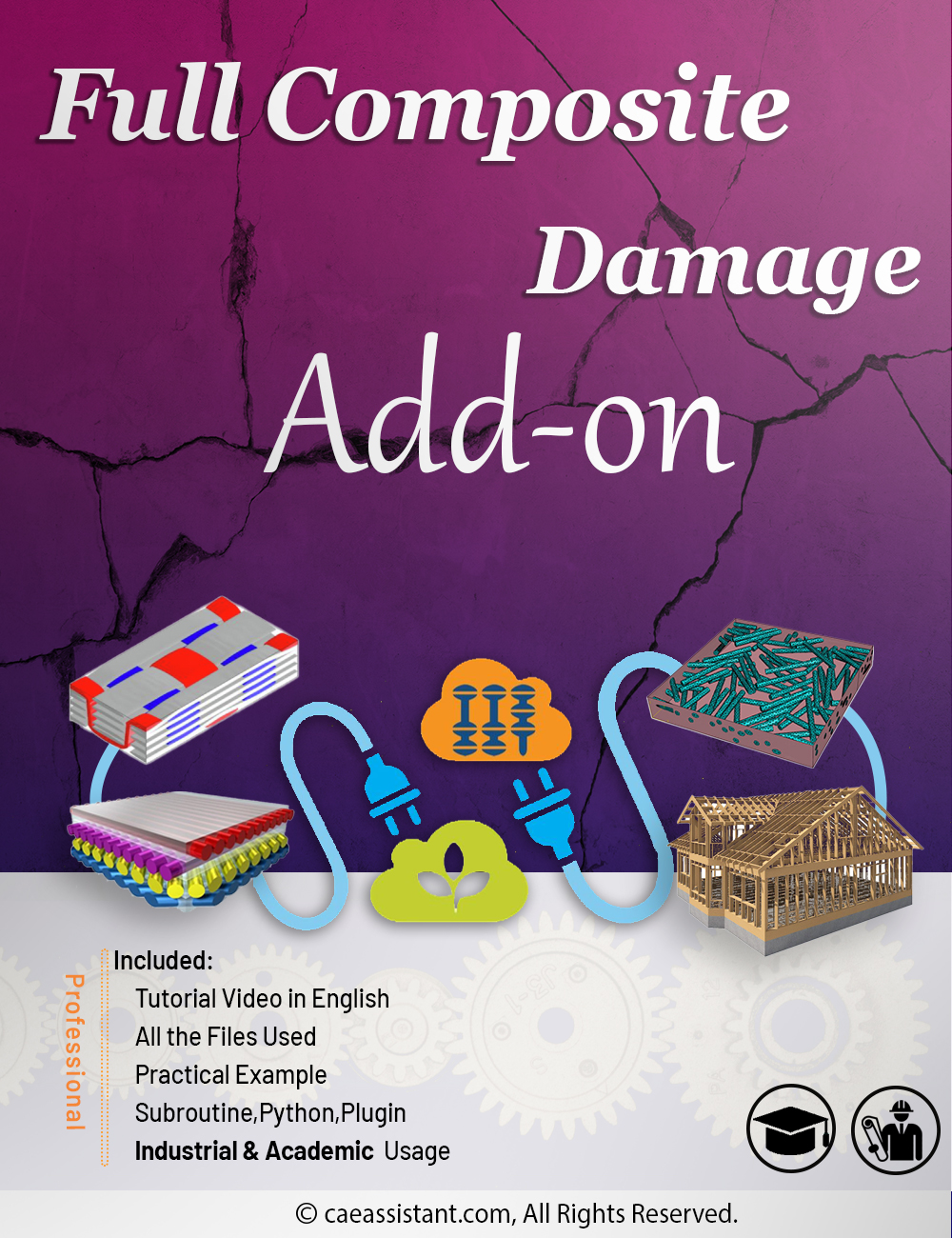
This package will teach you how to use the composite damage modeling Add-on. The Add-on eliminates the need for writing a subroutine for composite damage modeling. Instead, you only need to select the desired composite type, input the material properties, and click a button. The Add-on will then generate the subroutine for you. The Add-on includes four types of composites: Unidirectional, Woven, short fiber composites (chopped), and wood. The generated subroutine for all types is the VUSDFLD. The damage criteria used in each type is the same as the one used in its respective package. For instance, the damage criteria for the woven composite is identical to the one used in the "Simulation of woven composite damage in the Abaqus" package. This Add-on offers a user-friendly graphical user interface for composite damage modeling, which can be used for academic and industrial purposes.

Python Scripting in Abaqus Full Tutorial

 635.0
(1)
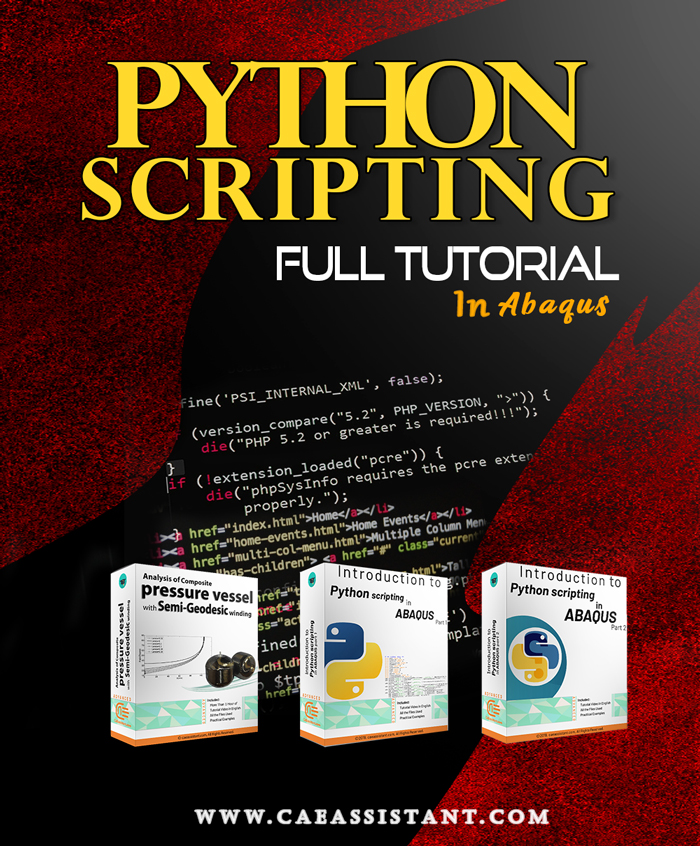
If you are a graduate or Ph.D. student, if you are a university professor or an expert engineer in the industry who deals with simulation software, you are definitely familiar with the limitations of this software in defining the material properties, loading or meshing, interaction properties, etc. You have certainly tried to define the properties of materials or geometry based on available features in the software, but sometimes you need to code on your own to define some complex issues. Now, here is your solution. This full tutorial package includes 3 training packages that help you to learn how to use Python scripting in Abaqus software. This is likewise the most comprehensive tutorial for the script, and it is appropriate for beginners to advanced users.

Bio-Mechanical Abaqus simulation Full package

 380.0
(4)

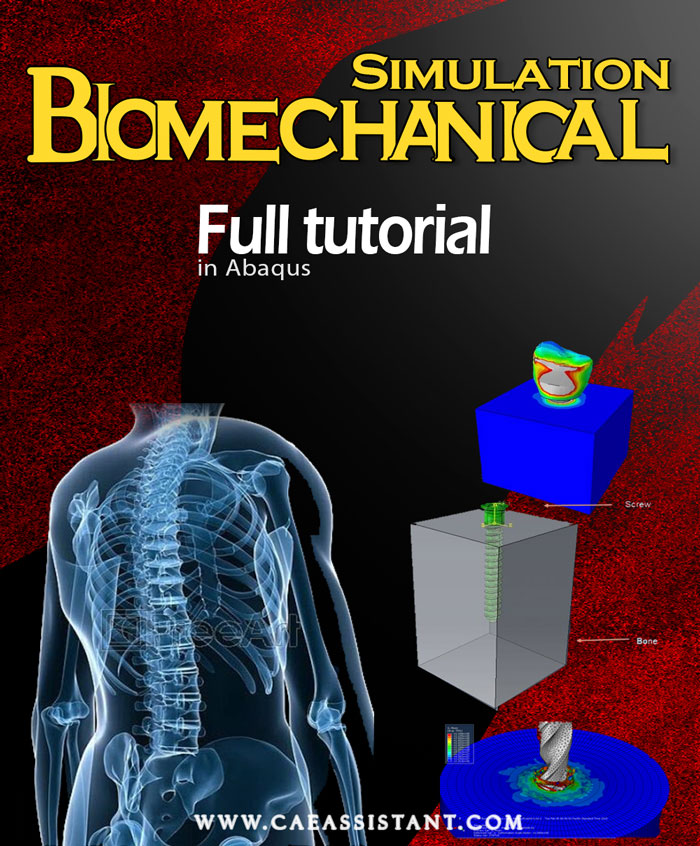
This video tutorial package offers a comprehensive guide to biomechanical simulations using Abaqus, covering a range of applications from dental to orthopedic and cardiovascular analyses. The workshops delve into finite element method (FEM) simulations, exploring static loading on human teeth, crack growth in bones under bending, bone drilling, and the behavior of titanium foam implants. Each tutorial emphasizes the importance of precise modeling and meshing techniques, utilizing dynamic explicit procedures, Johnson-Cook material models, and various contact and boundary conditions to simulate realistic biomechanical behaviors. Additionally, the package includes fluid-structure interaction (FSI) simulations for blood flow within coronary vessels, addressing both Newtonian and non-Newtonian models, and demonstrates the integration of computational fluid dynamics (CFD) with structural analysis for enhanced accuracy. The lessons complement the workshops by introducing fundamental FEM concepts, solver selection, explicit analysis considerations, and damage modeling, ensuring users gain a solid understanding of both theoretical and practical aspects of biomechanical simulations in Abaqus.

We also offer a similar budget-friendly package that includes all the workshops from this package. However, since it does not include the lessons, it is available at a lower price. You can purchase it on our website at a more competitive rate than similar platforms.  

Abaqus Soil Modeling Full Tutorial

 280.0
(10)
All facets of soil modelling and simulation are covered in this full tutorial. The package includes twenty titles on topics such as soil, saturated soil, TBM, earthquake, tunnel, excavation, embankment construction, geocell reinforced soil, geosynthetic-reinforced soil retaining wall, soil consolidation in interaction with the concrete pile, earthquake over gravity dam, infinite element method, sequential construction, calculation of the total load capacity of the pile group, bearing capacity of the foundation. Package duration: +600 minutes  

Abaqus steel material and structures Full Tutorial

 490.0
(3)
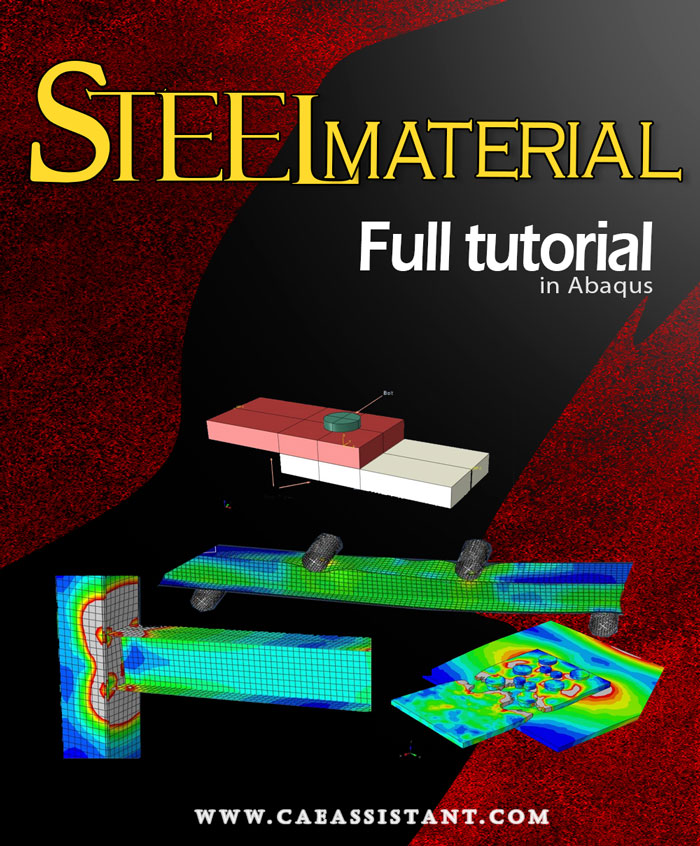
Here in this training package, numerous models of crack steel material structures modeling, such as the shear failure, FLD criterion and different metal damage theories in concrete, steel, dams, and bones are examined through ten step-by-step tutorials. Every tutorial includes all needed files and step-by-step English videos and is explained from A to Z.
We also offer a similar budget-friendly package that includes all the workshops from this package. However, since it does not include the lessonsit is available at a lower price. You can purchase it on our website at a more competitive rate than similar platforms.
 

Abaqus Crack Growth Full Tutorial

 410.0
(12)
Here in this training package, numerous methods of crack propagation modeling, such as the XFEM and H integral and so on, in concrete, steel, dams, bones, and other materials are examined through ten step-by-step tutorials. Every tutorial includes all needed files and a step-by-step English videos and is explained from A to Z. Package duration: +300 minutes We also offer a similar budget-friendly package that includes all the workshops from this package. However, since it does not include the lessonsit is available at a lower price. You can purchase it on our website at a more competitive rate than similar platforms.  

Composite simulation for experts-Part-1

 930.0
(18)
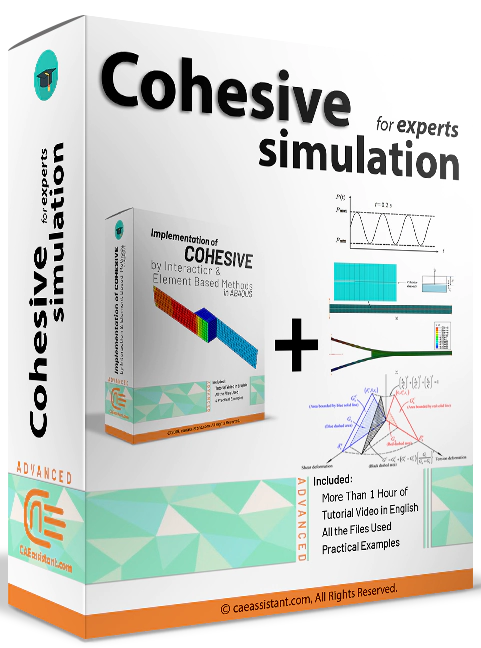
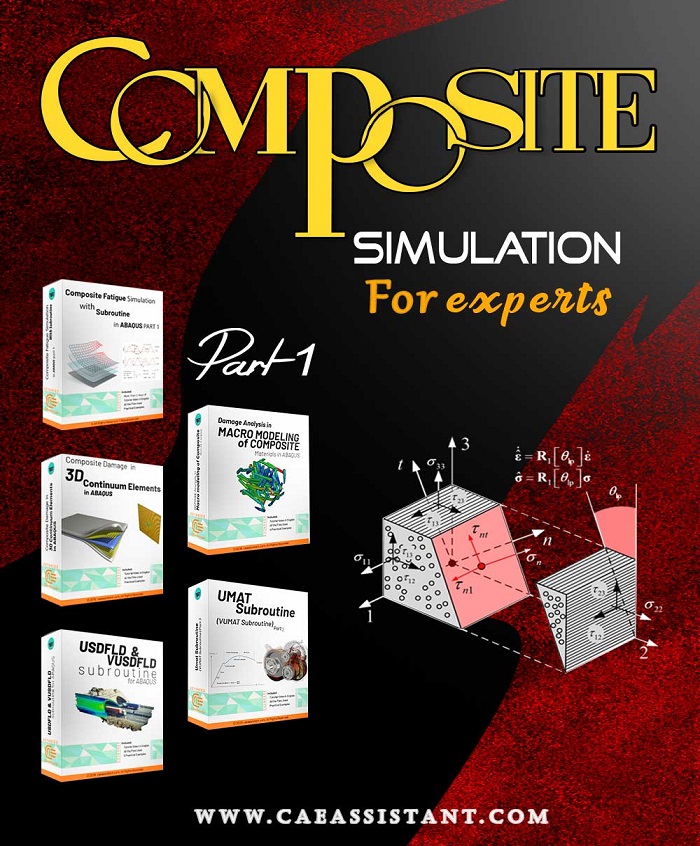
If you are a graduate or Ph.D. student, if you are a university professor or an expert engineer in the industry who deals with simulation software, you are definitely familiar with the limitations of this software in defining the material properties, loading or meshing, interaction properties, and etc. You have certainly tried to define the properties of materials based on advanced fracture theories in finite element software and are familiar with their limitations and problems. Now, here is your solution. Start writing subroutines in finite element software and overcome the limitations. With the tutorials in the Golden Package, you will learn how to write 8 subroutines in Abaqus software professionally.

Abaqus Concrete structure Modeling Full Tutorial

 600.0
(10)
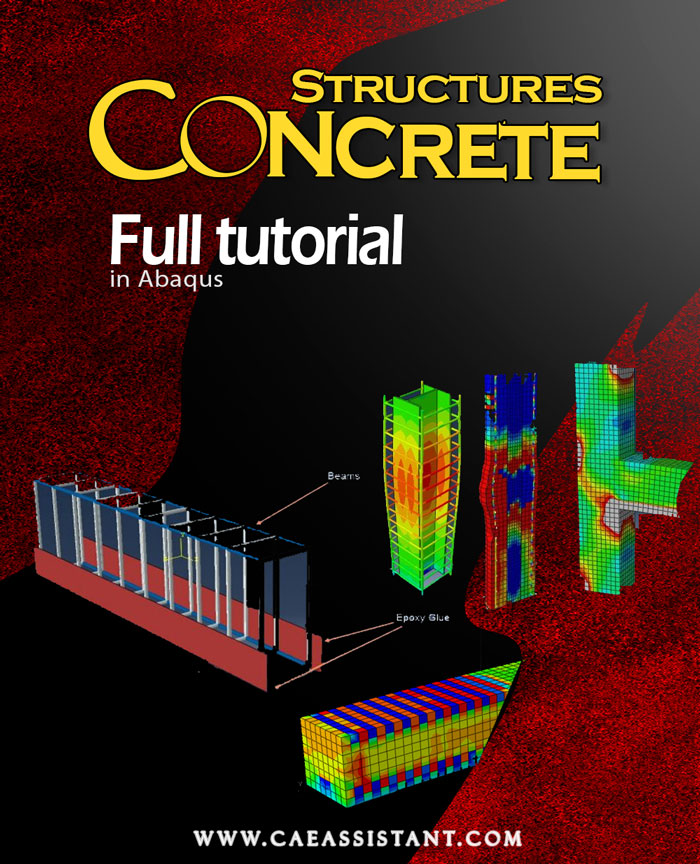
The package includes 19 workshops on topics such as concrete, beam-column structures, composites, steel rebars, Ultra-High-Performance-Fiber-Reinforcement Concrete columns, CFRP bars, hollow-core square reinforced concrete columns wrapped, damaged concrete beams, High Strength Concrete(HSC),ECC/Concrete Composite Beam-Column Joints, circular concrete-encased concrete-filled steel tube (CFST) stub columns, and etc. Every tutorial includes all needed files and step-by-step English videos and is explained from A to Z. Package duration: +600 minutes

We also offer similar budget-friendly packages that include the workshops from this package.

Since these packages do not include the lessons and contain a limited number of workshops, they are available at a lower price (250 euros each).

However, we recommend choosing the current full package instead of purchasing parts 1 to 4 separately, as it includes all 20 workshops and exclusive lessons not available on similar platforms, while still being priced lower than competing offerings.