
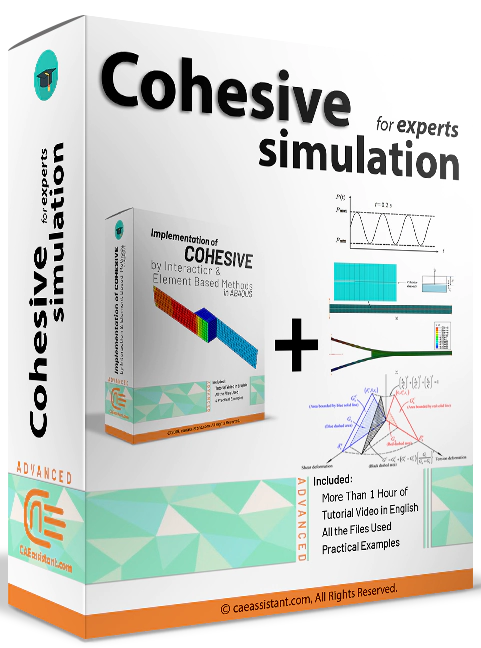
Cohesive simulation for experts

This educational package is used for experts in cohesive field simulation. This package includes simulation of elastic and damage area by Abaqus capabilities, Using UMAT subroutine for elastic and damage region and simulation of cohesive fatigue with USDFLD subroutine
What You'll Learn
  • tes1
  • tes2
  • tes3
  • tes4
  • tes5
  • tes6

Buy Together & Save

15%

Price range: € 2000.0 through € 4000.0

+

Original price was: € 580.0.Current price is: € 464.0.

 2464.0  2094.4

You Save 

15%

This Course Includes

Course Content

Cohesive simulation for experts
Lesson Test1
12h 45min

Product Informations

Cohesive simulation for experts

This educational package is used for experts in cohesive field simulation. This package includes simulation of elastic and damage area by Abaqus capabilities, Using UMAT subroutine for elastic and damage region and simulation of cohesive fatigue with USDFLD subroutine. In the following, there are more explanations regarding the package headings.
1- Cohesive simulation in elastic and damage region using Abaqus capabilities
This chapter is actually “Implementation of Cohesive by interaction & element based methods in ABAQUS” package and can be purchased separately. A full description of this chapter is available at this link.
2- Simulation of the elastic and damage region by UMAT subroutine
Sometimes, it is necessary to make minor changes in the parameters of the elastic or cohesive damage so that we can implement other models provided for cohesive in the software. For this, first, it is necessary to implement the main software model by the subroutine. In this chapter, first, the elastic and damage theory of cohesive material is explained. Then, the flowchart of the UMAT subroutine is described part by part, and the subroutine is written line by line with the complete explanation. Finally, the written subroutine is implemented on a simple joint and verified with the results of the Abaqus software in elastic and damaged areas.
3- Cohesive fatigue simulation
Due to the fact that cohesive is used in various joints, it fails along with other parts under fatigue loading. Since the fatigue of cohesive is not presented as an option in the Abaqus software, it is necessary to write a subroutine to implement this behavior. In this chapter, fatigue based on Khoramishad’s model has been implemented in the USDFLD subroutine and used on a single joint connection. In this part of the package, firstly, the theory of cohesive fatigue based on the article is explained completely along with all related equations. Then, the flowchart of the subroutine is  organized. Finally, the subroutine is written line-by-line and implemented on the model.

[woodmart_list icon_library=”openiconic” woodmart_css_id=”633aaaa948d99″ list=”%5B%7B%22list-content%22%3A%22Where%20can%20we%20use%20cohesive%20behavior%3F%5CnDifferent%20methods%20to%20simulate%20cohesive%20behavior.%5CnLimitations%20to%20simulate%20cohesive%20behavior%20in%20different%20methods%5CnTraction-separation%20formula%20for%20cohesive%20behavior%5CnDamage%20initiation%20criteria%20for%20cohesive%20in%20traction-separation%20law%5CnCriteria%20of%20progressive%20damage%20behavior%20in%20cohesive%20materials%5CnUsage%20Limitation%20of%20element-based%20cohesive%20modeling%5CnElement%20based%20method%20for%20cohesive%20material%20in%20continuum%20element%5CnElement%20based%20method%20for%20cohesive%20material%20in%20traction-separation%20law%5CnSettings%20for%20initial%20thickness%20of%20cohesive%20with%20traction-separation%20law%5CnDifferent%20types%20of%20cohesive%20elements%5CnOutputs%20for%20cohesive%20element%5CnViscous%20regulation%20for%20cohesive%20element%5CnUsage%20limitation%20of%20surface-based%20method%20for%20cohesive%20modeling%5CnElement-based%20method%20vs%20surface-based%20method%22%7D%2C%7B%22list-content%22%3A%22Workshop%201%3A%20Simulation%20Single%20Lap%20joint%20under%20tension%5CnProblem%20description%5CnHow%20to%20define%20traction-separation%20elastic%20behavior%20for%20cohesive%20elements%5CnWhat%20is%20the%20procedure%20to%20model%20cohesive%20via%20element%20based%20method%5CnHow%20to%20define%20damage%20initiation%20based%20on%20QUADS%20damage%5CnHow%20to%20apply%20initial%20thickness%20settings%5CnHow%20to%20assemble%20cohesive%20parts%20and%20other%20parts%5CnHow%20to%20define%20outputs%20for%20cohesive%20elements%5CnSettings%20in%20different%20module%20for%20cohesive%20behavior%20definition%5CnCohesive%20element%20settings%20in%20mesh%20module%5CnHow%20to%20see%20the%20result%20of%20damage%20initiation%20for%20cohesive%20materials%5CnPlot%20damage%20initiation%20criterion%20vs%20time%20for%20critical%20element%5CnPlot%20damage%20parameter%20vs%20time%20for%20critical%20element%5CnPlot%20stress%20vs%20strain%20for%20critical%20element%22%7D%2C%7B%22list-content%22%3A%22Workshop%202%3A%20Simulation%20of%20masonry%20wall%20in%20Abaqus%5CnProblem%20Description%5CnSettings%20to%20solve%20convergence%20problem%20in%20implicit%20solver%5CnSettings%20to%20remove%20element%20in%20visualization%20module%5CnSuitable%20method%20to%20simulate%20cohesive%20behavior%20between%20bricks%20and%20masonry%20wall%5CnSuitable%20method%20to%20simulate%20cohesive%20behavior%20between%20bricks%20and%20masonry%20wall%5CnHow%20to%20define%20Concrete%20damage%20plasticity%20behavior(CDP)%5CnUsing%20mass%20scale%20to%20increase%20simulation%20speed%5CnOutput%20settings%20for%20cohesive%20surface%20behavior%5CnSettings%20to%20define%20cohesive%20behavior%20via%20surface-based%20method%20in%20explicit%20solver%5CnHow%20to%20apply%20pressure%20when%20equivalent%20force%20in%20known%22%7D%2C%7B%22list-content%22%3A%22Workshop%203%3A%20Debonding%20behavior%20of%20a%20double%20cantilever%20beam%5CnProblem%20description%5CnSettings%20to%20define%20cohesive%20behavior%20via%20surface-based%20method%20in%20implicit%20solver%5CnPlot%20force%20vs%20displacement%20in%20debonding%20of%20DCB(double%20cantilever%20beam)%5CnHow%20to%20model%20damage%20initiation%20and%20progressive%20damage%20for%20cohesive%20in%20surface-based%20method%22%7D%5D” icon_openiconic=”vc-oi vc-oi-play” icons_color=”eyJwYXJhbV90eXBlIjoid29vZG1hcnRfY29sb3JwaWNrZXIiLCJjc3NfYXJncyI6eyJjb2xvciI6WyIgLmxpc3QtaWNvbiJdfSwic2VsZWN0b3JfaWQiOiI2MzNhYWFhOTQ4ZDk5IiwiZGF0YSI6eyJkZXNrdG9wIjoiI2Y1ODYzNCJ9fQ==”]
[woodmart_list icon_library=”openiconic” woodmart_css_id=”633aac089a0e5″ list=”%5B%7B%22list-content%22%3A%22Providing%20equation%20of%20elastic%20behavior%20of%20adhesive%20materials%5Cn%22%7D%2C%7B%22list-content%22%3A%22Providing%20the%20damage%20initiation%20and%20progressive%20damage%20equations%20of%20adhesive%20materials%20based%20on%20energy%20criteria%5Cn%22%7D%2C%7B%22list-content%22%3A%22Subroutine%20explanation%20line%20by%20line%5Cn%22%7D%2C%7B%22list-content%22%3A%22subroutine%20Implementation%20in%20simple%20joint%5Cn%22%7D%2C%7B%22list-content%22%3A%22Validation%20of%20the%20results%20by%20comparison%20with%20Abaqus%20simulation%5Cn%22%7D%5D” icon_openiconic=”vc-oi vc-oi-play” icons_color=”eyJwYXJhbV90eXBlIjoid29vZG1hcnRfY29sb3JwaWNrZXIiLCJjc3NfYXJncyI6eyJjb2xvciI6WyIgLmxpc3QtaWNvbiJdfSwic2VsZWN0b3JfaWQiOiI2MzNhYWMwODlhMGU1IiwiZGF0YSI6eyJkZXNrdG9wIjoiI2Y1ODYzNCJ9fQ==”]
[woodmart_list icon_library=”openiconic” woodmart_css_id=”633aac698377a” list=”%5B%7B%22list-content%22%3A%22How%20to%20write%20a%20subroutine%20for%20the%20evolution%20of%20the%20damage%20and%20the%20cohesive%20damage%3F%5Cn%22%7D%2C%7B%22list-content%22%3A%22How%20to%20create%20fatigue%20cycles%20in%20each%20step%3F%5Cn%22%7D%2C%7B%22list-content%22%3A%22How%20to%20omit%20damaged%20cohesive%20element%20in%20a%20single%20lap%20joint%3F%5Cn%22%7D%5D” icon_openiconic=”vc-oi vc-oi-play” icons_color=”eyJwYXJhbV90eXBlIjoid29vZG1hcnRfY29sb3JwaWNrZXIiLCJjc3NfYXJncyI6eyJjb2xvciI6WyIgLmxpc3QtaWNvbiJdfSwic2VsZWN0b3JfaWQiOiI2MzNhYWM2OTgzNzdhIiwiZGF0YSI6eyJkZXNrdG9wIjoiI2Y1ODYzNCJ9fQ==”]
  • item1
  • item2
  • item3
?Test Question1?
?Test Question1?

3 reviews for Cohesive simulation for experts

  1. Avatar of mei

    mei

    That was great! Any suggestions for more practice?

  2. Avatar of maria-8273

    maria-8273

    It seems to be a good package but isn’t that a little expensive for just one workshop?

  3. Avatar of rauf

    rauf

    The course was well-defined, and each section was explained in a way that helped the user comprehend the concept. thanks.

Add a review

Teaching Plan

Additive manufacturing simulation with Abaqus AM modeler plugin
Abaqus 3D Printing Simulation Course
Inherent strain method in Metal Additive Manufacturing simulation
Cohesive simulation for experts

Instructors

Stanzin Norboo

Price range: € 2000.0 through € 4000.0

Get Free Access to More Than the Demo!