
Steel structure analysis is the process of evaluating how steel frameworks respond to loads like gravity, wind, or seismic forces. It helps engineers assess whether a structure can safely carry these loads over its lifespan.
There are two main methods: the analytical approach, used for simpler structures and quick estimates, and finite element analysis (FEA), which is more detailed and handles complex, nonlinear behavior. Abaqus is a powerful tool for FEA, dividing steel structures into small, manageable elements for precise simulation (Abaqus steel modeling).
This blog walks through key topics, including the fundamentals of steel structure models and the importance of beam analysis (to prevent issues like buckling or shear failure). It compares analytical methods with Abaqus-driven FEA, and presents theory alongside hands-on workshops—covering plasticity, damage mechanics, cyclic loading, and composite joints. By reading, you’ll learn both core principles and practical application, all aimed at helping you design safe and efficient steel structures.

Steel Structure Analysis
Steel structures are widely used in building construction, so knowing how they behave is an important topic in many fields. To help you understand better, we’ve shared a simple overview below. You can use it to build on what you already know and make any corrections if needed.
What is Steel Structure Analysis?
Structure analysis involves evaluating the integrity and performance of steel frameworks under applied loads, such as gravity, wind, and seismic forces. This process plays a vital role in determining if a structure will withstand its expected loads throughout its lifecycle.
By using certain methods, and tools, engineers simulate various conditions to ensure the safety and functionality of steel structures.
Why is Steel Beam Analysis Critical?
Steel structures often use beams, along with other elements like columns and plates, as a basis for a structure. Beam analysis focuses on evaluating the behavior of beams, which often bear significant portions of vertical and horizontal loads in a structure. Accurate analysis prevents failures and optimizes resource usage. By examining factors like bending moments, shear forces, and deflections, engineers make informed decisions, upgrading the overall structural performance.
Failing to properly analyze these structures will result in the following:
- Bulking
- Overloading
- Yielding
- Shear Failure
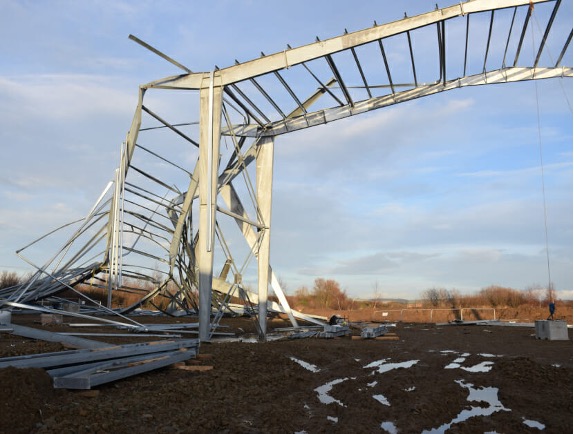
Figure 1: collapse of a steel frame [Ref]
Understanding the Steel Structure Model
A structure model is a digital or physical representation of a framework, providing insights into its behavior under various conditions. These models serve as test simulations, offering a view of the design.
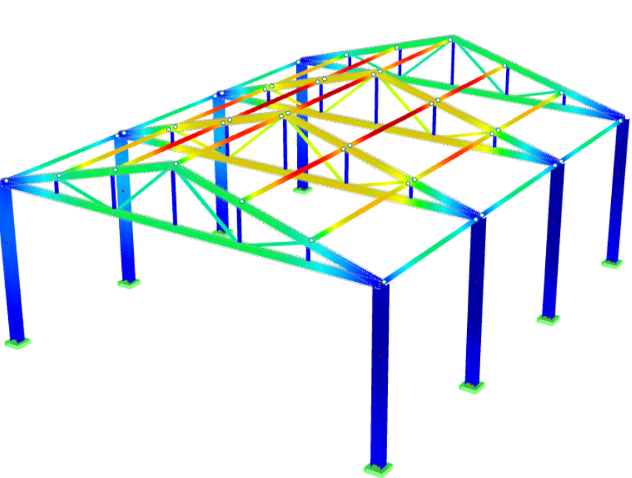
Figure 2: Steel structure models [Ref]
Techniques for Steel Structure Analysis
Steel structures can be analyzed using two primary approaches, each suited for different types of problems and applications:
The classical (Analytical) approach relies on mathematical formulations to solve the problems. It is best suited for simple structures with simple geometry and loading conditions, such as beams, columns, and trusses. However, due to its limitations analytical methods are often used for preliminary design, quick estimations, and educational purposes to understand the behavior of basic structures.
The finite element (FEM) method divides a structure into smaller, simpler elements, enabling the analysis of complex and nonlinear problems that are difficult or impossible to solve analytically. This numerical approach is widely used in the industry for designing and evaluating steel frames, connections, and structures subjected to irregular loading, material nonlinearity, and large deformations. It also plays a key role in advanced scientific research and simulations, allowing detailed insights into structural performance under diverse conditions.
You can learn the FEM method in practice! Explore +12 practical examples featuring diverse loading scenarios, including cyclic, dynamic, vertical, and horizontal loads. Master advanced analyses such as failure simulation, damage modeling, axial capacity evaluation, and earthquake effects. From bolted connections to composite joints and reinforced beams.
Analyzing Elements in Steel Structures
The analysis of individual elements such as beams, columns, and joints are fundamental in understanding the structural response. Engineers rely on the principles of solid mechanics to calculate these properties with high precision, making the reliability of their projections.
In static mechanics, analyzing elements in steel structures (particularly beams) involves evaluating several factors to ensure stability, safety, and efficiency. Here are the key factors examined:
- Moment of Inertia
- Material Properties
- Elastic & Plastic Behavior
- Dynamic Loading and Fatigue
- Deflection Limits
Additionally, engineers must account for other factors below to make structural stability.
- Load Types
- Buckling and Stability
- Connections and Joints
- Stress Concentration Points
In some situations, the temperature can make the properties change their behavior so the environment is essential to consider.
Analytical Approach (Hand Calculation): An Example
Engineers employ both analytical techniques or hand calculations and Finite Element Method (FEM) simulations to evaluate steel structural analysis, especially for joint simulations.
Hand calculations are used for preliminary design and verification. These involve classical mechanics principles, analytical formulations, and simplified assumptions. For joint analysis, key steps include:
Based on Newton’s laws which discuss force and moment equilibrium, summation of these forces and moments is used to determine the desired answer.
ΣF=0 / ΣM=0
Example: Consider the following beam in a structure which simplified to the following mathematical model. Because we have simplified part of our problem, we can determine its deflection.
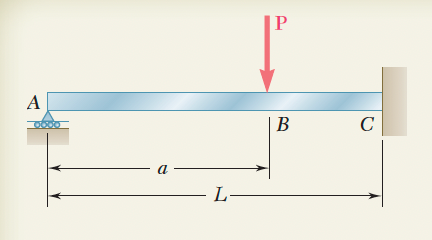
Figure 3: Cantilever beam
For the given vertical load P the reactions are as shown (figure 4). We note that they are statically indeterminate. Using a step function to represent the contribution of P to the shear, we write:
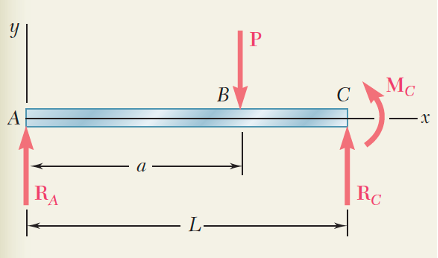
Figure 4: Reaction forces and moments

Integrating twice with respect to x:

Then following the boundary conditions and evaluation at the point a given deflection point to be at the middle of the beam we can determine the following as the deflection amount:
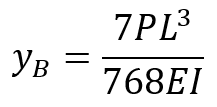
For a steel 3-meter-long beam, with the E = 200 GPa, and section inertia along the respective axis 1.14 E +6, we will expect the deflection to be 1.80E-06 meters.
Based on the other mathematical formulation that is proven in the mechanics of materials we can drive the shear force, bearing stress, bending moments, bolt group in steel structure analysis, and deflection of such frames using strain energy.
FEM & FEA | Abaqus Steel Example
FEM, particularly through software like Abaqus, provides high accuracy in predicting stresses and deformation patterns.
Here is the information and steps we need to simulate steel structure using Abaqus with the same example mentioned in the analytical approach.
Modeling
The first step for Abaqus steel simulation is to making a model is to make a 3D design using Abaqus or Solidworks or any other CAD designer to have our model geometry generated. Also, we would need the properties of our model such as Young’s module, etc.
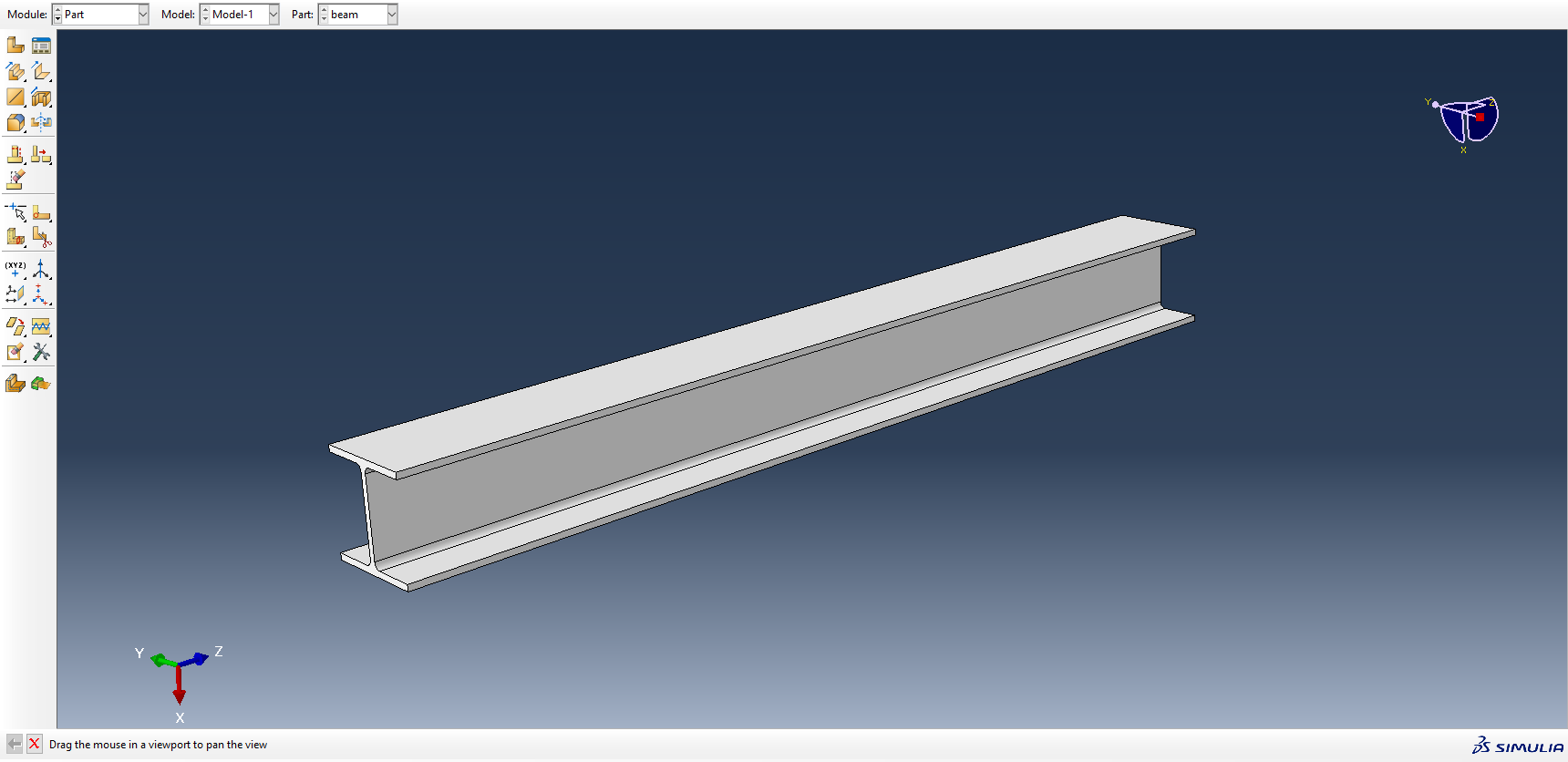
Figure 5: Creating part
Meshing
Secondly, we apply a mesh to define the part of the model in CAE software (in this case Abaqus) to define it.
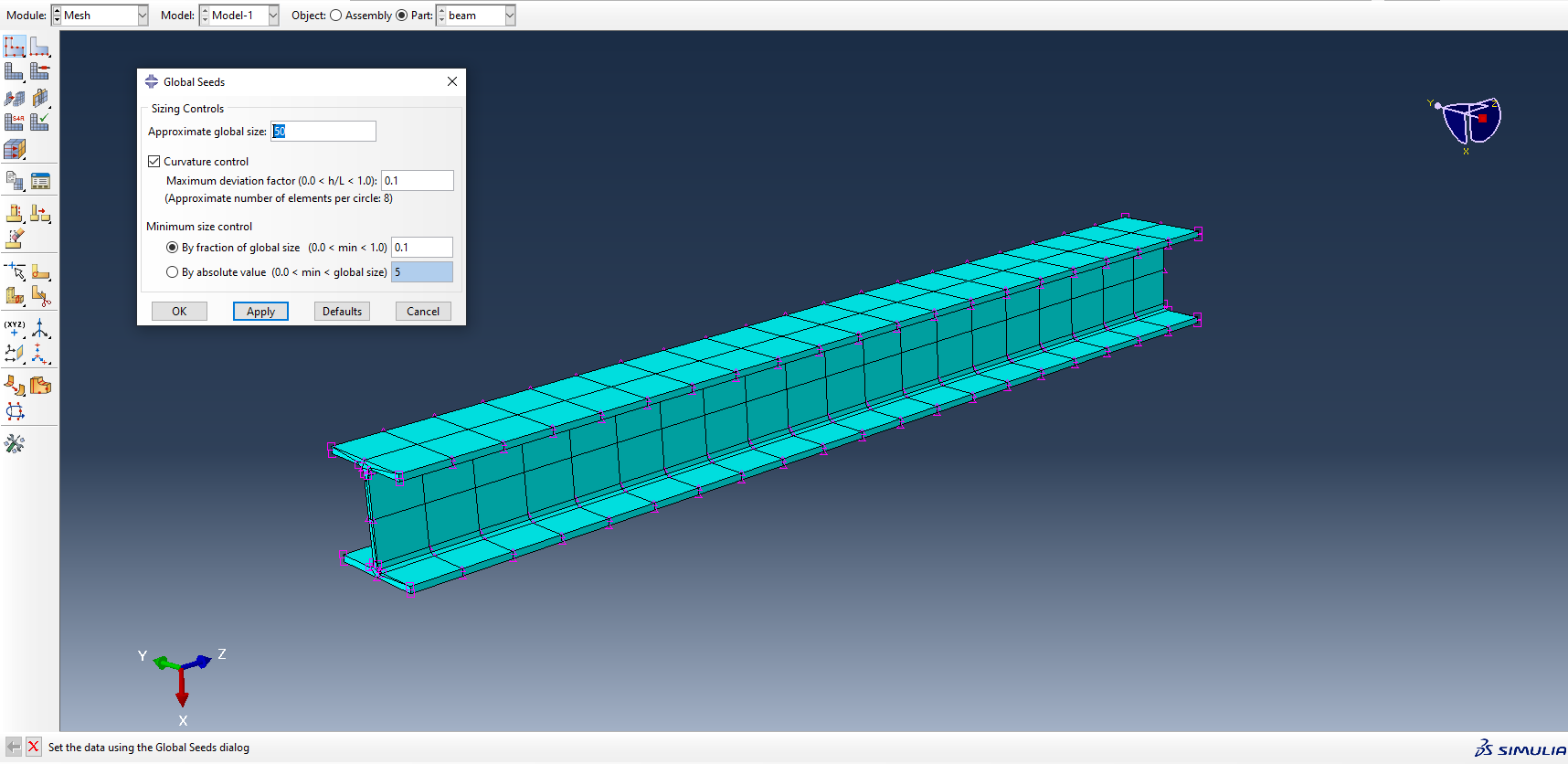
Figure 6: Meshing part in Abaqus
Boundary Conditions
Fixed or pinned constraints are applied to simulate the joint conditions that will be defined in this step. Also, loading conditions include point loads, distributed loads, or moment applications.
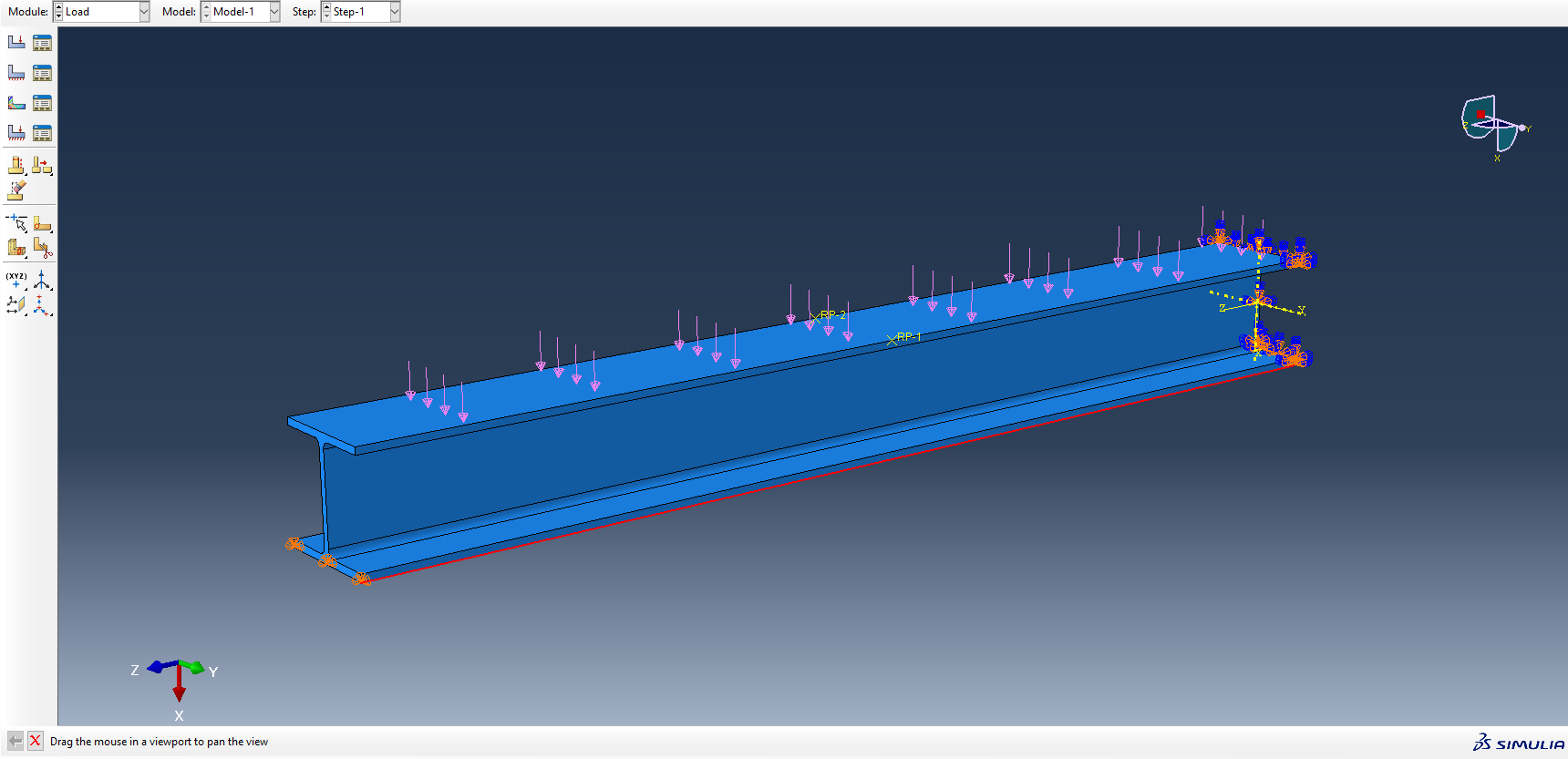
Figure 7: Boundary conditions in Abaqus
Solvers (Abaqus Step)
Next, we must select a proper solver (Abaqus Step for example, “Static, General” step) for our simulation; after that, we should determine the outputs we need. Then create a job then run the simulation.
Outputs
And finally, by defining the Job, we can see the desired output. For example, stress analysis, deflection of certain point, contact pressure, etc. will be calculated.
According to the figure 8 we can see the deflection is 1.81 E -6 meters with the minor error of 1%.
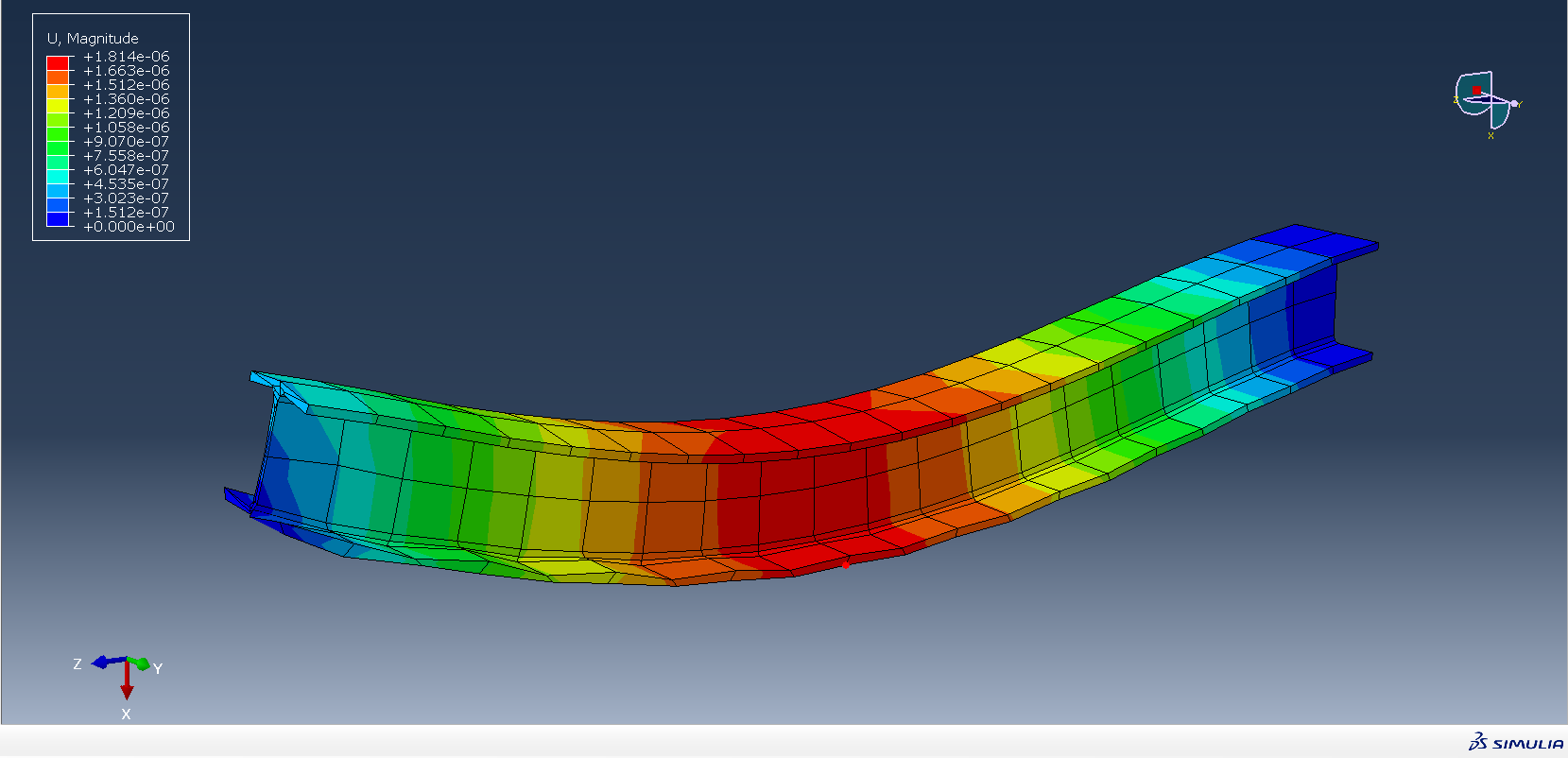
Figure 8: beam results
| Data comparison | Result |
|---|---|
| Analytical | 1.80E-06 |
| Abaqus (CAE) | 1.81E-06 |
Figure 9: FEM VS Analytical results
You can learn more advanced and practical examples in our Abaqus steel structure analysis tutorial. it contains more than 200 minutes tutorial containing many types of structures and loadings.
Abaqus FEM vs. Analytical
As you can see FEM is faster and uses software simulation that is user-friendly like Abaqus, and stands out in analyzing steel structures due to its efficiency and accuracy. This speed not only accelerates project timelines but also improves data reliability by minimizing human error.
- Accuracy & Speed
- Complexity
- Validation
Tools and Software for Steel Structure Analysis
As we discussed above the CAD model is needed using their certain software and using Abaqus software which is primarily used for CAE we can demonstrate the response of strain and stress derived by the force input to the structures.
Key Applications of Steel Structures
Steel structures find applications across a wide range of industries, including construction, transportation, and energy. Skyscrapers, bridges, and industrial plants rely heavily on steel due to its strength-to-weight ratio, adaptability, and durability.

Figure 10: Steel structure [Ref]
Designing Efficient Steel Structures
Steel structures form the backbone of modern construction, offering durability, strength, and versatility. Designing these structures efficiently requires a deep understanding of solid mechanics, advanced material modeling, and practical insights gained from simulation and analysis. This tutorial package is tailored to provide comprehensive knowledge and hands-on experience using Abaqus for the finite element analysis (FEA) of steel beams, columns, and connections under various loading conditions.
Solid Mechanics and Structural Design
Solid mechanics is fundamental to the design and analysis of steel structures. It enables engineers to predict how structures respond to forces, displacements, and environmental conditions. In this tutorial, key concepts such as plasticity, hardening models, and damage mechanics are explored in depth to optimize the performance of steel structures.
Topics Covered:
- Plasticity Hardening in Abaqus
- Understanding isotropic and kinematic hardening models.
- Application of combined hardening in cyclic loading conditions.
- Subroutines for Custom Simulations
- Writing VUMAT subroutine for kinematic hardening plasticity.
- Implementing the UHARD subroutine for isotropic hardening.
- Damage Modeling
- Introduction to the Lemaitre damage model.
- Writing and implementing Lemaitre subroutines for failure analysis.
These fundamental theories are reinforced through practical workshops that include:
- Cyclic loading simulation in steel beam-column structures.
- Dynamic and failure analysis of bolted connections.
- Finite element modeling of steel-concrete composite columns.
By mastering these concepts, engineers can design structures that are not only efficient but also resilient under complex loading scenarios.
Practical Insights for Structural Steel Design
Practical knowledge is vital when transitioning from theoretical design to real-world application. This tutorial package incorporates workshops to bridge this gap by focusing on real-world challenges and providing simulation-driven solutions.
Key Workshops:
- Cyclic Loading and Hysteresis Analysis
- Simulation of steel beam-columns reinforced with CFRP.
- Generation of hysteresis diagrams for honeycomb steel beams.
- Flexural and Shear Failure Analysis
- Flexural behavior simulation of CFRP-reinforced steel beams.
- Shear failure analysis of bolted connections under dynamic loading.
- Dynamic and Failure Analysis
- Bolt failure simulation in steel joints.
- Failure analysis of double-angle connections under dynamic loading.
- Composite and Stiffened Structures
- Finite element simulation of steel-concrete composite joints.
- Damage analysis of steel columns with stiffeners under cyclic loading.
- Axial Capacity and Earthquake Effects
- Simulation to determine the axial capacity of concrete-filled double-skin tube columns.
- Earthquake effect analysis on braced frames using kinematic hardening models.
These workshops emphasize the importance of simulation tools like Abaqus in solving practical problems, optimizing designs, and validating structural performance. With real-world case studies and hands-on exercises, participants gain insights into:
- Optimizing material usage while maintaining structural integrity.
- Understanding failure mechanisms to improve connection designs.
-
Enhancing earthquake resilience in steel structures.
Learn Steel Structure Analysis with Abaqus. Explore +12 practical examples featuring diverse loading scenarios, including cyclic, dynamic, vertical, and horizontal loads. Master advanced analyses such as failure simulation, damage modeling, axial capacity evaluation, and earthquake effects. From bolted connections to composite joints and reinforced beams, this package equips you with the tools and knowledge to tackle any structural challenge with precision.
Conclusion
This article discussed steel structure analysis, focusing on how steel frameworks behave under various forces like gravity, wind, and seismic loads. Understanding these behaviors is crucial for ensuring the safety, efficiency, and durability of steel structures in modern construction.
Steel structure analysis is important as it helps engineers design reliable and optimized structures while preventing issues such as buckling, overloading, and failure. The article covered key methods, including analytical techniques for simple structures and finite element analysis (FEA) for complex cases, highlighting the advantages of tools like Abaqus for accurate simulations (Abaqus steel simulation).
The article was structured around key topics. Steel Structure Analysis introduced fundamental concepts like load behavior, material properties, and modeling approaches. Techniques for Steel Structure Analysis explored analytical methods for initial calculations and FEA for advanced simulations. Designing Efficient Steel Structures combined theoretical knowledge with practical workshops, such as cyclic loading, failure analysis, and composite structure simulations, offering insights into real-world applications.
In conclusion, this article provided an in-depth understanding of steel structure analysis and its methods. By exploring key principles, tools, and practical applications, readers can better analyze, design, and optimize steel structures to ensure safety and performance in diverse conditions.











 English
  Korean
  Chinese