
Isotropic materials are those whose mechanical and physical properties are the same in all directions.
What is an Isotropic Material?
An isotropic material is one that has uniform properties in all directions. Whether stress, strain, heat, or electricity is applied in the x, y, or z direction, the material responds the same way. This simplifies both theoretical modeling and computational analysis.
On the other hand, anisotropic materials have different properties depending on the direction, homogeneous materials have uniform composition and properties throughout, and heterogeneous materials have varying composition or properties in different locations. See figure 1 to better understand.
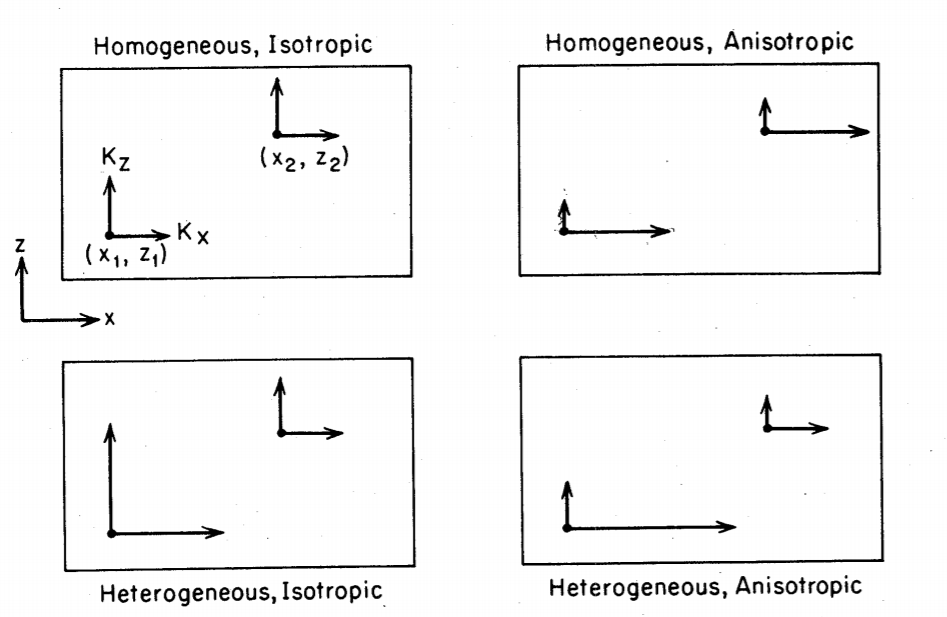
Figure 1: Four possible combinations of heterogeneity and anisotropy
Example: Most metals (like steel or aluminum), glass, and some plastics exhibit isotropic behavior when their internal structures are uniform and free of defects.
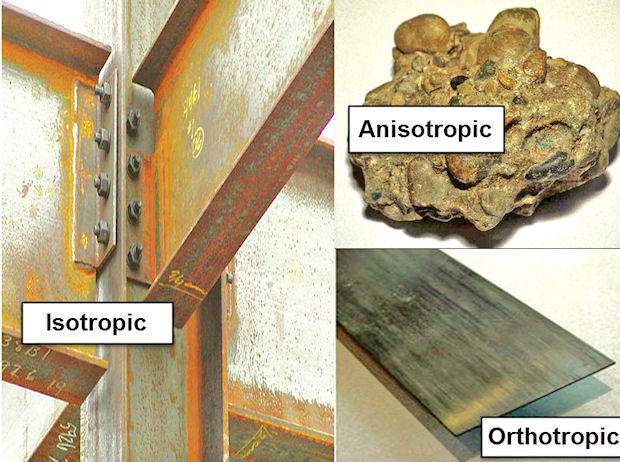
Figure 2: Material types
Define Isotropic Material properties (in technical terms)
In solid mechanics, a material is isotropic if:
- Its elastic constants (like Young’s modulus, shear modulus, and Poisson’s ratio) are the same in all directions.
The primary attribute of isotropic materials is their uniform response to mechanical stress. The essential properties encompass:
Elastic Modulus (Young’s Modulus): This measures the correlation between tensile or compressive stress σ (force per unit area) and axial strain ε (proportional deformation) within the linear elastic range of a material.
Poisson’s Ratio: This indicates the ratio of transverse strain to axial strain. According to the principles of isotropic linear elasticity, Poisson’s ratio may range from 0.2 to 0.35 for an object that has free surfaces and is devoid of external constraints.
Thermal Conductivity: In isotropic materials, thermal conductivity is ideally uniform in all directions. Nevertheless, in reality, minor discrepancies may arise due to elements such as grain structure or manufacturing methods, particularly in metals.
Yield Strength and Ultimate Strength: These properties, ascertained through stress-strain analysis, are vital for structural design.
For instance, an annealed AISI 304 stainless steel exhibits isotropic characteristics and possesses the following properties:
- Elastic Modulus (Young’s): 200 GPa
- Poisson’s Ratio: 0.28
- Yield Strength: 230 MPa
- Ultimate Tensile Strength (UTS): 580 MPa
- Shear Modulus: 77 GPa
- Shear Strength: 400 MPa
- Fatigue Strength: 210 MPa
- Brinell Hardness: 170
- Rockwell B Hardness: 79
- Elongation at Break: 43%
- Reduction in Area: 53%
It obeys Hooke’s Law with only two independent parameters instead of a full stiffness matrix.
Hooke’s law for isotropic materials in stiffness form is given by:
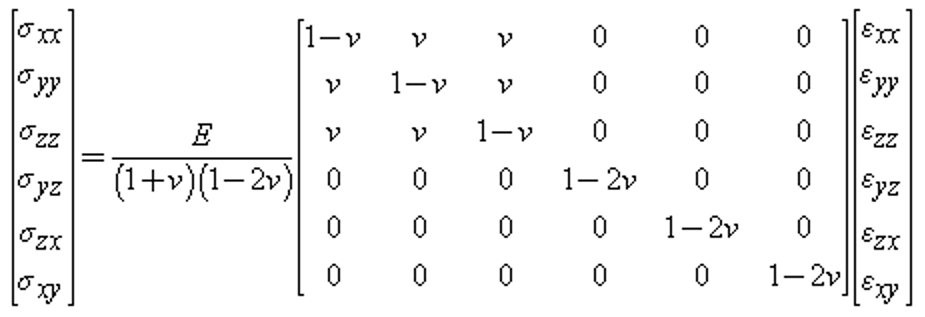
In FEA, this assumption allows for more efficient simulation models because directional properties don’t have to be defined separately.
Difference Between Isotropic and Anisotropic Materials
The table below shows you the difference between isotropic and anisotropic materials in one glance:
| Property | Isotropic Material | Anisotropic Material |
|---|---|---|
| Mechanical behavior | Same in all directions | Varies with direction |
| Elastic constants | 2 independent constants | 21 independent constants (in full 3D elasticity) |
| Examples | Steel, glass, rubber (homogeneous) | Wood, composites, carbon fiber, bone |
| Modeling complexity | Simpler (ideal for FEA) | More complex, needs directional property definition |
Anisotropic materials are essential in high-performance applications—like aerospace or prosthetics—where directionality improves strength or flexibility.
Isotropic Materials in FEA (Finite Element Analysis)
Isotropic materials in Finite Element Analysis (FEA) are substances characterized by mechanical and thermal properties that remain constant regardless of the direction in which they are tested. This consistency sets them apart from anisotropic materials, which display properties that vary with direction.
Typical examples of isotropic materials encompass specific metals (when in their annealed condition), unfilled plastics, and glass. These materials are frequently utilized in engineering applications where loads may be applied from various directions, necessitating a uniform response from the material, such as when subjected to both tensile and compressive forces.
Isotropic assumptions are widely used in FEA because:
- They reduce the input data required.
- They match the behavior of many commonly used engineering materials.
- They ensure simulation results are easier to interpret and validate.
But in cases involving composites or fiber-reinforced materials, engineers must switch to orthotropic or anisotropic definitions to reflect true material behavior.
FEA is a computational technique employed to model the behavior of materials under various loading scenarios. The precision of FEA simulations is significantly influenced by the accurate specification of material properties, boundary conditions, and applied loads prior to meshing. Isotropic materials are crucial in FEA for several reasons:
Predictable and Consistent Behavior: Due to their properties being uniform in all directions, isotropic materials streamline the modeling process and minimize the likelihood of errors stemming from directional variability.
Widely Available Material Data: Numerous engineering materials, including steel and aluminum, are isotropic, and their stress-strain relationships are extensively documented, rendering them suitable for FEA simulations.
Simplified Computations: In contrast to anisotropic materials, which necessitate intricate directional property definitions, isotropic materials can be represented with fewer parameters, thereby decreasing computational demands and processing duration.
Reliable Stress-Strain Analysis: The assumption of linear elasticity is applicable to most isotropic materials in structural simulations, enabling engineers to accurately forecast deformations, stresses, and potential failure points.
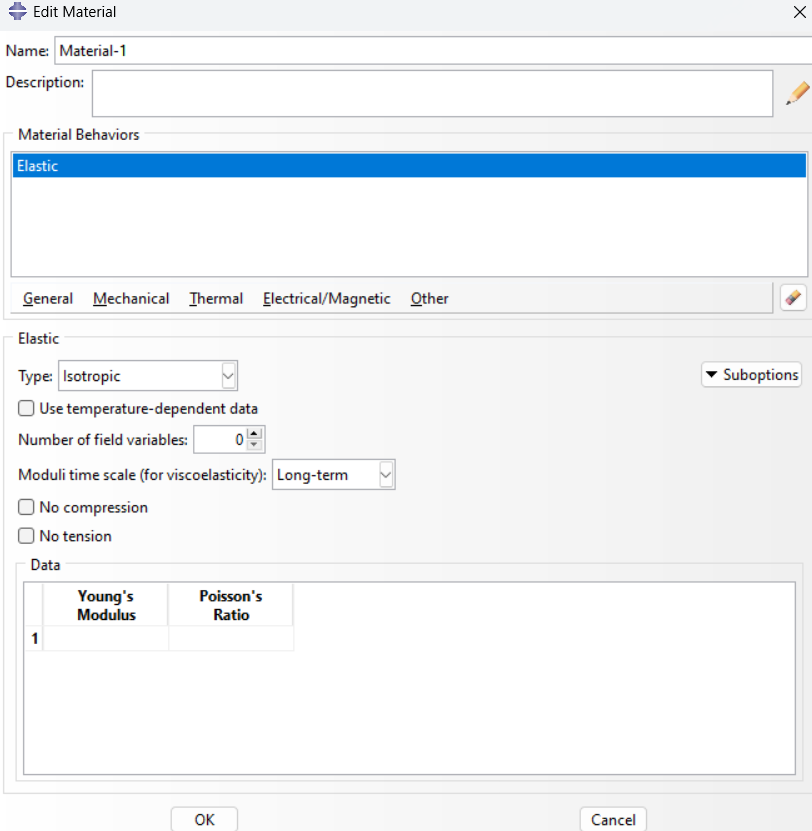
Figure 4: Define linear material in Abaqus
Common Uses of Isotropic Materials in Finite Element Analysis
Isotropic materials find extensive application across numerous engineering and industrial sectors owing to their consistent properties. Some prevalent applications are:
Structural Engineering: Materials such as steel, glass, and aluminum are utilized in the design of buildings and bridges to guarantee reliable load-bearing capabilities.
Aerospace and Automotive: Metals, including titanium and aluminum alloys, are employed to enhance weight efficiency and strength in components of aircraft and vehicles.
Manufacturing and Product Design: Unfilled plastics and glass are incorporated in consumer goods where uniform strength and thermal stability are essential.
Conclusion
Understanding whether a material is isotropic or anisotropic is crucial in both material selection and structural analysis. For everyday applications, isotropic models often suffice. But in advanced engineering, ignoring anisotropy can lead to inaccurate results or even failure.
If you’re using FEA, always validate whether your material behaves uniformly or needs more complex modeling.
Explore our comprehensive Abaqus tutorial page, featuring free PDF guides and detailed videos for all skill levels. Discover both free and premium packages, along with essential information to master Abaqus efficiently. Start your journey with our Abaqus tutorial now!
References:




 English
  Korean
  Chinese