
Multiscale Analysis of Hygrothermal Aging in Laminated Composites

 200.0

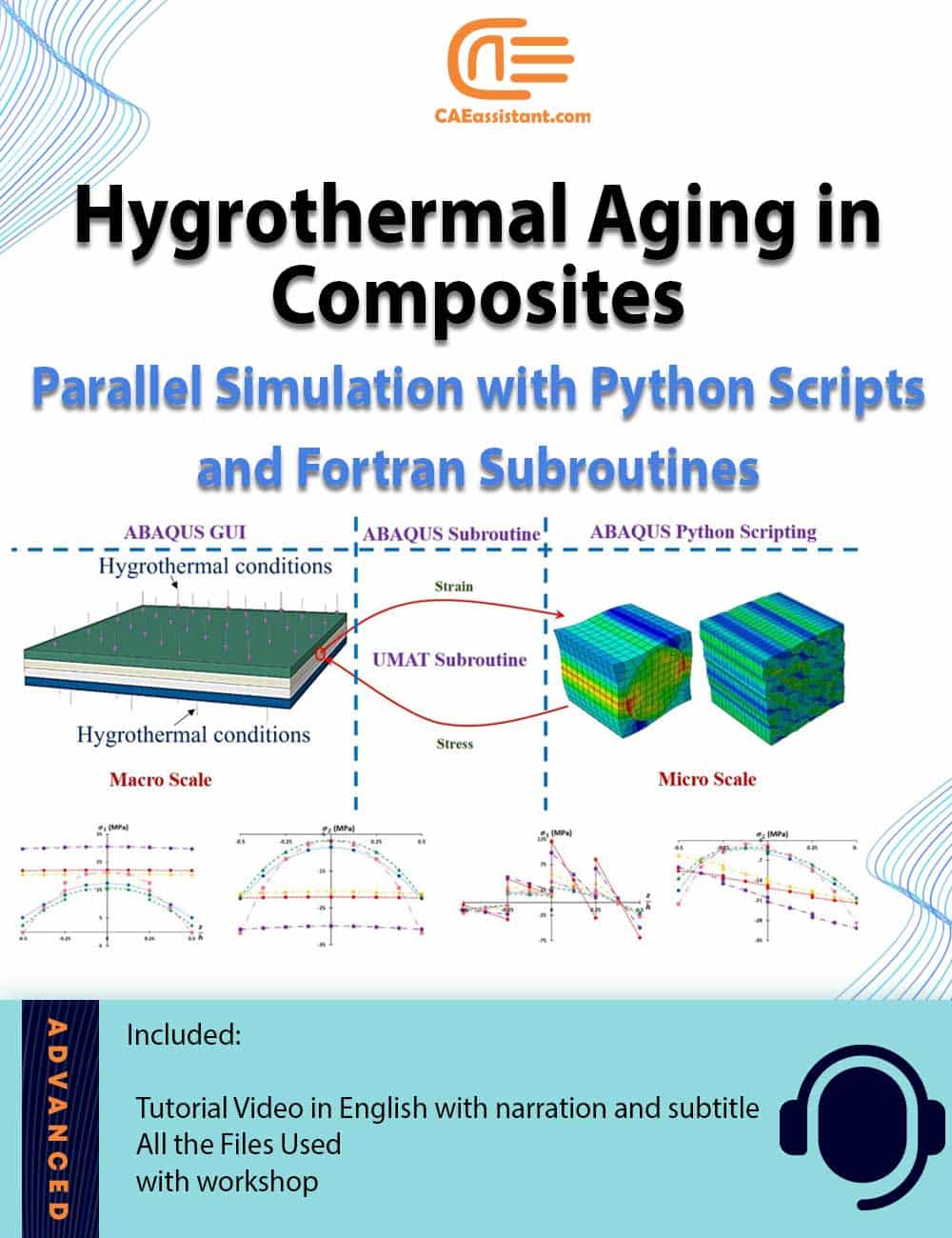
This package includes parallel and multi-scale aging analysis of fiber-reinforced composite laminates exposed to thermal and humidity loads. In this project, parallel analysis methods are used to simulate and analyze the composite at both micro and macro scales. The laminate simulations are carried out in the graphical interface of Abaqus at the macro scale, while the micro scale analysis is conducted through Python scripting in the non-graphical Abaqus environment. The parallel analysis between the two environments is facilitated using Abaqus UMAT subroutines. The stress tensor and elasticity properties obtained at the micro-scale are passed to the UMAT subroutine, which then defines and updates the Jacobian matrix and stress tensor for all macro-scale integration points.

Expert

Package Content

.for

,

.inp

,

.py

,

video file

Tutorial video duration

Ask from support

language

English

Level

Package Type

Software version

Applicable to all versions

Subtitle

English

Add-on

The option's price will be set post-order, requiring negotiation with support for confirmation.

The option's price will be set post-order, requiring negotiation with support for confirmation.
Product price:  200.0
Total options:
Order total:
37 People watching this product now!

Frequently Bought Together

hygrothermal aging​ + UMAT subroutine | Learn UMAT Abaqus | Umat Abaqus course + hygrothermal effects on composite materials
Price for all three: Original price was: € 700.0.Current price is: € 525.0. Save  175.0
Description

1. Introduction to Multiscale Hygrothermal Aging Analysis

The multi-scale analysis of composite materials, particularly fiber-reinforced composites, represents a paradigm shift in material engineering, offering a more cost-effective and time-efficient alternative to traditional laboratory testing. Unlike conventional empirical methods, analytical models of composites are based on simplified assumptions that fail to capture the full complexity of the material’s behavior. Laboratory investigations are not only resource-intensive but are also constrained by limited geometric and loading conditions, whereas numerical simulations overcome these limitations, providing a comprehensive understanding of material performance under real-world conditions.

As the field of composite materials continues to evolve, the ability to perform accurate multi-scale simulations becomes increasingly crucial. At the heart of this progress lies the need for precise modeling at both the micro and macro levels to fully understand the behavior of composites under various mechanical, thermal, and moisture-induced stresses. Numerical simulations at multiple scales allow engineers to predict the long-term behavior of composites, considering both material degradation and performance changes over time. This is particularly important when studying hygrothermal aging, a process that combines the effects of moisture absorption and temperature variations, leading to gradual changes in the material’s microstructure and mechanical integrity.

Furthermore, composites’ heterogeneous nature introduces additional challenges. The material’s properties can vary significantly across its structure due to non-uniform loading conditions, environmental influences, and microstructural variations. Therefore, multi-scale analysis becomes essential to capture the intricate interactions between different scales and to predict the performance of these materials under real-life conditions accurately. The integration of micro and macro scale models ensures that both localized material behavior and overall laminate response are accounted for, leading to more reliable predictions of hygrothermal aging effects and long-term durability.

2.  Incorporation of the parallel analysis thechniques for the multi-scale composite analysis

This project stands at the cutting edge of multi-scale composite analysis, incorporating parallel analysis techniques to bridge the gap between microscopic and macroscopic models. By utilizing both graphical and non-graphical Abaqus environments, this work allows for a comprehensive investigation of fiber-reinforced composite laminates subjected to aging under hygrothermal conditions. The combination of Python scripting for micro-scale modeling and Abaqus for macro-scale simulations ensures that the interactions between the two scales are captured with high accuracy, providing deeper insights into the material’s hygrothermal aging behavior.

2.1. Using Abaqus UMAT subroutine

The UMAT subroutine plays a crucial role in parallelizing the micro and macro environments. Essentially, it acts as a bridge between these two scales. This subroutine takes strain from the macro environment and passes it to the micro environment, then returns the stress obtained from the micro environment back to the macro environment. Within the UMAT subroutine, the stress tensor and stiffness matrix (Jacobian) are defined and updated for each integration point of the macro model.

The training package not only focuses on the practical implementation of these advanced simulation techniques but also emphasizes the theoretical foundations that underpin multi-scale analysis. By combining state-of-the-art numerical methods with a deep understanding of material science, this package equips engineers and researchers with the tools needed to design more durable, efficient, and cost-effective composite materials resistant to hygrothermal aging.

  • Introduction: Overview of multiscale composite analysis and objectives
  • Summary of Previous Package: Key results and methods from prior hygrothermal study
  • Multiscale-Parallel Finite Element Analysis: Parallel simulation setup, Python scripting, and implementation in ABAQUS
  • Hygrothermal Aging Analysis: Simulation and results of laminated composites under hygrothermal effects
  • Expected Outcomes: Ability to set up, run, and analyze a complete multiscale-parallel FEM simulation in Abaqus
  • Practical Exercises: Setting up boundary conditions, solving models, post-processing results
  • Key Focus: Troubleshooting common issues, preparing users for new problems
  • Interactive Exercises: Techniques for troubleshooting, Techniques for improving and enhancing to the new models

3. The topics covered in this package

The main topics covered in this package are as follows:

1. Review of the Previous Package on Hygrothermal Degradation of Fiber-Reinforced Composites
This chapter revisits the previous package titled “Hygrothermal Degradation in Fiber-Reinforced Composites – Abaqus Parallel Simulation with Python Scripts and Fortran Subroutines.”  Chapter 1 provides an overview of the previous software package. This chapter will cover several key areas, including an introduction to parallel simulation, necessary software and coding prerequisites, a detailed explanation of the simulation algorithm, and the potential results and conclusions that can be derived from it. The discussion naturally extends to the topic of hygrothermal aging, emphasizing how degradation mechanisms evolve over prolonged environmental exposure.

2. Parallel Analysis Training in ABAQUS, analysis and results
Chapter 2 focuses on the multiscale analysis of composite laminates subjected to hygrothermal conditions. This chapter introduces and explains the ABAQUS Python Scripting for Micro Modeling (APSMM) and ABAQUS Parallel Finite Element Analysis (APFEA) algorithms. These two algorithms are used, respectively, for micromechanical analysis of materials and for parallel (micro-macro) analysis where data is exchanged concurrently between the two scales as two ABAQUS environment.

As a case study, we will investigate a composite laminate under hygrothermal aging and loading, with the subsequent results presented. The simulation comprises three distinct environments:

1-the ABQUS Graphical User Interface (GUI) environment for modeling and analyzing the composite laminate at macro scale,

2- the ABAQUS scriptin noGUI environment for modeling and analyzing a Representative Volume Element (RVE) of the composite lamina, and

3- a subroutine environment that not only handles stress updates but also acts as the information intermediary responsible for transferring data between the macro and micro environments.

Workshop 1: Hands-On Simulation with Abaqus

Our first workshop will involve solving an example of a new laminated composite under specific hygrothermal loading. The session will comprehensively explain every stage of the simulation, from problem definition and boundary conditions to essential code alterations and the final post-processing of results.

Through this hands-on practice, participants will develop a clear understanding of how hygrothermal aging affects the material’s mechanical response across scales.

Workshop 2: Advanced Problem-Solving Techniques

Workshop two is dedicated to troubleshooting the package and providing expert guidance for future simulations. This session will thoroughly examine potential errors that may arise and explain the corresponding resolution techniques. We will also provide an overview of the necessary modifications that can be implemented to adapt the package for new problems, including simulations dealing with hygrothermal aging under various environmental cycles.

Shipping and Delivery

All the package includes Quality assurance of training packages. According to this guarantee, you will be given another package if you are not satisfied with the training, or your money is returned. Get more information in terms and conditions of the CAE Assistant.
All packages include lifelong support, 24/7 support, and updates will always be sent to you when the package is updated with a one-time purchase. Get more information in terms and conditions of the CAE Assistant.

Notice: If you have any question or problem you can contact us.
Ways to contact us: WhatsApp/Online Support/Support@CAEassistant.com/ contact form.
Projects: Need help with your project? You can get free consultation from us here.

  • Online payment: with MasterCard, VisaCard and etc.
  • Offline payment: In this payment method, you should pay via PayPal and send your payment receipt as an attached file in the offline payment form.
  • via download link After purchase, a download link will be sent to you a zip file included training videos, documents and software files.
  • Send us your machine ID

To access tutorial video run the .exe file on your personal pc and send the generated code to shop@caeassistat.com and wait for your personal code, which is usable only for that pc, up to 24 hours from CAE Assistant support.

Here you can see the purchase process of packages: Track Order

Features

Abaqus tutorial video
Lecture notes
Abaqus workshop files
Contains all required files
Certification
Works for all Abaqus versions
Safe payment
money-back guarantee
Free 24/7 online mentoring
Access for life
updated content
Time-Saving Short But Full
Premium Corporate and Academic Clients
Prepared by High-Level Researchers
Fortran Abaqus subroutines
All payment method
Teaching Plan

How to use ABAQUS Documentation (1)

None

None

0 reviews
0
0
0
0
0

There are no reviews yet.

Be the first to review “Multiscale Analysis of Hygrothermal Aging in Laminated Composites”