




Damage simulation of short fibre composites with subroutine
€ 340.0
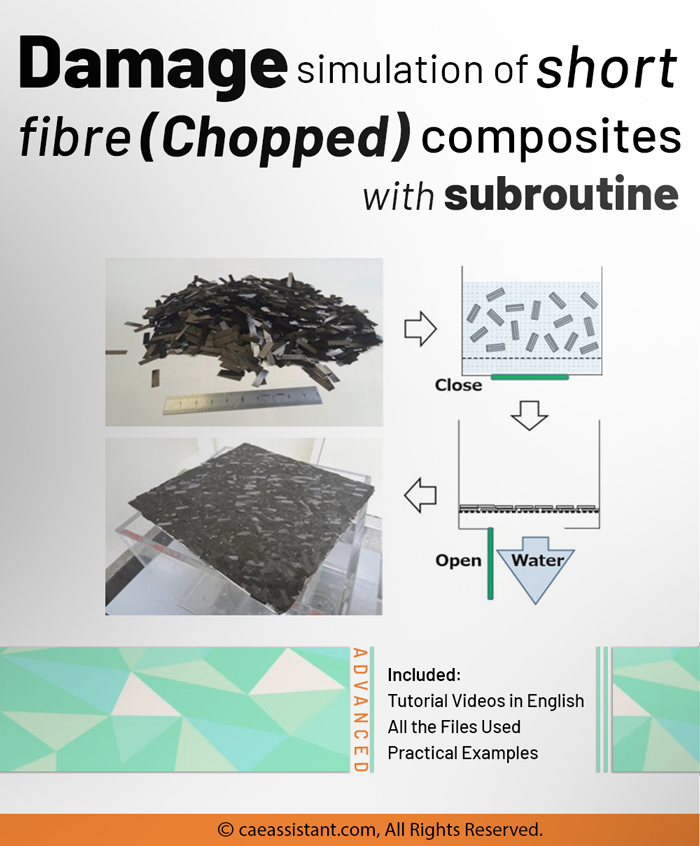
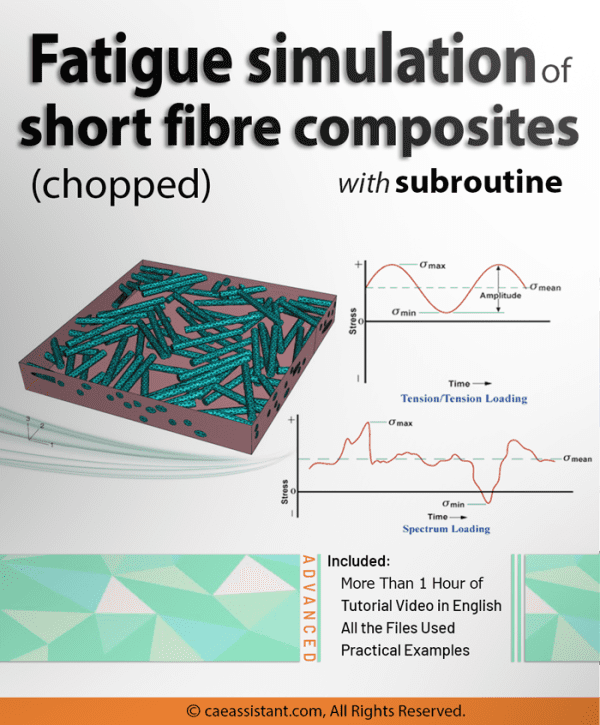
Short fiber composites consist of chopped fibers and a matrix, forming a discontinuous fiber-reinforced material, with fibers typically positioned either aligned or randomly within the matrix based on the intended application. In this training package, you will learn how to model the short fiber composite (SFC) damage in Abaqus based on this article: “Damage Modeling in Random Short Glass Fiber Reinforced Composites Including Permanent Strain and Unilateral Effect”. In the lesson one, you will learn the fundamentals such as the SFCs advantages, applications, and etc. Moving on to Lesson 2, the focus shifts to modeling Short Fiber Composites in Abaqus. The lesson introduces the critical decision between Macro and Micro modeling, which this package do a macro modeling. Lesson 3 advances the learning journey by exploring damage modeling in Short Fiber Composites, particularly through Dano’s model. This macroscopic approach incorporates irreversible processes and internal variables, addressing anisotropic damage, unilateral effects, and residual effects. Lesson 4 bridges theory to practical application, guiding users on how to implement Dano’s model in Abaqus through the VUSDFLD subroutine. The tutorial navigates through the subroutine’s flowchart, explaining each line sequentially. Complementing the lessons are two workshops. Workshop 1 features a 2D composite plate with a hole using plane stress elements, offering a detailed breakdown of material properties, boundary conditions, and simulation procedures. Workshop 2, mirroring the first, employs shell elements, showcasing variations in element types while maintaining consistency with the utilization of the VUSDFLD subroutine.
| Package Content |
.inps,video files, Fortran files (if available), Flowchart file (if available), Python files (if available), Pdf files (if available) |
|---|---|
| Tutorial video duration |
65 minutes |
| language |
English |
| Level | |
| Package Type | |
| Software version |
Applicable to all versions |
| Subtitle |
English |
Frequently Bought Together
Lesson 1: What is Short Fiber Composite (SFC)?
Composite materials are made of two main parts: reinforced and matrix. The reinforced part could come in different shapes: particle, flake, and fiber. The fibers in fiber-reinforced composites could have two shapes: they could be continuous or discontinuous. You can call the discontinuous fiber-reinforced composite the short fiber-reinforced composite. Therefore, the short (chopped) fibers plus the matrix will produce a short fiber reinforced composite. The fibers in this composite could be positioned aligned or randomly in the matrix depending on the use of the composite.
Common types of short fibers used in composites include glass fibers, carbon fibers, and aramid fibers. Each type of fiber has its unique properties, and the choice depends on the specific requirements of the application.
Some of the advantages of short fiber composites are:
- Impact resistance: The addition of short fibers enhances the impact resistance of composites, making them more capable of withstanding sudden loads or impacts without fracturing or breaking.
- Wide range of applications: Short fiber composites offer design flexibility due to their ability to be molded into complex shapes. They can be easily formed to meet specific geometries, enabling intricate and customized designs for various applications.
- Durability: when appropriately designed, manufactured, and used within their specified limits, short fiber composites can exhibit high durability and provide long-lasting performance in a wide range of applications.
- Lower cost: Short fiber composites can offer cost advantages over other advanced composite materials. They are typically more affordable to produce and process, making them a viable option for various industries seeking cost-effective solutions without compromising performance.
- Easy to process: Chopped fiber composites are generally easier to process compared to continuous fiber composites. The shorter length of chopped fibers and their random distribution within the matrix material facilitate better flowability, allowing for easier mold filling and achieving complex part geometries. This ease of processing can result in improved production efficiency and reduced manufacturing costs.
- Fatigue resistance: Short fiber composites exhibit good fatigue resistance, enabling them to withstand cyclic loading and prolonged use without significant degradation in performance. This property is crucial in applications subjected to repeated stress or dynamic loads.
Some of the applications of short fiber composites are:
Automotive Industry
Body Panels: Short fiber composites are used to manufacture lightweight and strong body panels, reducing overall vehicle weight and improving fuel efficiency.
Interior Components: Components such as dashboards, door panels, and seat structures benefit from the durability and impact resistance of short fiber composites.
Aerospace Industry
Structural Components: Short fiber composites are employed in the production of aircraft components, such as wing sections, fuselage parts, and interior structures, to achieve a balance between strength and weight.
Construction and Infrastructure
Building Materials: Short fiber composites are utilized in construction materials, such as reinforced concrete, to enhance structural strength and durability.
Pipes and Tanks: Composite materials are used to manufacture corrosion-resistant pipes and tanks for various industrial applications.
Sports and Leisure
Sporting Goods: Short fiber composites are used in the production of sporting equipment like golf club shafts, bicycle frames, and tennis rackets due to their lightweight and high strength properties.
Boats and Marine Applications: Composite materials find applications in boat hulls and other marine components due to their resistance to water and corrosion.
Electronics and Electrical Components
Enclosures and Housings: Short fiber composites are employed in the manufacturing of enclosures for electronic devices, providing both structural integrity and electrical insulation.
Circuit Boards: Some advanced composites are used in the construction of printed circuit boards (PCBs) to offer improved heat dissipation and mechanical stability.
Medical Devices
Prosthetics and Orthotics: Lightweight and durable short fiber composites are used in the production of prosthetic limbs and orthotic devices.
Dental Materials: Composites are used in dental applications, including crowns, bridges, and braces, due to their biocompatibility and aesthetic properties.
Consumer Goods
Furniture: Short fiber composites can be incorporated into furniture design to enhance strength and durability.
Luggage and Bags: Lightweight and impact-resistant composites are used in the manufacturing of luggage and bags.
Military and Defense
Armor and Protective Gear: Short fiber composites are utilized in the production of lightweight and high-strength armor for military vehicles and personnel protection.
In this lesson you will learn more about short fiber composites (SFC).
Lesson 2: Short Fiber Composite modeling
In this lesson, you will understand in order to model the short fiber composites or any other composite materials in Abaqus, you have to decide which approaches you need to go in with, macro modeling or micro modeling.
Modeling the behavior of short fiber composites with precision and accuracy is a critical aspect in the realm of materials science and engineering. Finite Element Analysis (FEA) has emerged as a powerful tool to simulate and understand the complex mechanical interactions within short fiber composites. Among the notable software platforms, Abaqus stands out for its advanced capabilities in simulating the intricate behavior of these composites under various loading conditions.
Composite modeling in Abaqus is done in two approaches: Macro modeling and Micro modeling. Macro modeling involves a holistic representation of the composite as a homogeneous material, simplifying the analysis by considering its effective properties. On the other hand, micro modeling delves into the fine-scale details, capturing the behavior of individual constituents and their interactions.
Macro modeling
Macro modeling in Abaqus involves representing a composite material as a homogeneous entity with effective material properties. This approach simplifies the analysis by considering the composite as a uniform material, making it computationally efficient for simulating large-scale structures.
Micro modeling
Micro modeling in Abaqus involves capturing the detailed microstructure of the composite, considering the behavior of individual fibers and matrix phases. This approach provides a more accurate representation of the composite’s mechanical response at a microscopic level. In micro modeling, we do not model the whole model, just a very small portion of it; in fact, we do an RVE modeling. The smallest volume that could represent the whole volume properties. With this method, you can simulate the smallest portion of the model instead of the whole model.
In this package, we do the macro modeling.
Lesson 3: Damage in short fiber composites (Dano model)
In this lesson, you will learn how to model the short fiber composites damage in Abaqus using Dano’s theory based on this article: “Damage Modeling in Random Short Glass Fiber Reinforced Composites Including Permanent Strain and Unilateral Effect”. This article talks about using the Thermodynamic of Irreversible Processes and internal variables to model damage mechanics. This model is based on a macroscopic approach using internal variables together with a thermodynamic potential expressed in the stress space. This model takes into account the Anisotropic damage, Unilateral effect, and Residual effect.
The Anisotropic damage is for the cases of nonproportional loading. The Unilateral effect (micro crack closure effect) could lead to the deactivation of damage. the residual effect (permanent strain) is calculated by a new term related to frozen energy, which is a function of the damage variable, the stress tensor, and some material constants to be identified, and is added to the basic thermodynamic potential.
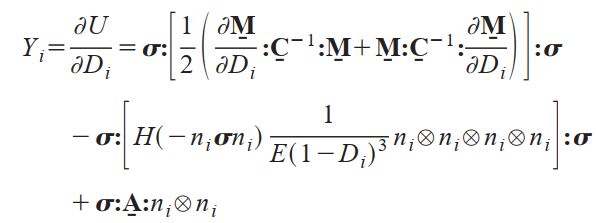
In a thermodynamic framework, the evolution of damage is governed by the associated thermodynamic forces. But what are the thermodynamic forces? They are the strain energy release rates. Since we want to use them to evaluate the damage, we use the damage strain energy release rates obtained by taking the derivative of the damaged material strain energy formula with respect to the associated damage variables.
This is the damaged material strain energy equation:

And this is the equation to calculate the thermodynamic forces:
Moreover, in this model, thermodynamic forces combination & Clausius–Duhem inequality must be take into account, which will be completely explained in this lesson.
Lesson 4: How to apply the damage criterion in Abaqus?
In this lesson, you will learn how to implement Dano’s model, incorporating all the formulas and theories discussed in the previous lesson, within Abaqus using the VUSDFLD subroutine. The tutorial begins by elucidating the flowchart of the subroutine to enhance your understanding of its operations. Subsequently, a detailed walkthrough of the subroutine follows, where each line is explained in sequence. To conclude, the tutorial demonstrates the validation of the subroutine through comparisons with experimental data and references from other articles. The accompanying diagrams and results of this validation process will also be thoroughly explained. For your convenience, a separate PDF file is provided, containing these results and validations for future reference.
Workshop 1: Composite plate with a hole with plane stress element
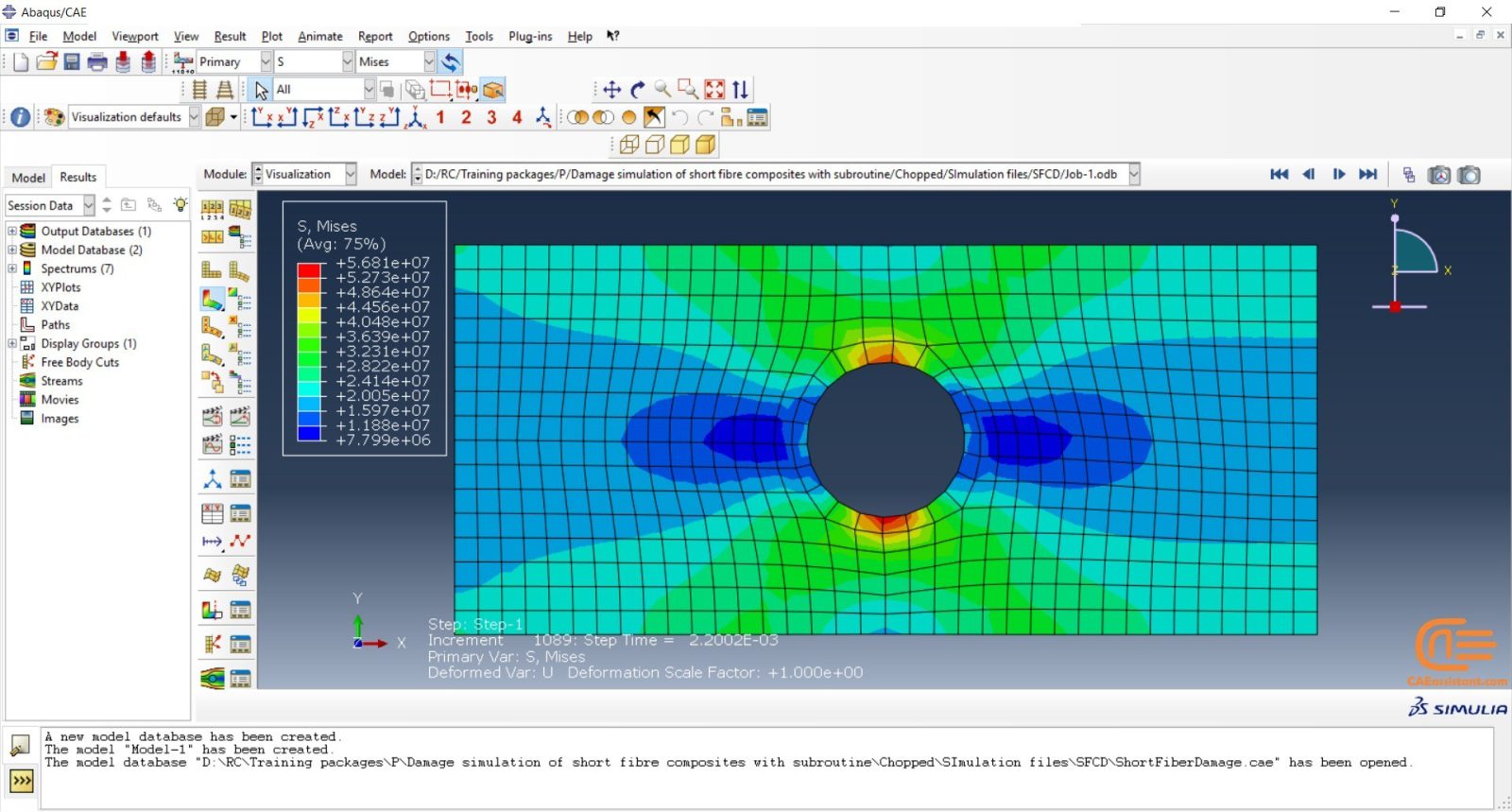
This workshop contains a 2D plate with a hole, which is meshed with plane stress elements. The boundary conditions and the material properties are explained and the simulation procedure is described completely. In the end, the results are discussed.
Workshop 2: Composite plate with a hole with shell element
This workshop closely mirrors the previous one, with the exception of the element type, boundary conditions, and a few other details, as you’ll observe. It employs the identical VUSDFLD subroutine featured in Workshop 1.
It would be useful to see Abaqus Documentation to understand how it would be hard to start an Abaqus simulation without any Abaqus tutorial. If you are working on Abaqus composite damage and need some resources about composite FEM simulation, click on the Abaqus composite analysis page to get more than 20 hours of video training packages on composite materials simulation.
All the package includes Quality assurance of training packages. According to this guarantee, you will be given another package if you are not satisfied with the training, or your money is returned. Get more information in terms and conditions of the CAE Assistant.
All packages include lifelong support, 24/7 support, and updates will always be sent to you when the package is updated with a one-time purchase. Get more information in terms and conditions of the CAE Assistant.
Notice: If you have any question or problem you can contact us.
Ways to contact us: WhatsApp/Online Support/Support@CAEassistant.com/ contact form.
Projects: Need help with your project? You can get free consultation from us here.
To access tutorial video run the .exe file on your personal pc and send the generated code to shop@caeassistat.com and wait for your personal code, which is usable only for that pc, up to 24 hours from CAE Assistant support.
Here you can see the purchase process of packages: Track Order











You must be logged in to post a review.
You may also like…

Simulation of woven composites damage in Abaqus
Fatigue damage simulation of short fibre composites with subroutine


 English
  Korean
  Chinese
Reviews
Clear filtersThere are no reviews yet.