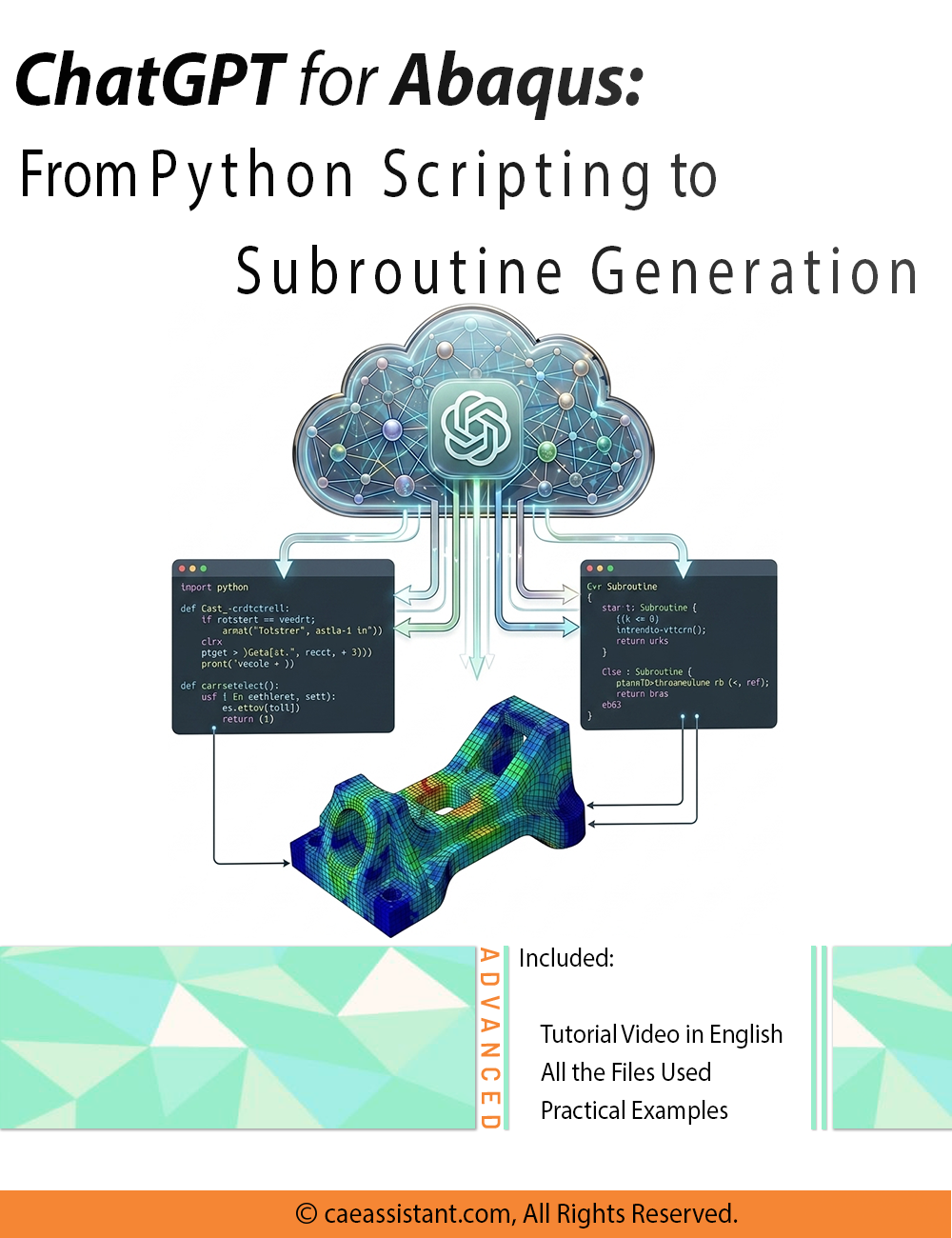
Composite Fatigue Simulation with Subroutine in ABAQUS (unidirectional) for 3D Element
€ 470.0
Fatigue in composites refers to the weakening of a material caused by repeatedly applied loads or stress cycles over time. When a composite material is subjected to cyclic loading, small cracks or microdamage can form within the material, which may grow and lead to failure after a certain number of loading cycles. This is a significant consideration in the design and analysis of composite structures, especially in applications subjected to repeated stress, such as in aerospace, automotive, or civil engineering.
In one of our other packages, we have used the UMAT subroutine in Abaqus to simulate fatigue in composites in two-dimensional space. The current project is more comprehensive, as it addresses composite fatigue in both 2D and 3D spaces. So you can use it for the simulation of both shells and solids. In this project, you will first become familiar with simulating composite fatigue in 2D space using the Abaqus UMAT subroutine. Then, we will provide a complete UMAT code along with Abaqus files for extending the simulation to 3D space, enabling the 3D simulation of composite fatigue in Abaqus.
| Expert | |
|---|---|
| Package Content |
.for ,.inp ,video file |
| Tutorial video duration |
+120 minutes |
| language |
English |
| Level | |
| Package Type | |
| Software version |
Applicable to all versions |
| Subtitle |
English |
Frequently Bought Together
Introduction
Fatigue in composites describes the deterioration of a material due to repeated loading or stress cycles over time. When exposed to cyclic loads, small cracks or microscopic damage can develop within the composite, which may expand and eventually result in failure after a specific number of cycles. This factor is crucial when designing and analyzing composite structures, particularly in industries like aerospace, automotive, or civil engineering, where materials face constant stress.
Considering the significance of this topic, we employed Abaqus in this package to simulate composite fatigue in both 2D and 3D domains. Due to the limitations of Abaqus’s built-in material library for this issue, we leveraged the UMAT subroutine. However, a key question arises: what is the importance of fatigue analysis in composites, and what risks might occur if it is not carried out properly? To answer this, we first examine some of the consequences of the fatigue phenomenon.
Consequences of Fatigue Phenomenon and its Importance
The importance of fatigue in composites can be explored from different perspectives, with the most critical issues discussed here.
- Safety and Durability: Fatigue failure is often gradual and may not be detectable until the material fails catastrophically. Understanding fatigue helps predict the lifespan of composite structures, which is crucial for safety and long-term durability.
- Design Optimization: In engineering, it’s essential to design composites that can withstand cyclic loads. By understanding fatigue behavior, designers can optimize the material choice, ply stacking, and overall structure to ensure longevity under operating conditions.
- Cost Efficiency: Predicting fatigue allows for better material usage. Instead of over-engineering a structure to ensure it lasts beyond its expected lifespan, manufacturers can use more efficient designs that consider the expected fatigue life, potentially lowering costs.
- Performance in Real-world Applications: Many composite materials are used in environments where cyclic loading is common. For example, airplane wings, car chassis, wind turbine blades, and bridges experience repeated loading. Accurate fatigue modeling is essential to ensure that these structures perform reliably throughout their service life.
- Fatigue Testing and Prediction: Understanding fatigue also helps in creating accurate life-prediction models for composites, which involve testing under controlled conditions (e.g., using S-N curves or strain-life models) to predict when a composite will fail.
What is Covered in this Package
In this package, we provide a comprehensive discussion on the phenomenon of fatigue and its importance in analysis. Additionally, we used the UMAT code to analyze composite fatigue in the 2D domain with Abaqus. The package includes detailed tutorials on modeling and how to write the subroutine code for this topic. Furthermore, we extended the modeling to the 3D domain and have included the corresponding 3D UMAT code, which is based on the 2D version, for your use.
What is Fatigue Life
Fatigue life refers to the number of loading cycles (stress) a material can endure before experiencing any form of failure. The fatigue life of composites can be determined using approaches based on strain, stress, or energy. As science and industry continue to advance, there is an increasing demand for the development of materials that offer enhanced benefits. Composite materials have become a viable alternative to traditional materials due to their superior efficiency and economic advantages. Consequently, it is crucial to develop these materials by understanding their production methods, studying their properties, and accurately calculating their fatigue life. Follow this guide to explore the capabilities and features of Composite Fatigue in Abaqus.
Abaqus Simulation
In this project, we used Abaqus’ General Static solver to analyze the fatigue behavior in composites, considering both 2D and 3D domains. By doing so, you will learn how to apply both cyclic and ramped-constant loading histories to the specimens to monitor and capture fatigue in composites. Note that degradation due to fatigue is considered in the model. So, when failure occurs, stiffness and strength reductions will be captured. This project will teach you how to implement 2D and 3D composite fatigue analysis in Abaqus using the UMAT subroutine, enabling you to analyze problems in this area.
- What do we learn from this package?
- Teaching plan and Prerequisites and Next steps
- Package specification
- What theories are used for failure of composite materials?
- What theories are used for fatigue of composite materials?
- Which experimental results are needed to use the subroutine?
- What are the uses of these subroutines?
- When can it be used?
- How does this subroutine work?
- How to design the desired model in Abaqus software?
- How to make settings for written subroutine in the software for composite material fatigue and assign subroutine to the model?
- How to view the results of this modeling for the outputs defined in the subroutine?
- Modification of the UMAT Subroutine Written for Workshop 1
- Abaqus Modeling
Workshops
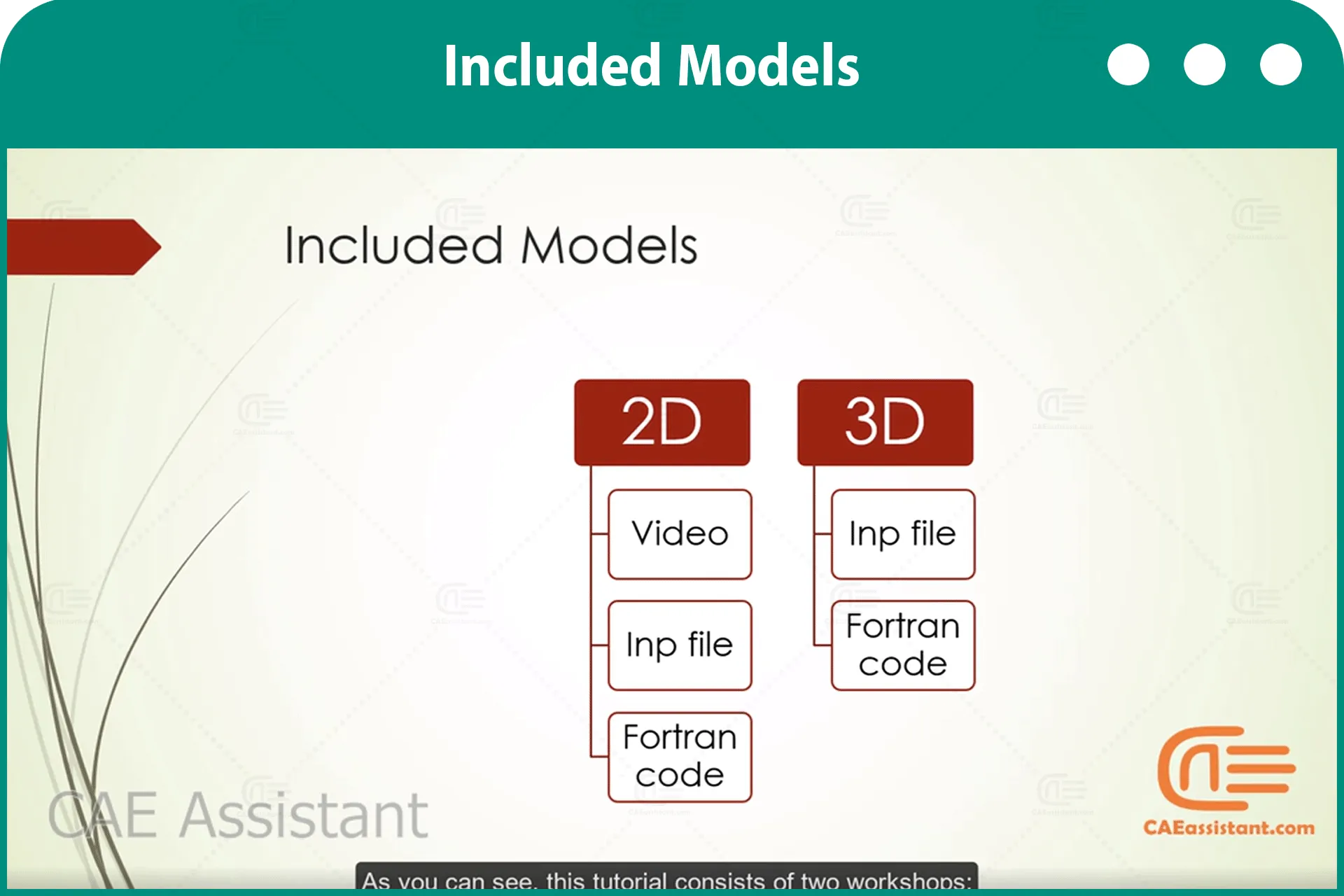
To better understand the modeling procedure, we have provided two workshops in this package. In workshop, we use Abaqus, with the written UMAT codes, to analyze the problems in two and three dimensional spaces. You can access the modeling files and Fortran files for both of the packages.
Workshop 1: Composite fatigue analysis with UMAT subroutine in Shell Elements
In the first workshop, we investigated fatigue behavior in a composite material in a two-dimensional space under cyclic loading, utilizing the UMAT subroutine in Abaqus. The details are provided below.
Workshop 1 part 1: Theory
In the first section of this workshop, we begin by highlighting the significance of material fatigue. To assess fatigue in composite materials, it’s essential to understand how to write subroutines. Next, we will explain the functionality of these subroutines. The underlying theory for writing these subroutines is based on the work of “Shokrieh” (for more details, you can refer to this relevant article). The equations in this theory are derived from the “Hashin” criterion, which we have discussed in this package. This theory focuses on calculating the composite’s final fatigue life in three dimensions, considering the number of loading cycles.
Workshop 1 part 2: Subroutine writing
In this section, we demonstrate how to write the UMAT subroutine in Fortran, following the flowchart presented, to calculate the fatigue and final fatigue life of the composite material (Composite Fatigue UMAT). The loading method used in this example is periodic and is based on the number of loading cycles. We assess the reduction in material properties and their impact on the overall lifespan of the model. Additionally, we cover how to define the parameters, set initial values, and write the necessary relationships in Fortran code in detail. Since composite materials consist of both matrix and fiber components, we have examined fatigue conditions separately for each of these parts.
Workshop 1 part 3: Modelling in Abaqus software
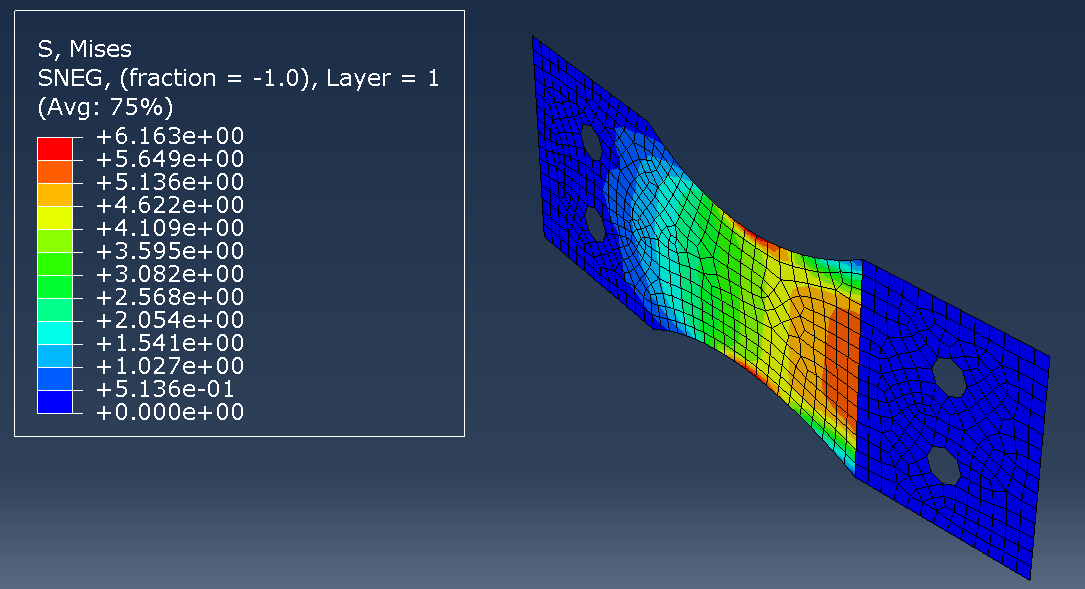
In the last part, we will go to the Abaqus software and explain how to implement the written subroutine on the model designed in the software. The required settings for each module are discussed. Finally, this subroutine will be able to display the final composite fatigue life, and behavior of the material, including the reduction of elastic properties, and strengths along with other parameters such as stress, strain, displacement, and fatigue failure criteria in different modes as output. The written subroutine can be used for a variety of complex to simple models.
Workshop 2: Simulation of Fatigue in a 3D Composite under Constant Load
In Workshop 2, we made several modifications to the UMAT subroutine that we developed for the two-dimensional composite in Workshop 1. We rewrote the relevant equations for the three-dimensional composite. Additionally, to enable you to examine two potential fatigue scenarios—cyclic loading and ramp loading followed by a steady state—we introduced a ramp loading in Workshop 2, followed by a constant load. Finally, the Abaqus model is provided, demonstrating the reduction in stiffness and strength of the composite material in three-dimensional space under the influence of fatigue. Since the theory and coding process for the subroutine were thoroughly covered in Workshop 1, and in Workshop 2 we only extended it to three-dimensional space, this workshop focuses solely on providing the modeling files. The theory and coding details are not repeated to avoid redundancy.
All the package includes Quality assurance of training packages. According to this guarantee, you will be given another package if you are not satisfied with the training, or your money is returned. Get more information in terms and conditions of the CAE Assistant.
All packages include lifelong support, 24/7 support, and updates will always be sent to you when the package is updated with a one-time purchase. Get more information in terms and conditions of the CAE Assistant.
Notice: If you have any question or problem you can contact us.
Ways to contact us: WhatsApp/Online Support/Support@CAEassistant.com/ contact form.
Projects: Need help with your project? You can get free consultation from us here.
- Online payment: with MasterCard, VisaCard and etc.
- Offline payment: In this payment method, you should pay via PayPal and send your payment receipt as an attached file in the offline payment form.
- via download link After purchase, a download link will be sent to you a zip file included training videos, documents and software files.
- Send us your machine ID
To access tutorial video run the .exe file on your personal pc and send the generated code to shop@caeassistat.com and wait for your personal code, which is usable only for that pc, up to 24 hours from CAE Assistant support.
Here you can see the purchase process of packages: Track Order
You must be logged in to post a review.
You may also like…
Composite Fatigue Simulation with VUMAT Subroutine in ABAQUS
Simulation of composite Puck damage in 3d continuum element in Abaqus (UMAT-USDFLD-VUMAT)
Simulation of cohesive fatigue in Abaqus with subroutine
Simulation of composite Hashin damage in 3d continuum element in Abaqus (UMAT-VUMAT-USDFLD)
Abaqus Fatigue Tutorial
3D continuum Abaqus HASHIN progressive Damage for composite materials (VUMAT Subroutine)
The Hashin failure criteria is a set of failure criteria developed specifically for composite materials. It predicts different failure modes in composites based on the stresses experienced by their constituents (fiber and matrix). The criteria are widely used in engineering and computational models to assess composite material performance under mechanical loading. The criteria, while highly efficient and widely used, pose challenges when implemented in numerical simulations. Abaqus has emerged as a powerful tool to address these challenges, enabling the prediction of damage initiation and its progression (via stiffness reduction) based on the Hashin criteria. However, a key limitation of Abaqus is its applicability being restricted to 2D plane stress elements. To overcome this limitation, we developed a VUMAT subroutine in this project. This custom subroutine extends the capabilities of Abaqus, allowing for the simulation of damage initiation and propagation in 3D problems in accordance with the Hashin criteria. It should be mentioned that this subroutine includes gradual progressive damage based on the energy method. This complex subroutine could be used for static and dynamic problems.
A notable point is that in one of our other packages, we also provide training on using Abaqus subroutines to analyze the Hashin criterion. However, in that package, damage occurs instantaneously. In the current package, we have modeled the progressive Damage, which is more complex but could be more beneficial for solving your specific problems.

Reviews
Clear filtersThere are no reviews yet.