
我们如何预测a的确切时刻? 复合材料 在压力下会失效吗?哈辛失效准则通过分解纤维增强复合材料复杂的失效行为,为工程师预测损伤发生的方式和时间提供了强有力的答案。.
Hashin损伤准则是专门为纤维增强复合材料开发的。它能够识别失效发生在纤维还是基体中,从而更清晰地展现材料在应力作用下的行为。这种方法使其适用于仿真,尤其适用于涉及多种应力类型的情况,而这在实际应用中十分常见。.
在本篇博客中,我们将深入探讨哈辛损伤准则,解释其二维和三维形式及其区别。我们还将使用图形用户界面 (GUI) 和子程序等方式,在 Abaqus 中探索哈辛损伤准则。 UMAT, 为工程师如何利用这一强大的理论来模拟复合材料损伤提供了见解。.
| Item | 描述 |
|---|---|
| Applicable materials | Fiber-reinforced composites (UD & laminated) |
| Failure type | Progressive damage (mode-based) |
| Failure modes | Fiber tension, fiber compression, matrix tension, matrix compression |
| Implementation in Abaqus | Built-in (Damage Initiation + Evolution) |
| Required inputs | Tensile/compressive strengths + shear strength |
| Typical use case | Damage initiation + progressive failure simulation |
| 2D vs 3D | 2D: plane stress laminates / 3D: solid composites |
| Main advantage | Separates fiber and matrix failure mechanisms |
| Main limitation | No intrinsic strain-rate or impact dependency |
What are the Hashin Failure Criteria?
Hashin失效准则是一种失效理论,旨在预测复合材料(例如纤维增强复合材料)中不同类型的损伤。该准则由Zvi Hashin开发,区分了纤维失效和基体失效,与最大应力或应变理论等传统准则相比,能够更详细地预测复合材料的失效机制。.
Hashin失效准则根据损伤发生在纤维还是基体中来区分失效模式。它针对不同类型的损伤采用不同的方程,这些方程基于复合材料中常见的物理失效模式。这使得该准则在应用于纤维增强聚合物等复杂材料时更加精确。.
哈辛准则是一种交互式失效准则,因为它考虑了多种应力的相互作用,而不仅仅是独立的拉应力或剪应力。这使得它非常适用于复合材料,因为复合材料的失效是由多种应力同时作用导致的。.
Damage in Composite Materials
复合材料,例如纤维增强聚合物,由于其非均质性,会通过多种机制发生损伤。复合材料的损伤十分复杂,可以以不同的形式出现:
- 基体开裂复合材料的基体(聚合物或树脂)中可能会形成裂纹,导致承载能力下降。.
- 纤维断裂纤维是主要的承载材料,在压力下会断裂,导致刚度和强度大幅下降。.
- 分层层压复合材料中各层之间的分离称为分层,分层会大大削弱结构强度。.
- 纤维基体脱粘纤维与基体之间的粘合可能会失效,导致基体与纤维之间传递载荷的能力下降。.
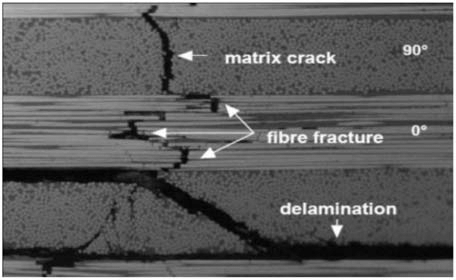
图1: 受损复合材料[参考文献]
Why Hashin’s theory?
Hashin失效准则因其能够预测基体和纤维的失效而被广泛应用。该准则也应用于计算模拟中,例如…… 有限元分析 当需要精确预测复合材料失效时,可采用有限元分析(FEA)。我们采用该理论的原因是:
- 复合材料失效预测的准确性与最大应力或应变理论不同,Hashin 准则考虑了纤维和基体的不同失效模式,能够更准确地表示复合材料的失效方式。.
- 纤维和基体的不同失效模式Hashin 准则分别评估纤维和基体的失效,从而可以对复合材料的两个部分进行明确且实际的失效预测。.
- 多功能性:它既可用于拉伸失效模式,也可用于压缩失效模式,因此适用于各种载荷条件。.
- 有限元分析中的实现Hashin准则通常在有限元软件(如Abaqus)中实现,从而能够对复合材料的行为进行详细模拟。.
- 适用于复杂载荷它考虑了复合材料在实际应用中常见的组合载荷条件。.
| 如果您需要深入的培训,我们的 Abaqus 课程可以满足您的需求。请访问我们的网站。 Abaqus课程 立即查找最适合您需求的课程,并将您的 Abaqus 知识提升到新的水平! |
2D and 3D form of Hashin Damage Criteria Theory
Hashin损伤准则(Hashin失效准则)既适用于二维应力状态,也适用于三维应力状态。两种形式的基本思想相同,但所考虑的应力分量会根据分析是在二维还是三维空间中进行而有所不同。.
| 故障模式 | 2D Hashin | 3D Hashin |
|---|---|---|
| Fiber Tension | $\left( \frac{\sigma_{11}}{X_T} \right)^2 + \left( \frac{\tau_{12}}{S_L} \right)^2 \ge 1$ | $\left( \frac{\sigma_{11}}{X_T} \right)^2 + \left( \frac{\sigma_{12}}{S_{12}} \right)^2 + \left( \frac{\sigma_{13}}{S_{13}} \right)^2 \ge 1$ |
| Fiber Compression | $\left( \frac{\sigma_{11}}{X_c} \right)^2 \ge 1$ | $\left( \frac{\sigma_{11}}{X_c} \right)^2 \ge 1$ |
| Matrix Tension | $\left( \frac{\sigma_{22}}{Y_T} \right)^2 + \left( \frac{\tau_{12}}{S_L} \right)^2 \ge 1$ | $\left( \frac{\sigma_{22} + \sigma_{33}}{Y_T} \right)^2 + \frac{\sigma_{23}^2 – \sigma_{22}\sigma_{33}}{S_{23}^2} + \left( \frac{\sigma_{12}}{S_{12}} \right)^2 + \left( \frac{\sigma_{13}}{S_{13}} \right)^2 \ge 1$ |
| Matrix Compression | $\left( \frac{\sigma_{22}}{2S_T} \right)^2 + \left[ \left( \frac{Y_c}{2S_T} \right)^2 – 1 \right] \frac{\sigma_{22}}{Y_c} + \left( \frac{\tau_{12}}{S_L} \right)^2 \ge 1$ | $\frac{\sigma_{22} + \sigma_{33}}{Y_c} \left[ \left( \frac{Y_c}{2S_{23}} \right)^2 – 1 \right] + \left( \frac{\sigma_{22} + \sigma_{33}}{4S_{23}^2} \right)^2 + \frac{\sigma_{23}^2 – \sigma_{22}\sigma_{33}}{S_{23}^2} + \left( \frac{\sigma_{12}}{S_{12}} \right)^2 + \left( \frac{\sigma_{13}}{S_{13}} \right)^2 \ge 1$ |
Hashin损伤准则的二维形式和三维形式的主要区别在于所涉及的应力分量的数量:
-
2D Form: In 2D, we typically deal with a plane stress state, which includes normal stresses in two directions ($\sigma_{11}, \sigma_{22}$) and shear stress in the plane ($\tau_{12}$).
-
3D Form: In 3D, the stresses are expanded to include normal stresses in three directions ($\sigma_{11}, \sigma_{22}, \sigma_{33}$)以及三个平面上的剪应力($\tau_{12}, \tau_{23}, \tau_{13}$).
一般来说,二维分析侧重于平面内的两个方向(通常称为 1-2 平面),而三维分析则包括所有应力,例如平面外应力。.
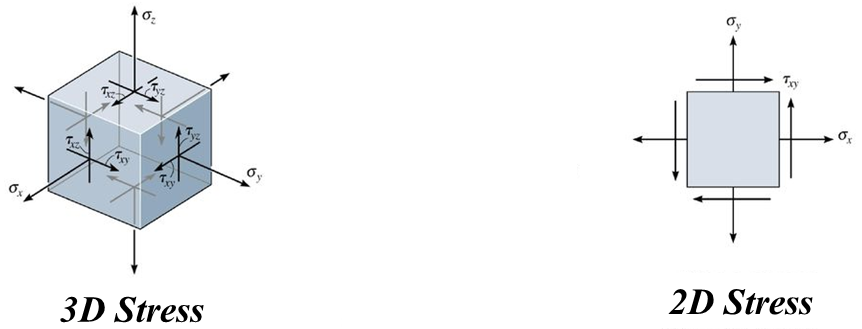
图2: 二维和三维应力分量
2D Hashin Damage Criteria (hashin failure criteria) Theory
在二维哈辛失效准则中,我们重点关注面内应力。纤维和基体在拉伸和压缩下的失效方程均基于这些面内应力分量推导得出。.
- 纤维张力(2D):
纤维张力的判定标准是:
在哪里:
- $\sigma_{11}$ : 是纤维方向的纵向应力。.
- $X_T$ : 是纤维的纵向拉伸强度。.
- $\tau_{12}$ : 是剪切应力。.
- $S_L$ : 是纵向剪切强度。.
如果满足此条件,则会发生纤维在拉伸作用下的断裂。.
- 纤维压缩(2D):
光纤压缩:
在哪里 $X_c$是纤维的纵向抗压强度。该方程较为简单,因为纤维的抗压破坏主要受纵向应力控制。.
- 矩阵张力(2D):
对于基体张力而言,失效受以下因素控制:
在哪里:
- $\sigma_{22}$ :是横向正应力(垂直于纤维方向的应力)。.
- $Y_T$ : 是基体的横向拉伸强度。.
- 矩阵压缩(2D):
对于矩阵压缩,如果出现以下情况,则压缩失败:
在哪里:
- $Y_c$ : 是基体的横向抗压强度。.
- $S_T$ : 是横向剪切强度。.
在二维情况下,我们仅考虑1-2平面内的应力(平面内的纵向应力、横向应力和剪切应力),这简化了分析和方程。如果满足上述四个条件中的任何一个,则根据Hashin失效准则,复合材料即发生失效。.
3D Hashin Failure Criteria Theory
在三维哈辛失效准则中,方程扩展到包含第三方向(第三轴,即面外方向)的应力。这使得失效分析更加全面,因为面外应力在许多实际应用中至关重要。.
- 纤维张力(3D):
三维空间中纤维拉伸的失效准则与之类似,但有所扩展:
在哪里:
- $\sigma_{12}, \sigma_{31}$ and : are the shear stresses in different directions.
- $S_{12}, S_{31}$ : 分别是纵向和横向的剪切强度。其他术语与二维哈辛准则中的相同。.
- 纤维压缩(3D):
针对三维光纤压缩:
这与二维情况相同,因为压缩破坏仍然主要受纵向应力控制。.
- 矩阵张力(3D):
对于三维矩阵张力:
- 矩阵压缩(3D):
对于三维矩阵压缩:
此外,在图 3 中,您可以看到根据 3D Hashin 关系绘制的 Hashin 失效包络线。.
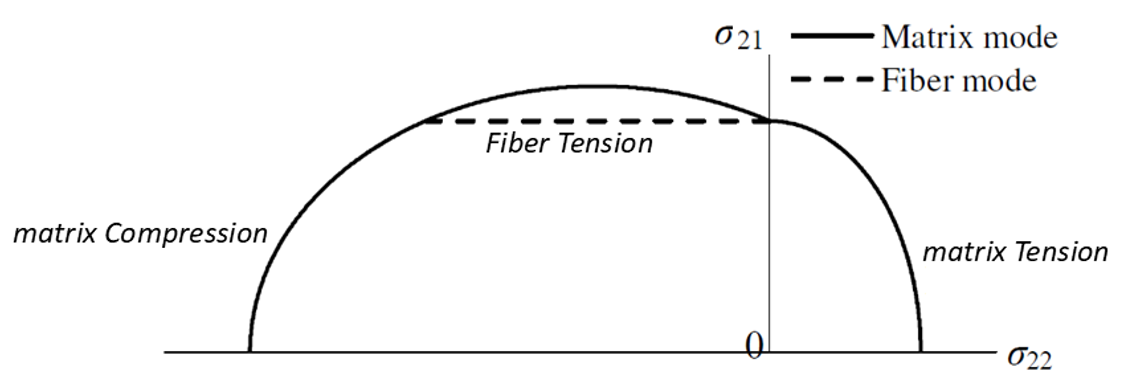
图 3: 故障包络线 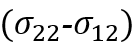 根据哈辛的标准预测
Differences Between 2D and 3D Hashin Forms
| 类别 | 2D Hashin | 3D Hashin |
|---|---|---|
| Dimensions | Focuses on in-plane stresses ($\sigma_{11}$, $\sigma_{22}$, $\tau_{12}$) | Includes out-of-plane stresses |
| Failure Modes | Fiber tension, fiber compression, matrix tension, matrix compression | Same failure modes |
| Equations | Simpler, fewer stress components | More complex, and involves additional normal and shear stresses |
| 应用程序 | 2D laminar composites (thin laminates) | 3D bulk composites or situations with significant out-of-plane stresses |
二维哈辛准则用于分析应力主要局限于二维的材料,例如薄层合板或板状结构。而三维哈辛准则则对于较厚的复合材料或面外应力显著的材料至关重要。两种准则都能有效预测失效,但其应用取决于复合材料的应力状态。.
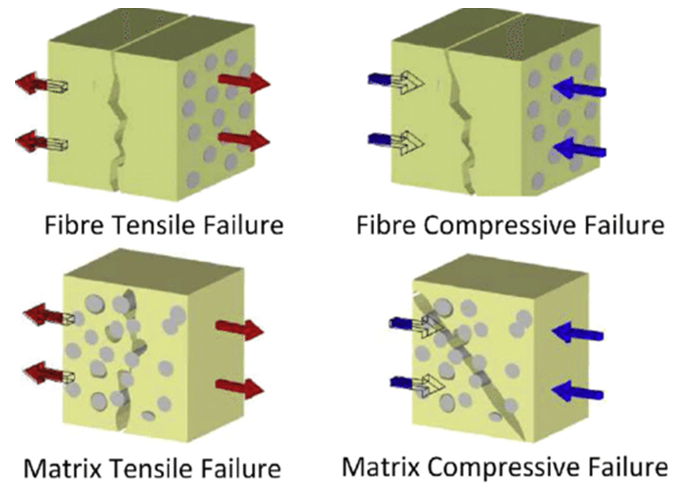
图 4: 纤维增强复合材料的损伤[参考]
这里,我们提供了一篇关于在 Abaqus 中进行 3D Hashin 损伤模拟的完整教程,标题为“复合材料三维连续体Abaqus Hashin渐进损伤“。”.
Hashin Damage Criteria in Abaqus: Using GUI and subroutines for simulation (UMAT -USDFLD)
在 Abaqus 中,Hashin 损伤准则可以直接通过图形用户界面 (GUI) 实现。 复合损伤 建模方面,Abaqus 提供了一个内置的损伤模型,该模型采用 Hashin 准则来分析纤维增强复合材料,尤其适用于多轴载荷条件下的渐进损伤分析。此外,Hashin 准则也可以通过 Abaqus 中的 UMAT 等子程序来实现。接下来,我们将详细解释这些方法。.
Damage Initiation and Damage Evolution
在 Abaqus 中,损伤萌生和损伤演化是模拟复合材料(尤其是纤维增强复合材料)失效的关键方面。它们使用户能够模拟失效的发生和随后的材料退化,从而真实地展现复合材料结构在载荷作用下的失效过程。.
损伤起始是指材料由于所施加的应力或应变而开始失效或性能退化的点。对于复合材料,损伤起始通常是由于纤维断裂、基体开裂或分层造成的,具体取决于载荷条件和材料属性。在 Abaqus 中,损伤起始的判定基于失效准则。对于复合材料,通常使用 Hashin 准则(Abaqus 中的 Hashin 损伤准则),该准则分别识别纤维和基体的失效(拉伸和压缩模式)。您可以学习如何对损伤起始进行建模。 在我们的教程第一次研讨会上,我们探讨了基于Hashin失效准则的损伤起始问题。.
在 Abaqus 中,复合材料的损伤起始通常在属性模块中定义。在该模块中,选择“纤维增强复合材料损伤”选项,即可访问 Hashin 失效准则。.
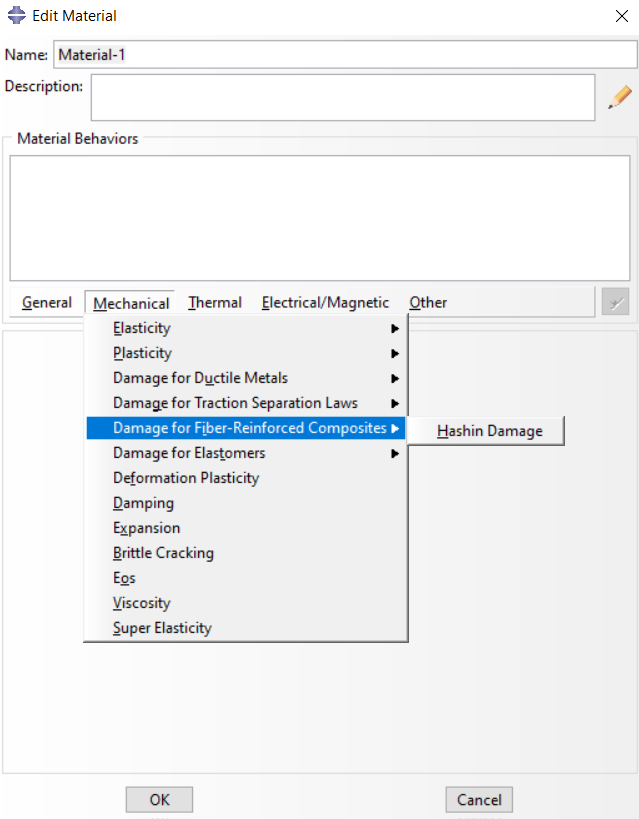
图 5:Abaqus 中的 Hashin 损伤
要使用此标准,必须确定以下参数:
- 纤维拉伸强度 $X_T$
- 纤维抗压强度 $X_c$
- 基体拉伸强度 $Y_T$
- 基体抗压强度 $Y_c$
- 纵向和横向剪切强度 $S_L$和$S_T$.
下图显示了软件中 Hashin 损伤 Abaqus 所需的参数。.
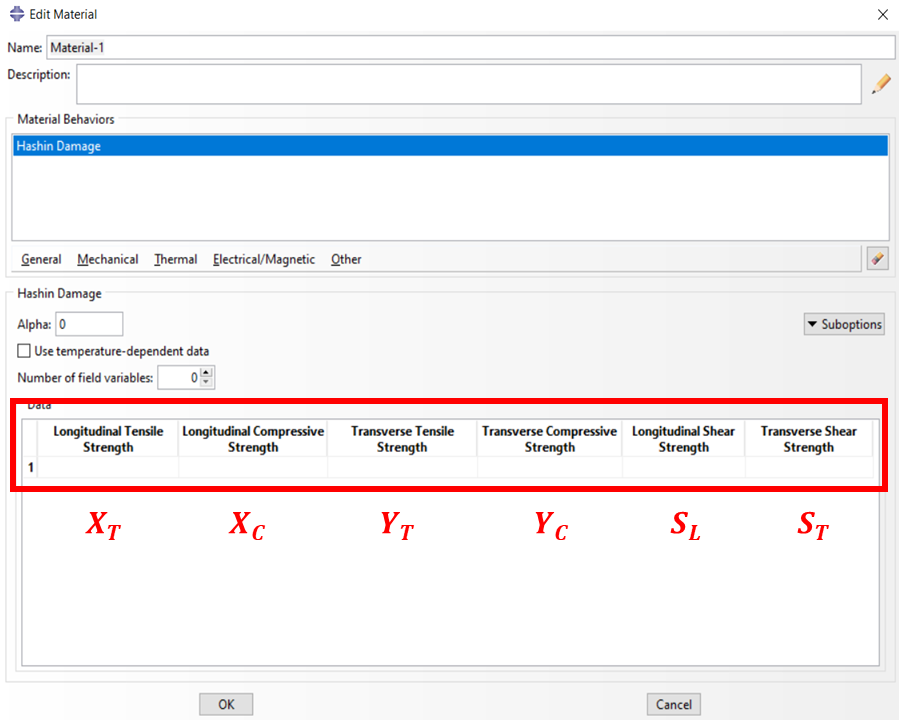
图 6: Hashin失效准则参数
另一方面,损伤演化描述了损伤萌生后材料性能退化的进程,为模拟失效扩展过程中材料刚度和强度的降低提供了一种机制。在复合材料中,损伤演化对于模拟纤维断裂、基体开裂和分层等现象至关重要。.
当复合材料层合板中特定材料点发生失效时,必须根据选定的退化模型修改该点的材料属性。这种调整可以通过以下三种退化模式之一进行: 瞬间降至零, ,一个 降低至指定的恒定应力水平,或逐渐降低 沿着预定路径。每种方法都代表了一种不同的材料损伤后完整性丧失建模方法,如图所示。.
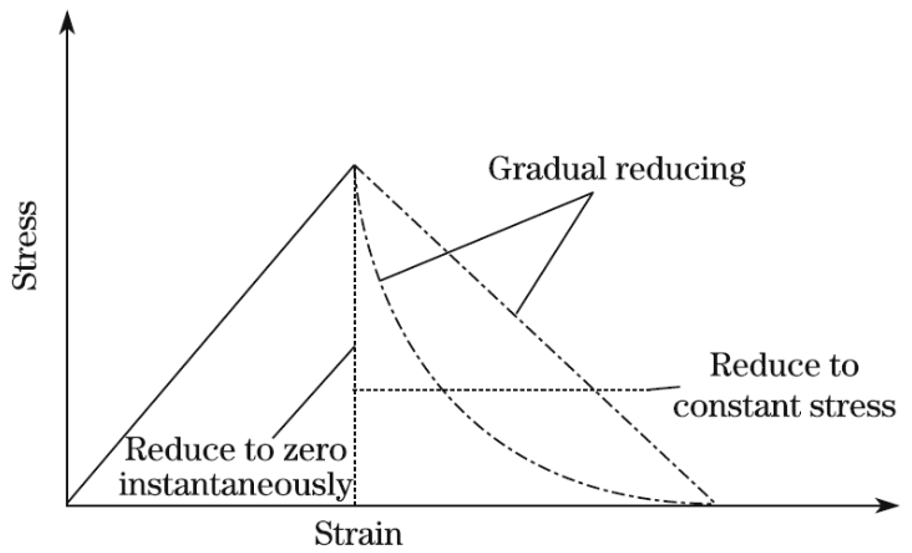
图 7: 复合材料损伤起始后各种性能的降低
瞬时强度降低会消除失效点处的所有材料强度,从而有效地丧失其承载能力。相比之下,恒应力强度降低即使在失效后也能将应力限制在一个固定值,从而保留一定的残余强度。最后,渐进强度降低允许强度逐渐损失,模拟损伤随时间或持续载荷作用下的扩展过程。如图所示,这种渐进式降低可以是线性的,也可以是其他函数(例如指数函数)的函数。.
在渐进式损伤中,一旦损伤开始,材料不会立即失效;相反,随着损伤在结构中扩展,材料性能会随时间推移而逐渐退化。损伤演化通常用断裂能或能量耗散来定义。其目的是模拟裂纹扩展过程中材料吸收的能量。.
损伤演化通常包含一个软化模型,该模型会在损伤起始准则满足后降低材料刚度。例如,与纤维或基体失效相关的断裂能决定了损伤发生后材料刚度下降的速度。.
在定义损伤起始准则后,即可启用损伤演化功能。Abaqus 用户在属性模块中选择“纤维增强复合材料的损伤”并定义损伤起始准则后,可以选择“损伤演化”来指定损伤的扩展方式。.
请记住,Abaqus 仅提供线性递减属性值的功能。要实现除线性函数之外的递减属性值,需要使用子程序对相关函数进行建模。为此,必须确定材料的刚度矩阵,该矩阵定义了应力与应变之间的关系。下一步,我们将介绍使用户能够实现此功能的子程序。.
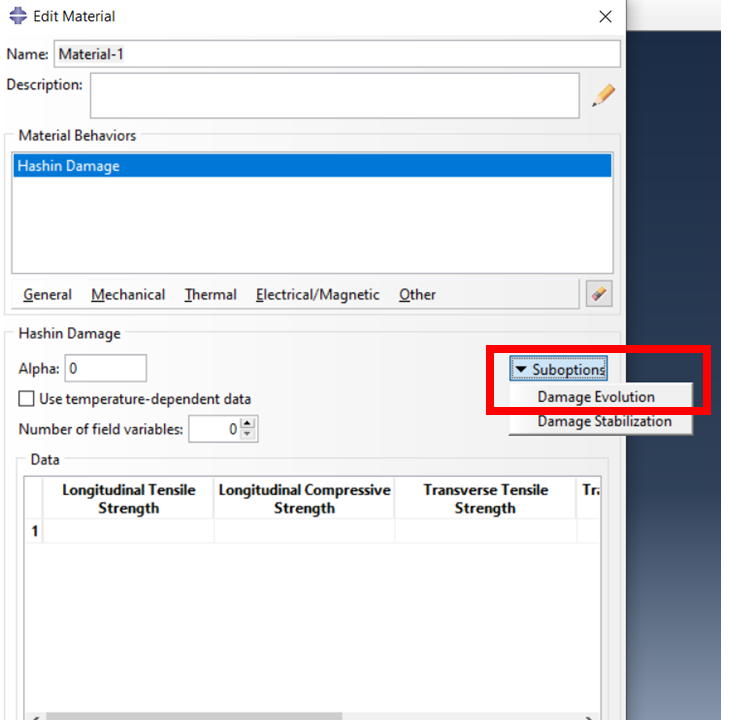
图 8: Abaqus中的损伤演化选项
要使用渐进损伤模型,必须确定断裂能。这些数值是通过实验测试获得的,是材料常数。.
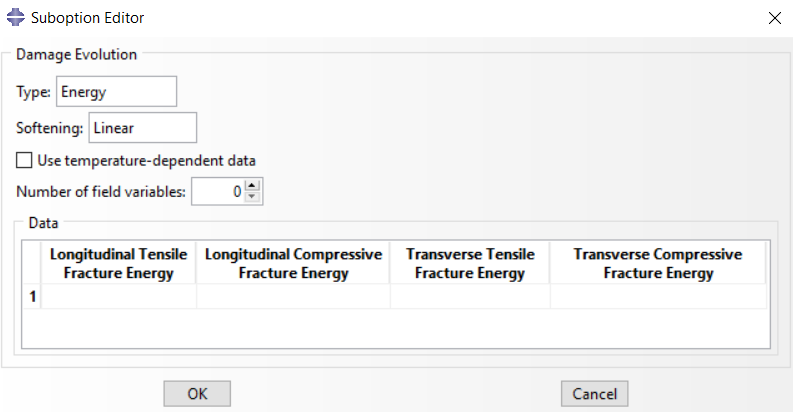
图 9: Abaqus中的损伤演化参数
The below figure presents a piece of the .inp file, where the material parameters associated with the Hashin failure theory have been implemented. In this section, the parameters related to damage initiation and damage evolution are introduced to model the progressive failure behavior.

元素删除
In the present damage modeling framework, the Hashin failure criterion was employed to identify the onset of different composite failure modes, including fiber and matrix failure under tensile and compressive loading conditions. Once the initiation criteria were satisfied, stiffness degradation was introduced through the damage evolution law, and Abaqus element deletion was activated when the material degradation reached its critical limit.
This procedure enables the numerical simulation of severe material failure, crack propagation, and the complete loss of load-carrying capacity in highly damaged regions.
Characteristic Element Length
The characteristic element length is an important parameter in continuum damage mechanics models based on the Hashin criterion, particularly when damage evolution is defined using fracture energy concepts. Since the predicted softening response may become dependent on mesh size, the characteristic element length is used to regularize the energy dissipation during damage progression.
In this way, the amount of energy released during failure remains more consistent for different mesh densities, leading to more objective numerical results. Therefore, in combination with the Hashin criterion, the characteristic element length plays a key role in achieving mesh-independent and physically meaningful progressive damage simulations.
Subroutine and Hashin failure criteria
Abaqus 中的子程序允许用户自定义材料模型、本构行为和自定义场变量。Abaqus 拥有多种子程序,可用于扩展软件的默认功能,包括:
- UMAT(用户材料子程序):用于 Abaqus/Standard 中,为静态和准静态问题定义自定义材料模型。.
- USDFLD(用户自定义字段子程序)允许用户定义影响材料响应的自定义字段变量。.
笔记: 本教程视频完整讲解了如何使用 UMAT 和 USDFLD 子程序来模拟 Hashin 理论。“在Abaqus中用三维连续体单元模拟复合材料Hashin损伤(UMAT-VUMAT-USDFLD)“。”.
子程序使用户能够灵活地实现更复杂的材料模型、相互作用和损伤准则,这些内容在 Abaqus 的默认库中可能不可用。但是,何时应该在 Hashin 损伤 Abaqus 建模中使用子程序呢?在以下情况下,您应该考虑在 Hashin 损伤 Abaqus 建模中使用子程序:
- 需要自定义失败标准:如果 Abaqus 中内置的 Hashin 损伤准则不足以进行分析,例如当您需要考虑非标准载荷条件或多尺度建模时。.
- 渐进式伤害或自定义伤害演变对于超出 Abaqus 默认提供的更复杂的渐进损伤建模,子程序允许用户定义自定义损伤演化规律。.
在子程序中使用 UMAT 子程序来实现 Hashin 失效准则(Abaqus/Standard):
- 步骤 1:定义材料行为:在 UMAT 子程序中,定义复合材料的应力-应变关系。使用 Hashin 失效准则计算失效起始点,然后根据损伤状态降低材料刚度。.
- 步骤 2:渐进损伤:实施损伤演化模型,随着损伤的累积降低材料刚度,并在每次迭代中更新应力和应变。.
- 步骤 3:输出变量:定义仿真后要可视化的输出变量(例如损伤参数)。.
USDFLD 子程序:
- 步骤 1:自定义字段变量:使用 USDFLD 定义影响材料响应的自定义字段变量,例如损伤扩展或应变软化。.
- 步骤 2:与材料模型的交互:USDFLD 中定义的场变量可以与材料模型交互,根据 Hashin 准则改变复合材料的刚度、强度或失效行为。.
Hashin vs Tsai-Hill vs Tsai-Wu
To evaluate the performance of composite laminates under different loading conditions, several failure criteria have been developed based on distinct mathematical formulations and physical assumptions. Among the most widely used criteria are Hashin, Tsai-Hill, and Tsai-Wu, each offering a different level of accuracy, complexity, and capability in predicting failure initiation. While some criteria are better suited for preliminary strength assessment, others are more appropriate for advanced progressive damage simulations in finite element environments such as Abaqus. The following table presents a technical comparison of these three commonly used composite failure theories.
| 特征 | 哈辛准则 | 蔡-希尔准则 | 蔡-吴准则 |
|---|---|---|---|
| Application | Unidirectional and laminated fiber-reinforced composites | Anisotropic brittle materials and laminated composites | Orthotropic composites under multiaxial loading |
| Failure Mode Identification | Yes; Fiber Tension / Fiber Compression / Matrix Tension / Matrix Compression | 不 | 不 |
| Tension-Compression Asymmetry | Fully considered | 有限的 | Fully considered |
| Fiber Orientation Dependence | Explicit and direct | Indirect through directional strengths | Explicit through tensor coefficients |
| Sensitivity to In-plane Shear Stress | 高的 | 缓和 | 高的 |
| Matrix Failure Prediction | 出色的 | 有限的 | 缓和 |
| Fiber Failure Prediction | 出色的 | 缓和 | 好的 |
| Progressive Damage Modeling | 出色的 | 贫穷的 | 缓和 |
| Common Use in Abaqus | Damage Initiation + Damage Evolution | Failure Index | Failure Index / User Material |
| 计算成本 | 缓和 | Low | 缓和 |
| Main Advantage | Realistic representation of composite failure mechanisms | Simplicity, speed, minimal material data | Accurate multiaxial failure prediction with tension/compression asymmetry |
The comparison shows that no single criterion is universally superior; rather, the appropriate selection depends on the objective of the analysis. Tsai-Hill is often preferred for fast and simplified strength estimation, whereas Tsai-Wu failure criterion is more effective for multiaxial stress interaction problems. However, when failure mode identification, stiffness degradation, and damage evolution are required, Hashin is generally considered the most reliable option for composite damage modeling. Therefore, engineers should choose the criterion according to the required fidelity, available material data, and computational objectives.

伤害起始+ 渐进性损伤 (检测到材料性能立即或突然下降) + 使用分步指南 UMAT, VUMAT、USDFLD 子程序
想精通 Abaqus 中的复合损伤计算吗? 使用 VUMAT 进行 Hashin 渐进性损伤 非常适合建模 渐进性损害 在深入研讨会的分析中,同时 综合 Hashin 损伤(包含 UMAT、VUMAT 和 USDFLD) 重点是 突发性损害 通过易于实现的子程序进行分析。请根据您的需要点击下方各个软件包。.
|
3D连续体元素+ 哈辛失效准则 +伤害启动+ 渐进性损伤 (基于能量的渐进式降解) + 使用分步指南 VUMAT 子程序
|
3D连续体元素+ 哈辛失效准则 +伤害启动+ 渐进性损伤 (检测到材料性能立即或突然下降) + 使用分步指南 UMAT, VUMAT、USDFLD 子程序 |
结论
本文探讨了哈辛损伤准则,这是一种用于预测复合材料(尤其是纤维增强复合材料)损伤的失效理论。该准则能够详细分解失效模式,使其成为有限元分析中进行精确模拟的重要工具。.
理解哈辛失效准则至关重要,因为复合材料广泛应用于各个行业,准确预测其失效能够确保更优的设计和安全。我们首先探讨了复合材料中不同的损伤机制,例如基体开裂和纤维断裂,哈辛失效准则正是针对这些机制而制定的。然后,我们解释了哈辛损伤准则的二维和三维形式,并阐述了两种情况下应力分量的处理方式。最后,我们讨论了如何在Abaqus中使用图形用户界面(GUI)或子程序来实现哈辛损伤准则,重点关注损伤的萌生和演化。.
总的来说,我们了解到 Hashin 损伤准则是模拟复合材料行为的有效方法,与传统的失效理论相比,它能提供更精确的预测。.
浏览我们内容全面的 Abaqus 教程页面,其中包含免费的 PDF 指南和适合所有技能水平的详细视频。探索免费和付费套餐,以及高效掌握 Abaqus 的必备信息。立即开启您的 Abaqus 学习之旅! Abaqus教程 现在!
这 CAE 助手 我们致力于满足您所有的 CAE 需求,您的反馈对我们实现这一目标至关重要。如果您有任何疑问或遇到任何问题,请随时通过我们的社交媒体账号(包括 WhatsApp)与我们联系。.
Hashin Failure Criterion FAQs
1. What is the Hashin failure criterion in composite materials?
The Hashin failure criterion is a widely used damage model for fiber-reinforced composites that predicts failure initiation based on stress components and distinguishes between different failure mechanisms in fibers and matrix.
2. What are the failure modes defined by Hashin?
Hashin typically defines four main failure modes: fiber tension, fiber compression, matrix tension, and matrix compression. This mode separation makes it more realistic than many interactive criteria.
3. Why are elements not deleting in Abaqus when using the Hashin damage model?
Elements usually do not delete because only Damage Initiation has been defined. To enable deletion, Damage Evolution and element removal settings must also be properly activated.
4. What is the difference between the 2D and 3D Hashin failure criteria?
The 2D Hashin criterion is mainly used for plane stress laminate models, while the 3D version includes out-of-plane stresses and is more suitable for solid composite elements.
5. Do I need a UMAT or VUMAT subroutine to use the Hashin criterion in Abaqus?
Not always. Abaqus provides a built-in Hashin model for many composite analyses. However, UMAT or VUMAT is needed for advanced custom damage criteria.
6. What is the difference between Damage Initiation and Damage Evolution in Hashin?
Damage Initiation identifies when failure starts, while Damage Evolution controls how stiffness degrades and damage progresses after initiation until final failure.








 English
  Korean
  Chinese