
冯·米塞斯应力 | 莫尔圆与主应力和应变
 In the world of engineering, accurately predicting how materials will behave under stress is essential. One key concept in this domain is the Von Mises stress, a valuable tool used to forecast when a material might start to yield or fail under various loading conditions. This type of stress analysis is particularly significant when working [...]
 人工智能在机械工程中的应用:工作流程优化实用指南
Mechanical engineering spans everything from conceptual design to long-term maintenance. Traditional workflows often involve repetitive, manual steps that can be slow and error-prone. Today, AI in mechanical engineering is changing the game. By automating tasks, enhancing precision, and enabling data-driven decision-making, engineers can innovate faster, reduce costs, and deliver better results. Mechanical Engineering AI Integration [...]材料蠕变入门 | 关键概念 + Abaqus 蠕变模型

Creep is the slow, time-dependent deformation of solid materials. This permanent strain happens under constant load, even when the stresses are well below the material’s yield strength. Understanding and accounting for creep behavior is vital for designing reliable components. This phenomenon is critical in high-temperature structures, such as pressure vessels, boiler tubes, turbine blades, and […]
什么是热应力分析?Abaqus 指南详解
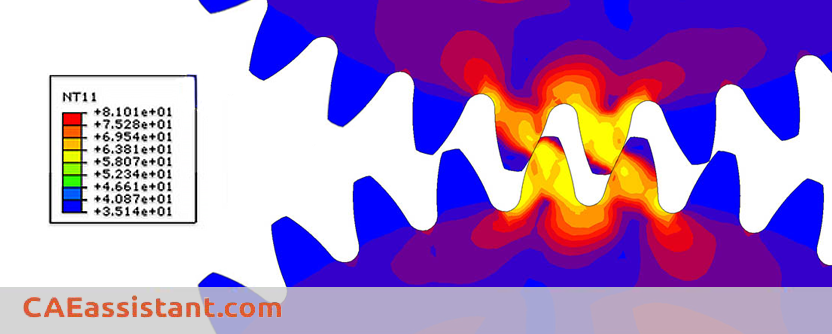
Thermal stress analysis is how engineers predict the extra stress materials feel when they heat up or cool down. In simple terms, when a structure wants to expand or shrink but is held in place, stress builds up — that’s thermal stress. Ignoring it can crack a turbine blade, warp a PCB, or weaken a […]
粘塑性原理详解 | Abaqus 模型和 Perzyna 指南

Under constant load, some materials keep deforming little by little, showing that stress is not just about force but also about time. They slowly change shape over time, depending not only on how much load is applied but also on how long it lasts. This time-dependent behavior is what makes them different from purely elastic […]
桁架分析完整指南 | 理论 + 仿真教程
 Trusses are structural systems made of straight members joined at nodes. Each member carries only axial loads—tension or compression. Truss analysis helps engineers predict how these members behave under various forces. This is key for safe designs in bridges, roofs, towers, and other load-bearing structures. Engineers use two main approaches to truss analysis: the Method [...]
 什么是 Abaqus 接触阻尼?如何在 Abaqus 中应用它?

When two parts come into contact in a simulation, things can get unstable quickly. Movements like sliding or bouncing can cause sudden changes that make your model hard to solve. That’s why Abaqus includes contact damping — a built-in way to smooth things out during contact, similar to how a shock absorber works in real […]
Abaqus不稳定问题的自动稳定化 | 耗散能量分数,阻尼系数

Have you ever set up an Abaqus simulation, hit run, and watched it crash almost instantly? Maybe the time step dropped to something microscopic. Maybe you got a cryptic error message. Or worse — maybe it just froze. If that sounds familiar, you’re not alone. One of the most common reasons for simulation failure in […]
Abaqus Standard 与 Explicit 详解:如何选择合适的版本

Which one should you use: Abaqus Standard or Abaqus Explicit? If you’ve run into this question while working in Abaqus, you’re definitely not alone. Abaqus gives you two powerful solvers for finite element analysis—Standard (Implicit) and Explicit. But when you’re dealing with complex simulations, knowing which one to use isn’t always obvious. Think of it […]
激光辅助加工在难加工工件上的应用 | 使用 Abaqus 进行模拟

Machining is a complex process that involves extreme stresses, high temperatures, rapid tool wear, and intricate chip formation. Accurately predicting what happens during cutting is not easy—but FEA machining simulation offers a powerful solution.Let’s start with a few important questions: How can we predict chip shape and material deformation during cutting? Can we estimate the […]
 English
  Korean
  Chinese