



This training package provides a specialized deep dive into the implementation of implicit gradient-enhanced ductile damage models within the Abaqus finite element framework. The curriculum is built around a comprehensive set of PDF and video tutorials that meticulously detail the underlying theory and mathematical formulations required to regularize strain localization and simulate material degradation. Participants will engage in a rigorous, line-by-line investigation of the Fortran source code for UMAT and UHARD subroutines, including advanced versions designed for element erosion and crack growth simulations. By dissecting these subroutines, users will gain a transparent understanding of how to couple mechanical stress-strain relationships with internal damage variables and non-local interactions.

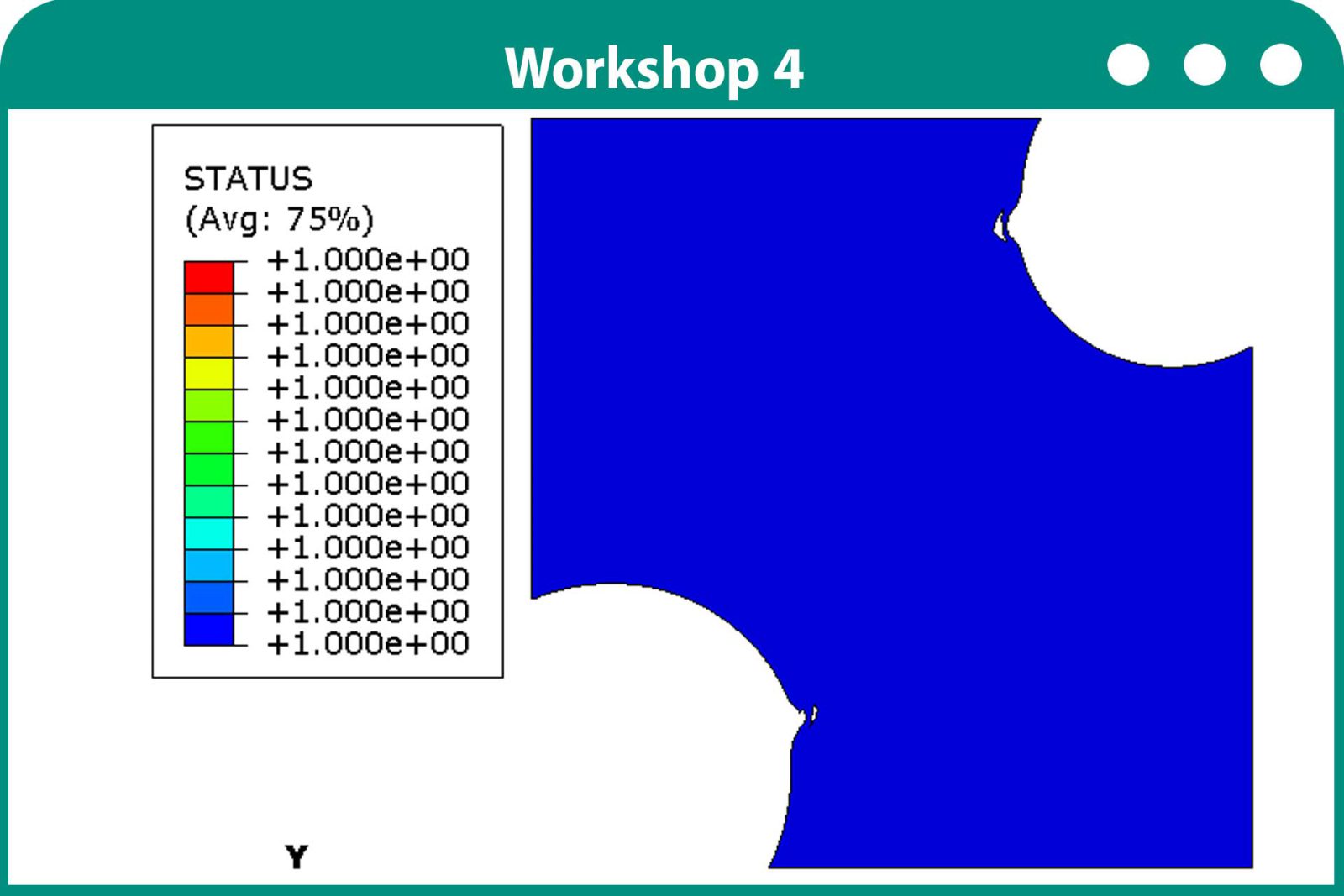
Practical application is reinforced through dedicated workshops featuring the Shear Band Specimen and the Double Notch Tensile Test, which guide users through the setup of complex input files and the definition of material properties for non-local failure. These workshops demonstrate how to manage state variables and implement the gradient-enhanced damage methodology to achieve mesh-independent results in ductile failure analysis. Upon completion of these materials, users will possess the practical skills necessary to develop, debug, and implement their own user-defined material models, enabling them to conduct high-fidelity fracture simulations and predict the structural integrity of components under extreme loading conditions.
This training is particularly applicable in industry for the accurate simulation of metal sheet forming processes, such as shearing and blanking, where severe shear deformations occur. It enables engineers to reliably predict damage initiation and crack propagation in industrial components using commercial finite element software such as Abaqus. By incorporating a robust gradient-enhanced damage formulation, the approach significantly reduces common numerical issues, such as mesh dependency and localization errors, allowing for stable and high-precision fracture simulations in practical engineering applications.

The following sections outline the essential concepts covered in this training:
1- Comprehensive Guide in PDF Format
In the PDF guide, we provide an exhaustive theoretical foundation for the implicit gradient-enhanced methodology, specifically focusing on its ability to regularize strain localization. We teach how to develop an efficient fracture simulation framework by integrating gradient-enhanced damage theory, heat conduction analogy, constitutive modeling, and advanced numerical implementation. We explain how mesh dependency is eliminated using an implicit gradient formulation based on a Helmholtz-type equation, and how this equation is cleverly solved through its analogy with stationary heat conduction. The training also covers the hypo-elastic–plastic material model with von Mises plasticity, damage-softening through yield surface degradation, and a hyperbolic-tangent damage evolution law governed by plastic strain and stress triaxiality. Finally, we demonstrate the full numerical implementation using the Newton–Raphson method, consistent tangent stiffness in UMAT, comparison with UHARD, and crack growth simulation through element deletion, highlighting the role of the internal length parameter and the differences between implementation strategies.
The document includes a detailed, line-by-line investigation of the Fortran source code for the UMAT, UHARD, and UMAT_ELEMENT_EROSION subroutines. We break down the mathematical formulations used to couple mechanical stress-strain relations with internal damage variables and non-local interactions. You will find full details on defining material properties (PROPS) and managing state variables (STATEV) for both the Shear Band Specimen and the Double Notch Tensile Test workshops. This guide ensures you understand every line of the code before running your simulations, covering everything from the basic elasticity setup to advanced element deletion criteria for crack growth.
2- Step-by-Step Instructional Video
The instructional videos serve as a practical companion to the theory, walking you through the entire implementation process in Abaqus/Standard. We demonstrate how to set up the provided input files—specifically for the Shear Band Specimen and Double Notch Tensile Test—and how to link the Fortran subroutines to the Abaqus solver. The video tutorials guide you through a line-by-line investigation of the code in a live environment, showing how the subroutines interact with the global solver during the incrementation process. You will learn how to visualize the damage driving forces and interpret the results of element erosion in ductile failure scenarios. By following these step-by-step videos, you will gain the practical skills to develop, debug, and execute high-fidelity predictive models for structural integrity and fracture initiation.
[/woodmart_text_block][woodmart_button style=”link” color=”primary” align=”left” woodmart_css_id=”699433ea20686″ title=”Read More” full_width=”no” button_inline=”no” button_smooth_scroll=”no” wd_button_collapsible_content=”yes” responsive_spacing=”eyJwYXJhbV90eXBlIjoid29vZG1hcnRfcmVzcG9uc2l2ZV9zcGFjaW5nIiwic2VsZWN0b3JfaWQiOiI2OTk0MzNlYTIwNjg2Iiwic2hvcnRjb2RlIjoid29vZG1hcnRfYnV0dG9uIiwiZGF0YSI6eyJ0YWJsZXQiOnt9LCJtb2JpbGUiOnt9fX0=” wd_hide_on_desktop=”no” wd_hide_on_tablet=”no” wd_hide_on_mobile=”no”]
| An overview of Implicit-gradient formulation |
| An Introduction of heat conduction and its transformation into Helmholtz-equation |
| Step-by-Step overview of the Ductile Damage Model (Theory and Formulation) |
| Line-by-line exploration of the UMAT Subroutine Code |
| Line-by-line exploration of the HETVAL Subroutine Code |
| Line-by-line exploration of the UHARD Subroutine Code |
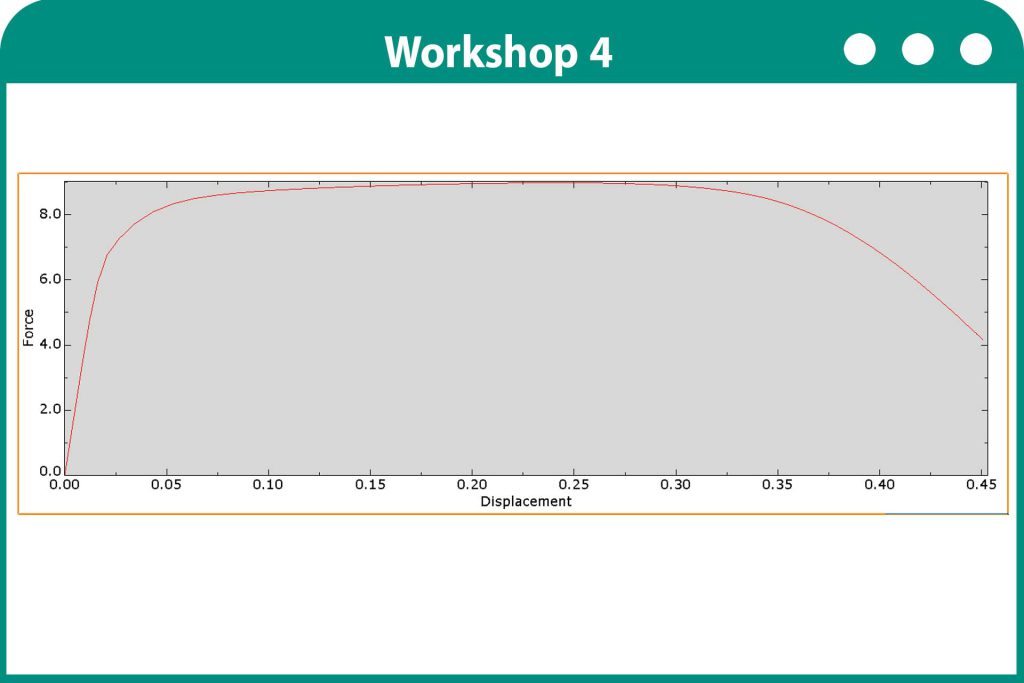
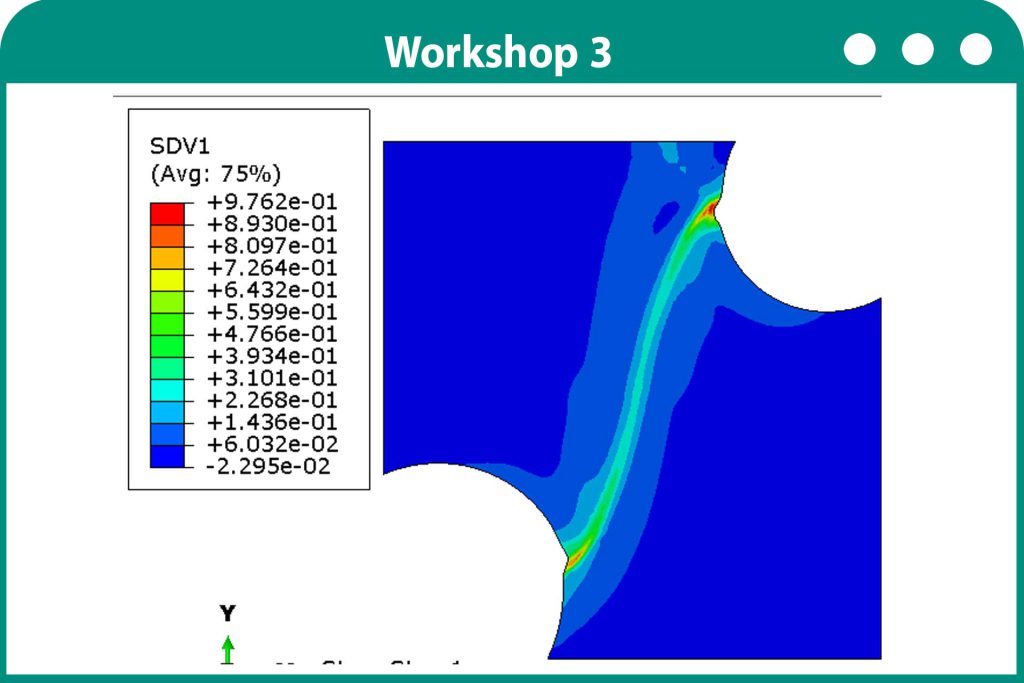
| Workshop 1: Ductile Failure in a Double-notched tensile Test | – |
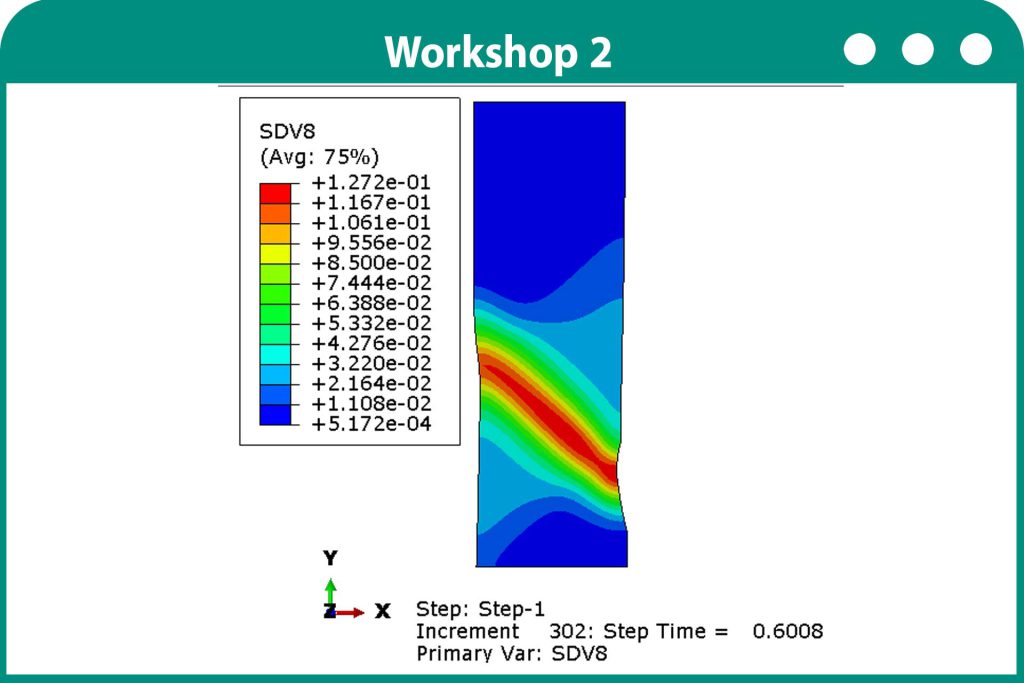
| Workshop 2: Failure in a 3D Specimen | – |
| An introduction to the ductile damage models and their industrial apploications | – |
| Full Review of the Applied Theory and Formulation For the simulation of Ductile Failure | – |
| Line-by-Line Review of the HETVAL Fortran Code | – |
| Line-by-Line Review of the UMAT Fortran Code | – |
| Line-by-Line Review of the UHARD Fortran Code | – |
| Workshop 1: Ductile Failure in a Double-notched tensile Test (Abaqus Implementation) | – |
| Workshop 1: Ductile Failure in a 3D Specimen (Abaqus Implementation) | – |





defects in input file (.inp) execution.
defects in subroutine file (.for) execution.
guarantees validation and accurate simulation results.
ensures product matches page descriptions.[/woodmart_info_box]
Issued upon successful completion.
Verifiable anytime on our website.
Proof of training participation.
Validates understanding of topic simulation.[/woodmart_info_box]
The CAE Assistant team, in collaboration with numerous academics, researchers, and industry professionals holding bachelor’s, master’s, and PhD degrees, has developed a variety of educational packages. One of the key advantages of leveraging the expertise of such individuals is the creation of high-quality, valuable content that stands out compared to competitors. This has earned the trust of many individuals from renowned companies and universities in our team and the quality of the content we produce, which has always been a source of pride for us.
[/woodmart_text_block]
This training package provides a comprehensive workflow for implementing implicit gradient-enhanced ductile damage models in Abaqus, utilizing PDF and video tutorials that detail the necessary theoretical formulations. Through a line-by-line investigation of UMAT, UHARD, and UMAT_ELEMENT_EROSION subroutines, you will learn to couple damage variables with mechanical stress-strain relations and manage state variables. By completing workshops on the Shear Band Specimen and Double Notch Tensile Test, you will gain practical skills in configuring input files and simulating mesh-independent fracture, enabling high-fidelity predictive modeling of structural failure and element deletion.
This course is designed for mechanical and structural engineers, researchers, and PhD students specializing in computational fracture mechanics and finite element analysis. It is specifically tailored for individuals who need to implement advanced constitutive models in Abaqus and require a deep understanding of gradient-enhanced regularization techniques to prevent mesh-dependent results. The materials are ideal for practitioners familiar with Fortran subroutines who wish to master the simulation of ductile failure, crack growth, and element erosion through detailed, line-by-line code analysis and practical, industry-relevant workshops like the Shear Band Specimen and Double Notch Tensile Test.
Due to the complexity of non-local regularization and the coupling of mechanical fields, understanding the internal logic—or knowing how to write the Abaqus subroutine codes for implicit gradient-enhanced ductile damage models for your specific research needs—can be incredibly challenging.
In this package, we bridge that gap. We cover the theoretical foundations of the implicit gradient methodology and provide a detailed, line-by-line explanation of the Fortran subroutines, including UMAT, UHARD, and UMAT_ELEMENT_EROSION. This ensures you fully grasp how the code manages damage variables, state variables, and element deletion. Additionally, you will receive ready-to-run files for practical workshops, specifically the Shear Band Specimen and the Double Notch Tensile Test. By purchasing this training package, you will receive a comprehensive PDF guide and high-quality video tutorials in English.
The PDF provided in this training is written in English. It is error-free, written by a human, and presented in a clear and straightforward manner, making it easy for anyone with a basic understanding of English to follow.
As the PDF is available, the tutorial video does not include subtitles or narration and focuses solely on demonstrating the process of linking Abaqus and Fortran.
We fully and unconditionally guarantee the accuracy and functionality of our content, ensuring it matches the descriptions provided on our website. This guarantee covers any discrepancies between the training and the presented syllabus, as well as any issues with the files, code, and videos you receive. For more information you can check the Terms and Conditions.
The files included in this training are checked on Abaqus 2022. However, we have provided the input (INP) file to allow you to run the simulations on other versions as well. Please note that subroutine arguments may vary slightly between Abaqus releases. If you encounter any version-specific errors, you may need to adjust these parameters manually; however, we will do our best to assist you if possible.
By purchasing this package, you will get access to the following:
Training video: To facilitate your learning experience, we provide video tutorial that complements the PDF guide. The video offers an in-depth explanation of the code and guide you through the workshop, demonstrating exactly how to analyze the files and interpret the results.
PDF file: Upon purchasing this training package, you will receive a comprehensive PDF Guide. This document covers all the necessary theories and mathematical formulations. Furthermore, we provide a detailed line-by-line (or block-by-block) explanation of the subroutines, ensuring you understand exactly how the code is structured and implemented.
Abaqus inp File You will receive full access to the Abaqus inp file for the workshop, along with the Fortran source code, allowing you to keep and utilize them for your own projects.
Yes, you can receive this training in a language other than English, which includes an additional fee. If you are interested, please contact our online chat or support email for more information.
Yes, depending on the modifications you require, we can implement the changes you need. To learn more about the terms and conditions for such custom orders, please contact our support email or our online chat.
If you are a faculty member or a company requiring multiple training packages for your staff, or If you’re an individual seeking to enhance your skills across various domains, we offer a tailored bundle plan. This plan provides access to a specific number of packages for a duration of 1 or 2 years. By paying the bundle plan fees, you’ll also receive discounts on a range of our additional services. This is a comprehensive and cost-effective solution to enhance the knowledge and skills of your team or students.
Please note: This bundle plan includes a variety of our popular training packages. If you would like to confirm the specific packages included in this plan (all packages under 400€), please check THIS PAGE or feel free to contact our support team via online chat.
55% Silver | 60% Gold | 65% Platinum | Enterprise |
€789/ Yearly | €1389/ Yearly | €2489/ Yearly | Contact Us |
5 Download Package Credits
|
10 Download Package Credits
|
20 Download Package Credits
|
Customized Package Selection
|
1 Year Package Access
|
1-Year Access to Packages
|
2-Years Access to Packages
|
Negotinalbe Access Duration
|
25% Discount for Consultation Services
|
40% Discount for Consultation Services
|
55% Discount for Consultation Services
|
Custom Discount (Negotiable) for Consultation Services
|
25% Discount Code for Cloud Computation
|
40% Discount Code for Cloud Computation
|
55% Discount Code for Cloud Computation
|
Negotiated Cloud Compute Credits
|
25% Discount Code for Project Services
|
40% Discount Code for Project Services
|
55% Discount Code for Project Services
|
Discounted Custom Project Services
|
25% Discount Code for Certificate
|
40% Discount Code for Certificate
|
55% Discount Code for Certificate
|
Bulk Certificate Discounts
|
Single User
|
Two Users
|
Three Users
|
Multi-User Access
|








 English
  Korean
  Chinese
Reviews
There are no reviews yet.