
Abaqus中的内聚元素:简介
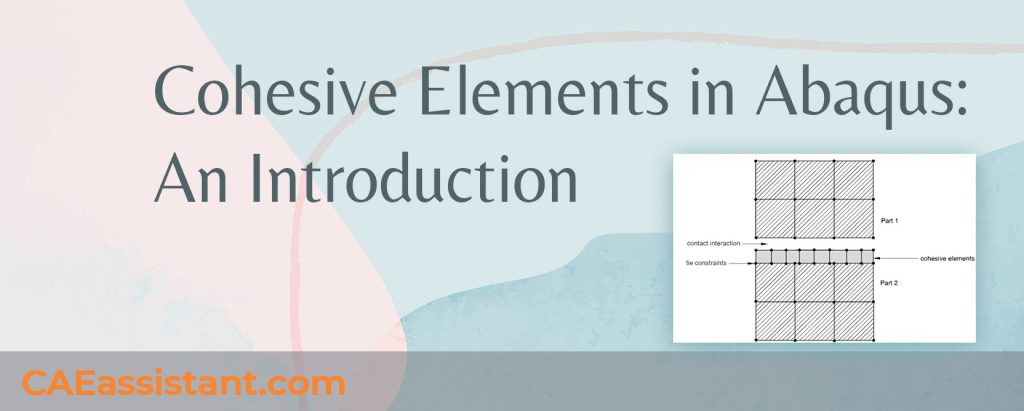
Cohesive elements are specialized finite element types used in Abaqus to model the behavior of interfaces between two or more materials. They are particularly useful for capturing the failure and debonding of adhesive bonds, composites, and other layered structures. Abaqus offers a library of cohesive elements to model the behavior of adhesive joints, interfaces in […]
Abaqus中的沙漏效果:什么是Abaqus中的沙漏效果?
 Hourglassing is basically a weird internal movement within an element that messes up your simulation. Finite element analysis (FEA) is a powerful tool for simulating complex physical phenomena. Abaqus utilizes a variety of elements to represent the geometry of the model. However, one common challenge encountered in Abaqus simulations is “Hourglassing” (Hourglass Abaqus). This phenomenon [...]
 Abaqus单元类型简介
 Stuck on choosing Abaqus element types for your simulation? Now, let me ask you a question, Do you even familiar with them? As you know, Choosing the right element type is important, and Abaqus element library offers a variety of options! This post will give you a breakdown of Abaqus element types, categorized in a [...]
 Abaqus中的大旋转 | Abaqus中的大旋转
 Ever tried modeling a spinning top or a flapping flag in Abaqus? These seemingly simple objects can quickly turn into analysis nightmares when large rotations come into play. Large rotations refer to the significant rotations experienced by a body during its deformation, often much larger than typical engineering rotations. Large rotation Abaqus is handled using [...]
 COMSOL Multiphysics

When it comes to solving engineering problems, there are three main approaches: experimental methods, analytical solutions, and simulation and modeling. All engineering and science students regardless of their specific major have heard about simulation and modeling during their education, however, in the following, its advantages are explained. Advantages of simulation These days, simulation as an […]
 English
  Korean
  Chinese