
什么是 Abaqus 硬接触? | 定义 Abaqus 正常行为
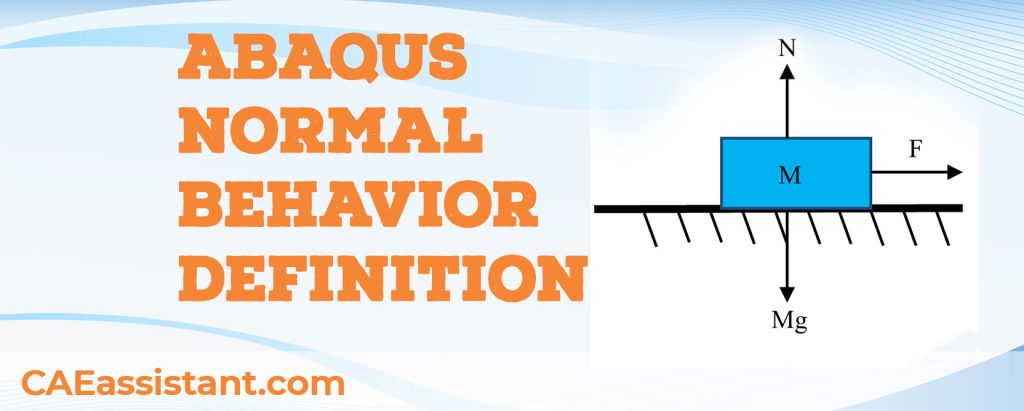
In Abaqus, “Abaqus normal behavior” defines how surfaces interact perpendicularly when they come into contact, focusing on pressing together, separating, and resisting penetration. A specific type of normal behavior, “hard contact,” (hard contact Abaqus) ensures surfaces do not penetrate each other and no tensile stress is transmitted across the interface, akin to a rigid interaction […]
什么是 Abaqus 弹簧单元? | 应用弹簧刚度 Abaqus
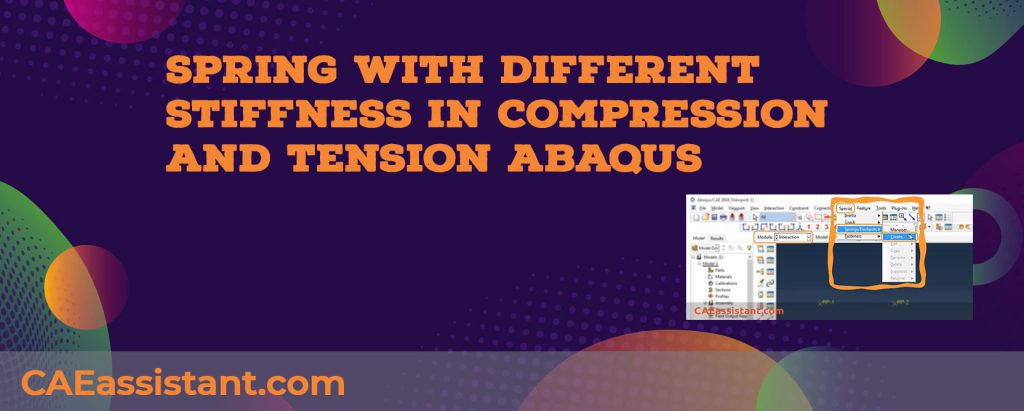
Abaqus spring element(s) allow engineers to accurately represent physical springs and idealized axial or torsional components. By coupling forces with displacements or moments with rotations, these elements can exhibit both linear and nonlinear behaviors, making them highly versatile for various applications. From modeling physical springs and structural dampers to restraining rigid body motion and performing […]
应用 Abaqus 速度 | 角速度与线速度

Linear velocity refers to how fast an object moves in a straight line, while angular velocity measures the rate of rotation around an axis. Linear velocity is measured in units such as meters per second (m/s), whereas angular velocity is measured in radians per second (rad/s). The main difference is that linear velocity focuses on […]
阿巴克斯非线性分析与线性分析
 The world of FEA engineering thrives on precise simulations that mirror real-world scenarios. But a crucial question often arises: when can a straightforward linear analysis provide sufficient results, and when do we need to navigate the intricate world of nonlinearity? Understanding this fundamental distinction is paramount for choosing the right tools within Abaqus and achieving [...]
 简述 Abaqus 收敛性问题 | 有限元分析收敛性问题
 What is Abaqus convergence? great question, right? Did you know there are different aspects of convergence in FEA and Abaqus? Aspects such as solution accuracy and mesh convergence? in this blog post we will cover and introduce all the aspects and concepts regarding the Abaqus Convergence. Also, we will cover "Abaqus Convergence problem". Here, we [...]
 10 个实用的 Abaqus 子程序(第二部分)| 有限元分析应用

Before reading the article “engineering applications of finite element method”, you can read the first part of article of finite element analysis applications: “10 Useful Abaqus Subroutine part-1” Finite Element Analysis Applications | Engineering applications of finite element method When you want to simulate an analysis in the ABAQUS, you may encounter some complications that […]
比内能和非弹性耗散比能的含义
 In Abaqus, specific internal energy and dissipated inelastic specific energy are key concepts that help capture the energy dynamics in a material. Specific internal energy refers to the internal energy per unit mass, while dissipated energy is the energy converted into other forms and lost from the system. These concepts are essential for analyzing thermodynamic [...]
 什么是 Abaqus 小滑动? | 有限滑动与小滑动
 1. What is Abaqus small sliding and Finite Sliding? In Abaqus, “small sliding” and “finite sliding” refer to different modeling assumptions for contact behavior. Small sliding assumes that the contact surfaces remain nearly parallel and that relative sliding between them is minimal. It implies that the tangential displacements between the contacting surfaces are small compared to [...]
 ABAQUS 与 ANSYS:ANSYS 和 Abaqus 的区别
 Difference between Ansys and Abaqus | ANSYS vs ABAQUS When it comes to simulating mechanical models, two names often come up: ABAQUS ANSYS. The question that frequently arises is, "Which one is better? (Ansys vs Abaqus)" This query is commonly asked by engineer designers, particularly beginners, who are seeking guidance. In this article, we, the [...]
 Abaqus中最常用的子程序

Abaqus provides the users with an extensive array of user subroutines regarding standard, explicit (or CFD analyses). For instance, here we introduce some of the most popular and important subroutines in Abaqus/Standard and Explicit. Writing user subroutines with Abaqus will be presented in the last part of the article. However, all user subroutines applicable in […]
 English
  Korean
  Chinese