
폰 미제스 응력 | 모어 원 및 주응력과 주변형률
 In the world of engineering, accurately predicting how materials will behave under stress is essential. One key concept in this domain is the Von Mises stress, a valuable tool used to forecast when a material might start to yield or fail under various loading conditions. This type of stress analysis is particularly significant when working [...]
 기계 공학에서 AI 활용: 워크플로 최적화를 위한 실용 가이드
Mechanical engineering spans everything from conceptual design to long-term maintenance. Traditional workflows often involve repetitive, manual steps that can be slow and error-prone. Today, AI in mechanical engineering is changing the game. By automating tasks, enhancing precision, and enabling data-driven decision-making, engineers can innovate faster, reduce costs, and deliver better results. Mechanical Engineering AI Integration [...]재료의 크리프 101 | 핵심 개념 + Abaqus 크리프 모델

Creep is the slow, time-dependent deformation of solid materials. This permanent strain happens under constant load, even when the stresses are well below the material’s yield strength. Understanding and accounting for creep behavior is vital for designing reliable components. This phenomenon is critical in high-temperature structures, such as pressure vessels, boiler tubes, turbine blades, and […]
열응력 해석이란 무엇인가요? Abaqus 가이드 설명
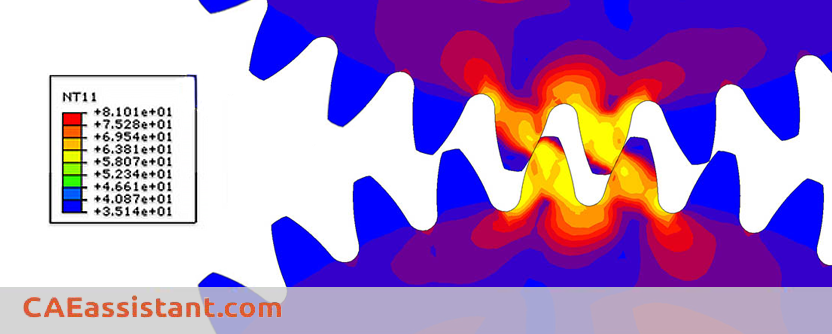
Thermal stress analysis is how engineers predict the extra stress materials feel when they heat up or cool down. In simple terms, when a structure wants to expand or shrink but is held in place, stress builds up — that’s thermal stress. Ignoring it can crack a turbine blade, warp a PCB, or weaken a […]
점소성 설명 | Abaqus 모델 및 Perzyna 가이드

Under constant load, some materials keep deforming little by little, showing that stress is not just about force but also about time. They slowly change shape over time, depending not only on how much load is applied but also on how long it lasts. This time-dependent behavior is what makes them different from purely elastic […]
트러스 해석 전체 가이드 | 이론 + 시뮬레이션 튜토리얼
 Trusses are structural systems made of straight members joined at nodes. Each member carries only axial loads—tension or compression. Truss analysis helps engineers predict how these members behave under various forces. This is key for safe designs in bridges, roofs, towers, and other load-bearing structures. Engineers use two main approaches to truss analysis: the Method [...]
 Abaqus Contact Damping이란 무엇이고 Abaqus에 어떻게 적용하나요?

When two parts come into contact in a simulation, things can get unstable quickly. Movements like sliding or bouncing can cause sudden changes that make your model hard to solve. That’s why Abaqus includes contact damping — a built-in way to smooth things out during contact, similar to how a shock absorber works in real […]
불안정 문제의 자동 안정화 Abaqus | 소실 에너지 분율, 감쇠 계수

Have you ever set up an Abaqus simulation, hit run, and watched it crash almost instantly? Maybe the time step dropped to something microscopic. Maybe you got a cryptic error message. Or worse — maybe it just froze. If that sounds familiar, you’re not alone. One of the most common reasons for simulation failure in […]
Abaqus Standard vs Explicit 설명: 적합한 것을 선택하세요

Which one should you use: Abaqus Standard or Abaqus Explicit? If you’ve run into this question while working in Abaqus, you’re definitely not alone. Abaqus gives you two powerful solvers for finite element analysis—Standard (Implicit) and Explicit. But when you’re dealing with complex simulations, knowing which one to use isn’t always obvious. Think of it […]
까다로운 절단을 위한 레이저 지원 가공 | Abaqus에서 시뮬레이션됨

Machining is a complex process that involves extreme stresses, high temperatures, rapid tool wear, and intricate chip formation. Accurately predicting what happens during cutting is not easy—but FEA machining simulation offers a powerful solution.Let’s start with a few important questions: How can we predict chip shape and material deformation during cutting? Can we estimate the […]
 English
  Korean
  Chinese